
Vermillion Flycatcher
The Vermilion Flycatcher (Pyrocephalus rubinus) is a small passerine bird in the Tyrannidae, or tyrant flycatcher family. Most flycatchers are rather drab, but the Vermilion Flycatcher is a striking exception. It is a favourite with birders, but is not generally kept in aviculture, as the males tend to lose their vermilion coloration when in captivity.
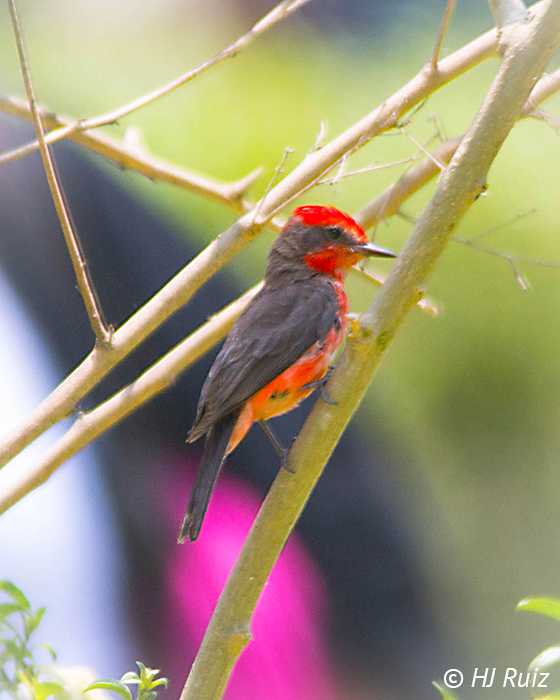
Vermillion Flycatcher (M)
Vermilion Flycatchers generally prefer somewhat open areas, and are found in trees or shrubs in savannah, scrub, agricultural areas, riparian woodlands, and desert as well, but usually near water. Their range includes almost all of Mexico; it extends north into the southwestern United States, and south to scattered portions of Central America, parts of northwestern and central South America, and on southwards to central Argentina. They are also found in the Galapagos Islands. The form inhabiting the Galapagos (P. r. nanus) is sometimes split as Pyrocephalus nanus, Darwin’s Flycatcher or the Galapagos Flycatcher.
The species grows to about seven inches in length, and is strongly dimorphic; males are bright red, with dark brown plumage. Females have a peach-coloured belly with a dark grey upperside, and are similar to Say’s Phoebe.
The flycatchers feed mostly on insects such as flies, grasshoppers and beetles. These are usually taken in mid-air, after a short sally flight from a perch.
They lay 2-3 whitish eggs in a nest made of twigs, stems and roots, and lined with hair. The eggs are incubated for around two weeks by the female and the young are ready to leave the nest 15 days after hatching.
NOTE: The Vermillion Flycatcher is a new addition to my Bird List as: # 162

Vermillion Flycatcher (F)
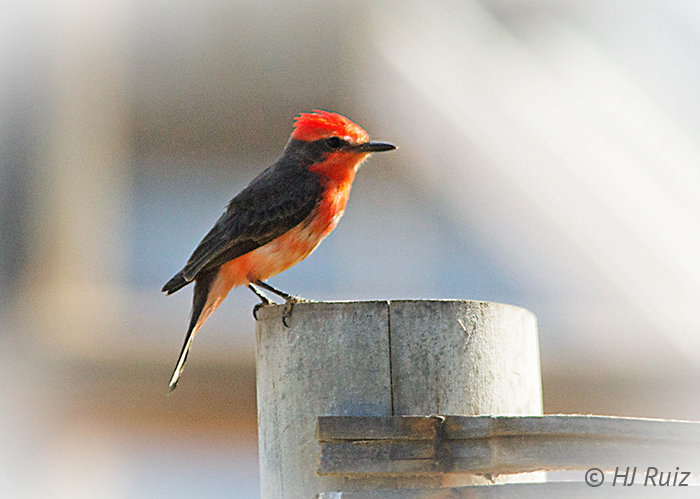
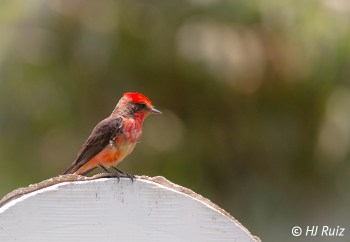
Text © Wikipedia – All photographs © H.J. Ruiz – Avian 101
Share this:

Striated Heron
Striated Heron – Latin name: Butorides striata
A.k.a. Mangrove Heron, Is a small heron. Striated Herons are mostly non-migratory and noted for some interesting behavioral traits. Their breeding habitat is small wetlands in the Old World tropics from west Africa to Japan and Australia, and in South America. Vagrants have been recorded on oceanic islands, such as Chuuk and Yap in the Federated States of Micronesia, the Marianas and Palau; the bird recorded on Yap on February 25, 1991, was from a continental Asian rather than from a Melanesian population, while the origin of the bird seen on Palau on May 3, 2005 was not clear.
This bird was long considered to be conspecific with the closely related North American species, the Green Heron, which is now usually separated as B. virescens, as well as the Lava Heron of the Galápagos Islands (now B. sundevalli, but often included in B. striata, e.g. by BirdLife International; collectively they were called “green-backed herons”.
Adults have a blue-grey back and wings, white underparts, a black cap and short yellow legs. Juveniles are browner above and streaked below.
These birds stand still at the water’s edge and wait to ambush prey, but are easier to see than many small heron species. They mainly eat small fish, frogs and aquatic insects. They sometimes use bait, dropping a feather or leaf carefully on the water surface and picking fish that come to investigate.
They nest in a platform of sticks measuring between 20–40 cm long and 0.5–5 mm thick. The entire nest measures some 40–50 cm wide and 8–10 cm high outside, with an inner depression 20 cm wide and 4–5 cm deep. It is usually built in not too high off the ground in shrubs or trees but sometimes in sheltered locations on the ground, and often near water. The clutch is 2–5 eggs, which are pale blue and measure around 36 by 28 mm.
An adult bird was once observed in a peculiar and mysterious behavior: while on the nest, it would grab a stick in its bill and make a rapid back-and-forth motion with the head, like a sewing machine’s needle. The significance of this behavior is completely unknown: While such movements occur in many other nesting birds where they seem to compact the nest, move the eggs, or dislodge parasites, neither seems to have been the case in this particular Striated Heron.
Young birds will give a display when they feel threatened, by stretching out their necks and pointing the bill skywards. In how far this would deter predators is not known.
Widespread and generally common, the Striated Heron is classified as a Species of Least Concern by the IUCN
NOTE: The Striated Heron is a new addition to my Bird List as: # 161

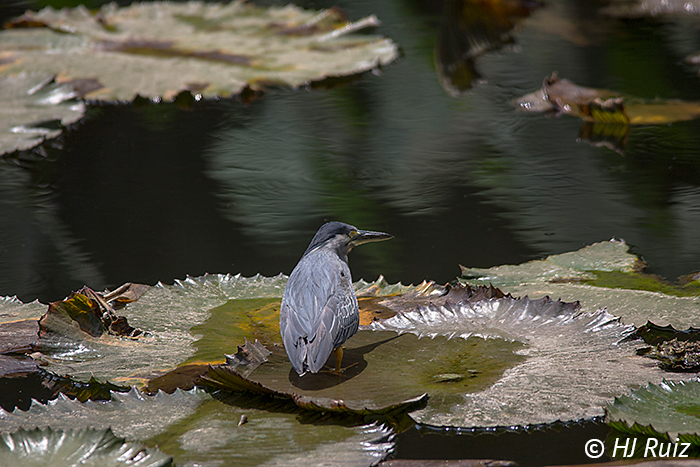
Text © Wikipedia – All photographs © H.J. Ruiz – Avian 101
Share this:

For the Birds!
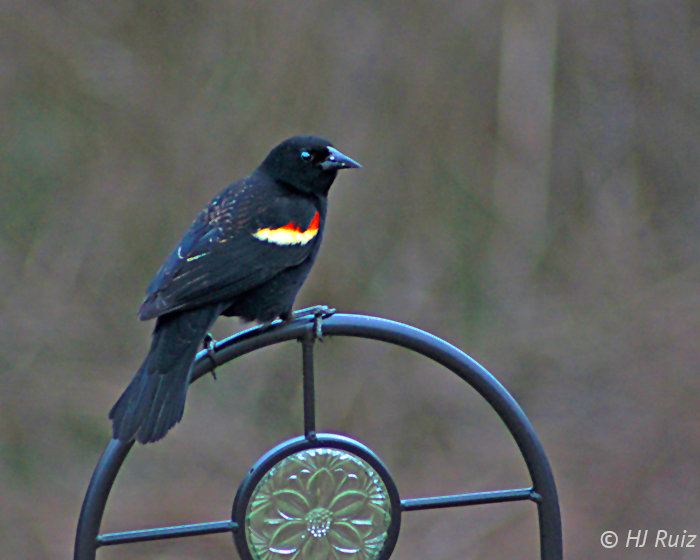
Red-winged Blackbird (M)

Red-headed Woodpecker

Blue Jay
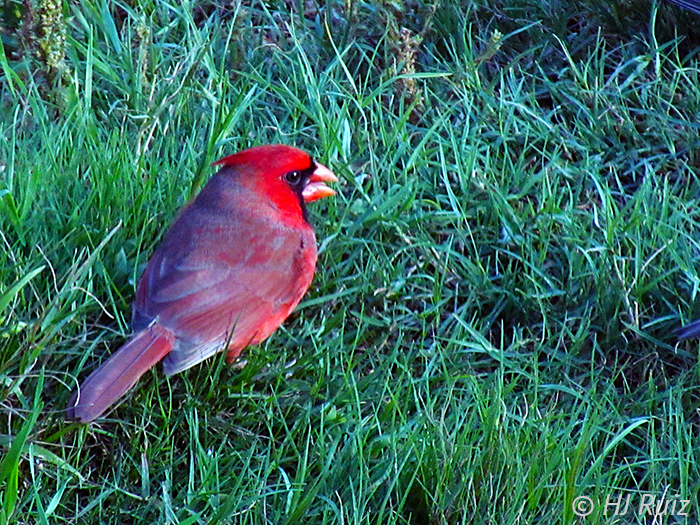
Northern Cardinal (M)
All photographs © H.J. Ruiz – Avian 101
Share this:

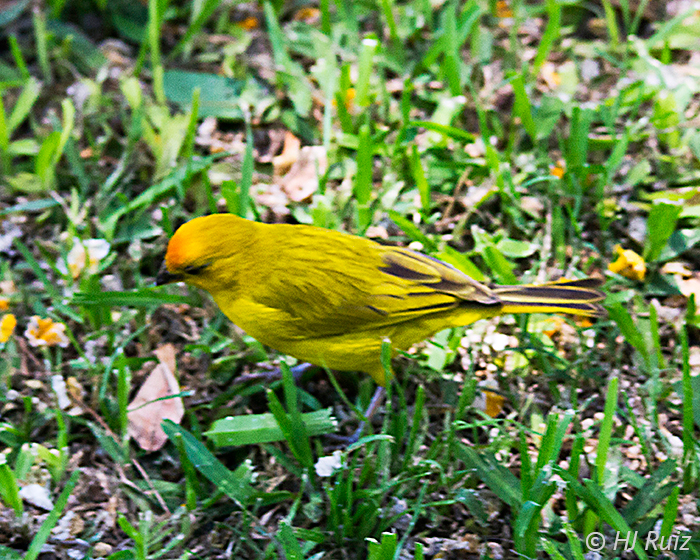
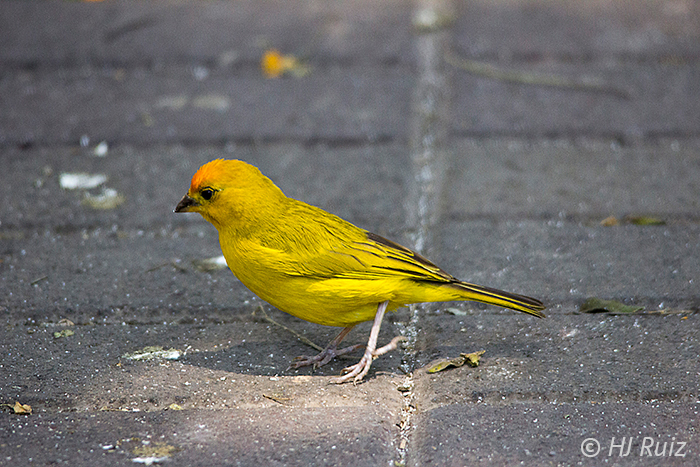
Saffron Finch
Saffron Finch – Latin name: Sicalis flaveola
This is a tanager from South America that is common in open and semi-open areas in lowlands outside the Amazon Basin. They have a wide distribution in Colombia, northern Venezuela (where it is called “canario de tejado” or “roof canary”), western Ecuador, western Peru, eastern and southern Brazil (where it is called “canário da terra” or “earth canary”), Bolivia, Paraguay, Uruguay, northern Argentina, and Trinidad and Tobago. It has also been introduced to Hawaii, Puerto Rico and elsewhere. Formerly, it was placed in the Emberizidae but it is close to the seedeaters.
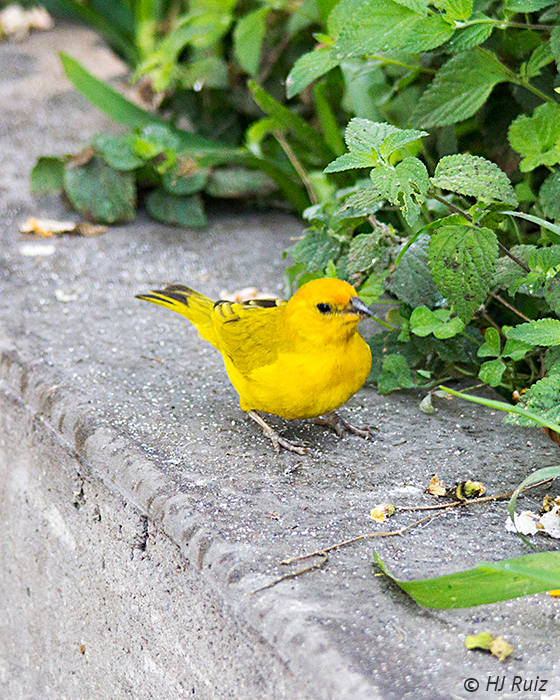
Saffron Finch
The male is bright yellow with an orange crown which distinguishes it from most other yellow finches (the exception being the Orange-fronted Yellow-finch). The females are more confusing and are usually just a slightly duller version of the male, but in the southern subspecies S. f. pelzelni they are olive-brown with heavy dark streaks.
Typically nesting in cavities, the Saffron Finch makes use of sites such as abandoned Rufous Hornero (Furnarius rufus) nests, bamboo branches and under house roofs – this species is tolerant of human proximity, appearing at suburban areas and frequenting bird tables. They have a pleasant but repetitious song which, combined with their appearance, has led to them being kept as caged birds in many areas. Males are polygamous, mating with two females during the nesting season, and territorial.
NOTE: The Saffron Finch is a new addition to my Bird List as: # 160
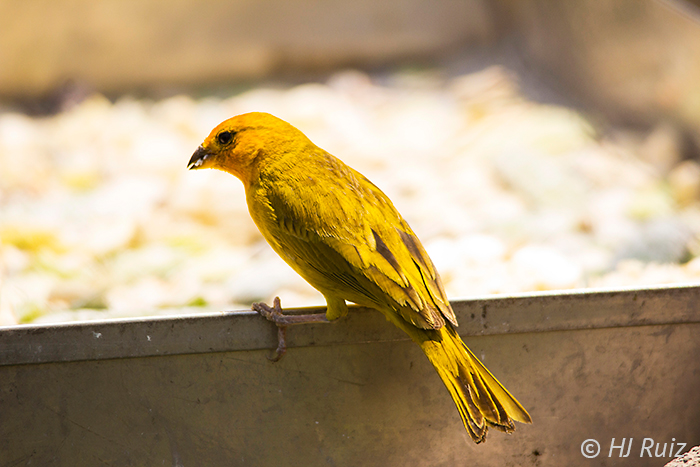
Text excerpts © Wikipedia – All photographs © H.J. Ruiz – Avian 101
Share this:


Read Past Reviews

Book # 69

Quote from the Author
“A good chuckle is healthy, it helps you break the monotony of a serious life.” ~ H.J. Ruiz


You must be logged in to post a comment.