
Black-necked Stilt
The Black-necked Stilt – Latin name: Himantopus mexicanus is a locally abundant shorebird of American wetlands and coastlines. It is found from the coastal areas of California through much of the interior western United States and along the Gulf of Mexico as far east as Florida, then south through Central America and the Caribbean to northwest Brazil southwest Peru,east Ecuador and the Galápagos Islands. The northernmost populations, particularly those from inland, are migratory, wintering from the extreme south of the United States to southern Mexico, rarely as far south as Costa Rica; on the Baja California peninsula it is only found regularly in winter.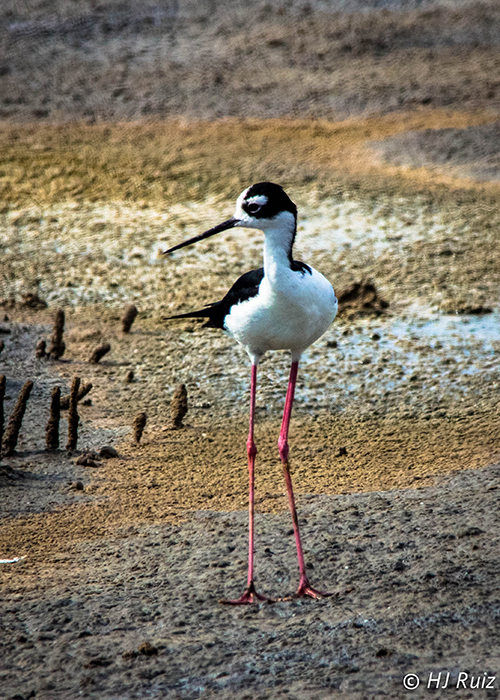
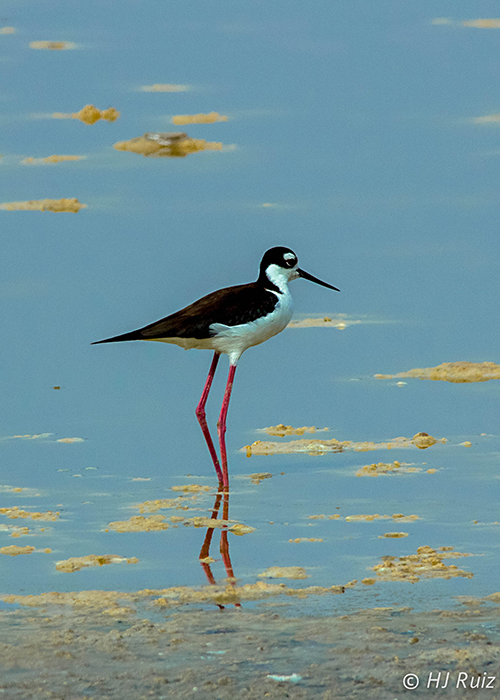
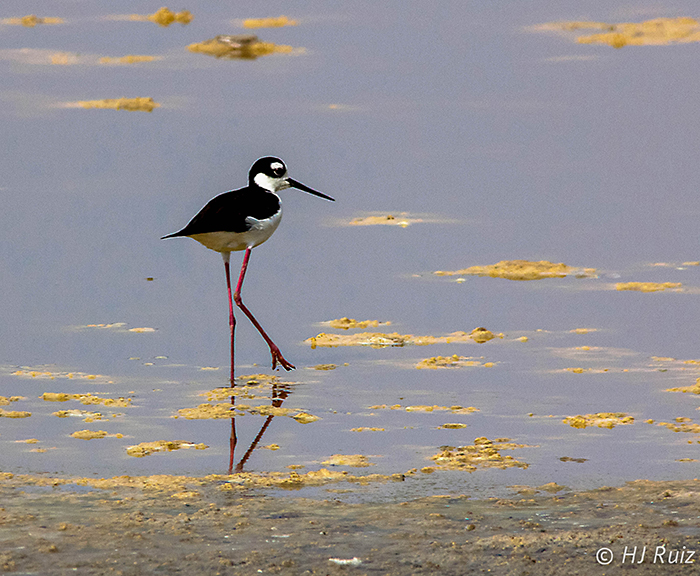
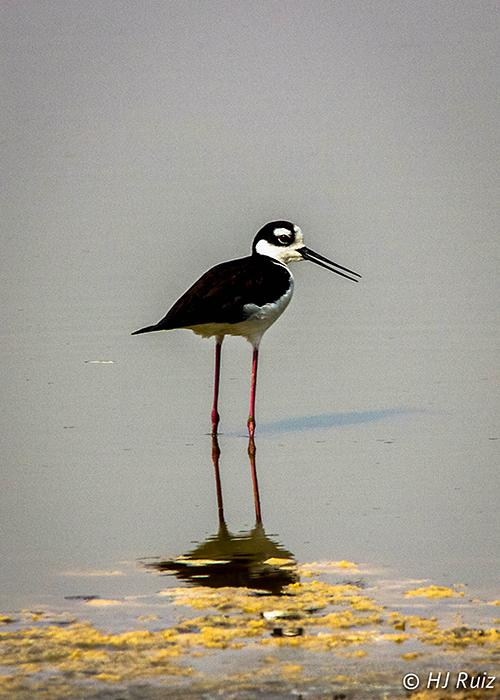
Adults have long pink legs and a long thin black bill. They are white below and have black wings and backs. The tail is white with some grey banding. A continuous area of black extends from the back along the hind-neck to the head. There, it forms a cap covering the entire head from the top to just below eye-level, with the exception of the areas surrounding the bill and a small white spot above the eye. Males have a greenish gloss to the back and wings, particularly in the breeding season. This is less pronounced or absent in females, which have a brown tinge to these areas instead. Otherwise, the sexes look alike.
Downy young are light olive brown with lengthwise rows of black speckles (larger on the back) on the upper-parts – essentially where adults are black – and dull white elsewhere, with some dark barring on the flanks.
Where their ranges meet in central Brazil, the Black-necked and White-backed stilts intergrade. Such individuals often have some white or grey on top of the head and a white or grey collar separating the black of the hindneck from that of the upper back.
The Black-necked Stilt is distinguished from non-breeding vagrants of the Old World Black-winged Stilt by the white spot above the eye. Vagrants of the northern American form in turn is hard to tell apart from the resident Hawaiian Stilt, in which only the eye-spot is markedly smaller. But though many stilt populations are long-distance migrants and during their movements can be found hundreds of miles offshore, actual trans-oceanic vagrants are nonetheless a rare occurrence.
The Black-necked Stilt is found in estuarine, lacustrine, salt pond and emergent wetland habitats; it is generally a lowland bird but in Central America has been found up to 8,200 ft (2,500 m) ASL and commonly seen in llanos habitat in northern South America.
NOTE: The Black-necked Stilt is a new addition to my Bird List as: # 164

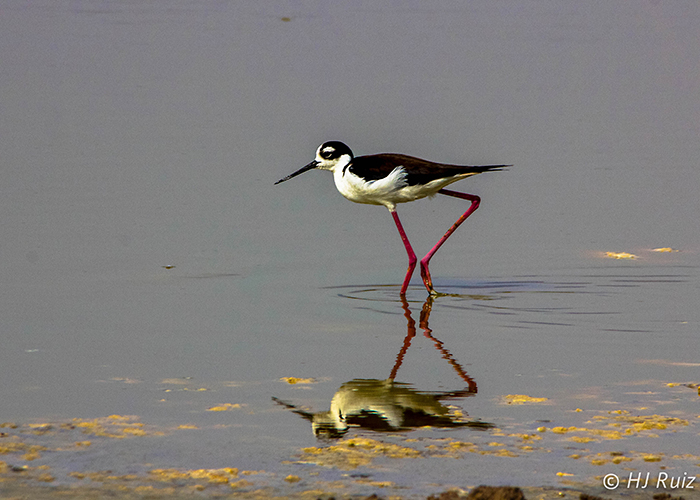
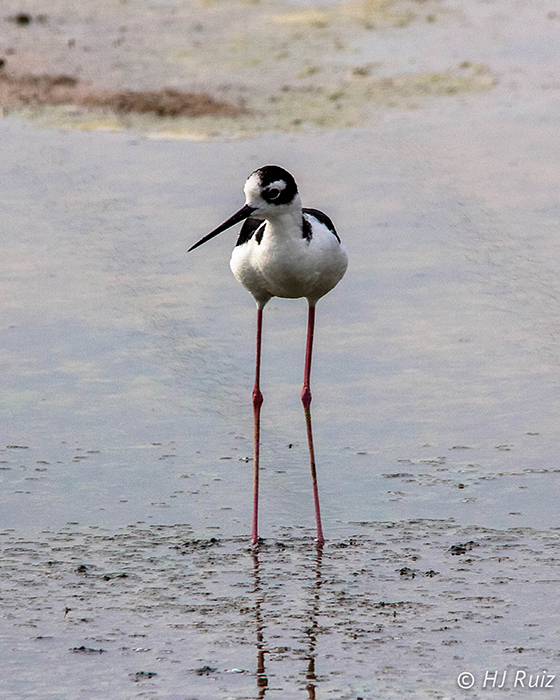
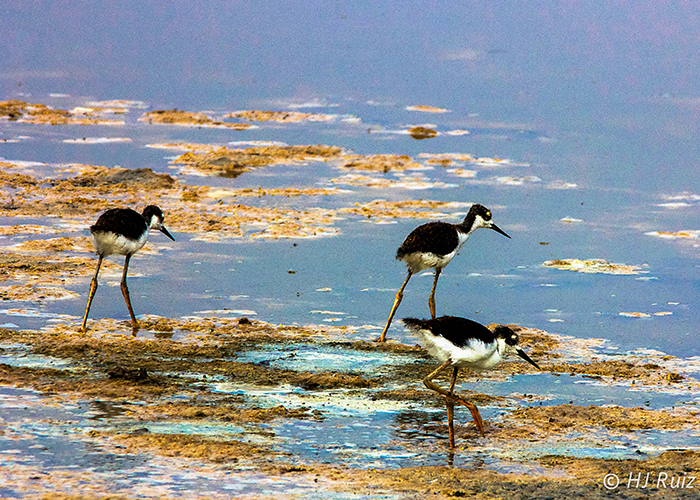

Text excerpts © Wikipedia – All photographs © H.J. Ruiz – Avian 101
Share this:

Previously I Wrote…
Last Sunday I blogged about my so called adventures in Peru, there I mentioned that I had been to the Amazon jungle region of that country in two different occasions.
That’s the topic for my story today.
The Amazon river is the heart of the jungle, the dynamic engine that moves that environment. It was very exciting to navigate the river that originates in Peru and runs across South America for thousands of miles and meets the Atlantic Ocean.
Life in the jungle is exciting and interesting but at the same time can be dangerous and hard. (Long story)
Don’t take me wrong, there are large cities such as Iquitos and also many towns and tribal villages scattered all over the jungle but are reachable either by airplane or river.
I bring you some pictures to give you an idea of what is to be in the Amazon Rainforest.

Leaving Iquitos port heading east navigating the Amazon river.

Clouds approaching indicate a torrential rain soon!

Here and there you see huts along the river side.

View from a high point at a floating village.

Stairs constructed with rough wood.

River gets a muddy color after a hard rain.

It’s starting to get dark at our camp.

Chanty town at the edge of the Amazon river.

Our boat that brought us near the camp.

Jungle native trading their crafts.

Tribal Village

Chanty town near the river

Stilted hallway connecting our camp’s facilities.

Award winning photo – Elderly native living in a different wold that ours.

H.J. and wife Lucy crossing a creek.
Text and photographs © H.J. Ruiz – Avian 101
Share this:

Miscellaneous
NORTHERN MOCKINGBIRD


 All photographs © H.J. Ruiz – Avian 101
Share this:

American Oystercatcher
The American Oystercatcher (Haematopus palliatus), occasionally called the American Pied Oystercatcher, is a member of family Haematopodidae. The bird is marked by its black and white body and a long, thick orange beak. This shorebird is approximately 19 inches (42 – 52 cm) in length.
The American Oystercatcher is found on the Atlantic coast of North America from New England to northern Florida, where it is also found on the Gulf coast, and south to northern South America. It is found also in the Pacific coast of Mexico, Central America and northern South America. In the 19th century they became locally extinct in the northeast due to market hunting and egg collecting. After receiving protection under the Migratory Bird Treaty Act, their range extended northward to re-occupy historical habitat in New England.
Oystercatchers are closely tied to coastal habitats. They nest on beaches on coastal islands and feed on marine invertebrates. The large, heavy beak is used to pry open bivalve mollusks. Oystercatchers raise a clutch of two or three eggs. In winter, they are found in flocks along the coast from central New Jersey to the Gulf of Mexico.
Although Oystercatcher populations are low, the species is not protected under the Endangered Species Act. Oystercatchers are listed as a species of concern in several states because of low and declining populations, and threats to coastal habitats. Threats include development and recreational use of nesting beaches.
NOTE: The American Oystercatcher is a new addition to my Bird List as: # 163


Text excerpts © Wikipedia – All photographs © H.J. Ruiz – Avian 101
Share this:


Read Past Reviews

Book # 69

Quote from the Author
“A good chuckle is healthy, it helps you break the monotony of a serious life.” ~ H.J. Ruiz


You must be logged in to post a comment.