
The Crossley ID Guide: Raptors
The Crossly ID Guide: Raptors
Author: Richard Crossley with expert contributions by Brian Sullivan and Jerry Liguori (Raptor authorities)
Book to be published on April 2013 by Princeton University Press
“Once again the readers of Richard Crossley superb work done with his The Crossly ID Guide: Eastern Birds will have another fantastic ID Guide coming up only this time is dedicated to Raptors! Always the favorites of many bird enthusiasts, photographers and avian scholars. This guide makes that process of identifying quite easy, by visualizing and comparing with the help of a number of superb plates, colorful and razor sharp images.The information about all the species is comprehensive and precise as much as clear and intelligent.
This ID Guide is a must have as part of your library. I’m very excited about this book because it helped me identified a Snail Hawk that I photographed a couple of years ago and could not pinpoint the specie’s name! Thank you Mr.Crossley!”
This review was made by H.J. Ruiz – Avian 101 (avian101.wordpress.com)
I invite you to see a sampler (Includes plates and text)
Share this:

Killdeer
The Killdeer – Latin name: Charadrius vociferus is a medium-sized plover.
Adults have a brown back and wings, a white belly, and a white breast with two black bands. The rump is tawny orange. The face and cap are brown with a white forehead. They have an orange-red eyering. The chicks are patterned almost identically to the adults, and are precocial — able to move around immediately after hatching. The Killdeer frequently uses a “broken wing act” to distract predators from the nest. It is named onomatopoeically after its cry.
The range of the Killdeer spreads across the Western Hemisphere. In the summer, Killdeer live as far north as the Canadian provinces of British Columbia, the Yukon, Quebec, as well as the southern parts of the U.S. state of Alaska. Killdeer hold a year-round presence across the southern half of the United States and parts of Peru. The Killdeer winters throughout Central America. Although Killdeer are considered shorebirds, they often live far from water. They live in grassland habitats such as fields, meadows, and pastures.[4] The nest itself is merely a shallow depression or bowl in the ground, fringed by some stones and blades of grass. The precious nest is well camouflaged, as the spots of the eggs disguise them as stones, and the simple structure of the nest resembles its surroundings.[6] Like many other waders, Killdeer hatchlings are precocial birds and are able to see and forage soon after hatching.
They are migratory in northern areas and winter as far south as northern South America. They are rare vagrants to western Europe, usually late in the year.
These birds forage for food in fields, mudflats, and shores, usually by sight. They mainly eat insects.
Their name comes from their frequently heard call. These birds will frequently use a distraction display (“broken-wing act”) to distract predators from their nests. This involves the bird walking away from its nesting area holding its wing in a position that simulates an injury and then flapping around on the ground emitting a distress call. The predators then think they have easy prey and are attracted to this seemingly injured bird and away from the nest. If the parent sees that a potential predator is not following them, they will move closer and get louder until they get the attention of the predator. This is repeated until the predator is far from the nest, and the killdeer suddenly “heals” and flies away.
Their ability to exploit a wide range of agricultural and semi-urban habitat has helped keep them common and widespread in their range.
NOTE: The Killdeer is a new addition to my Bird List as: # 166


Text © Wikipedia – All photographs © H.J. Ruiz – Avian 101
Share this:

Tropical Kingbird
The Tropical Kingbird – Latin name: Tyrannus melancholicus is a large tyrant flycatcher. This bird breeds from southern Arizona and the lower Rio Grande Valley of Texas in the USA through Central America, South America as far as south as central Argentina and western Peru, and on Trinidad and Tobago. Birds from the northernmost and southern breeding areas migrate to warmer parts of the range after breeding.
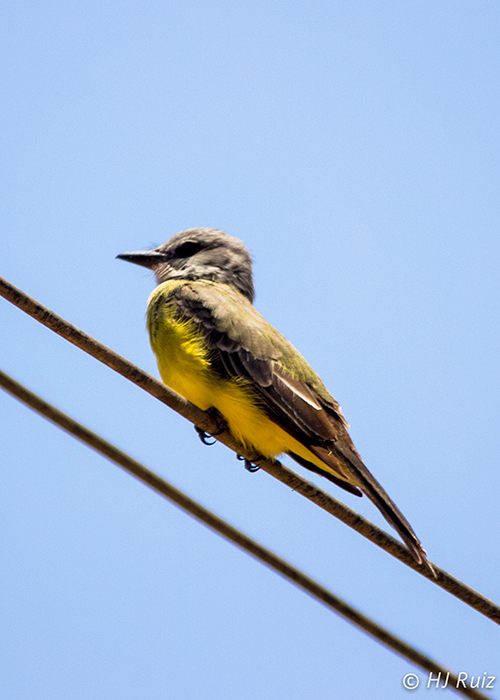
Tropical Kingbird
An adult Tropical Kingbird is 22 cm long and weighs 39 g. The head is pale grey, with a darker eye mask, an orange crown stripe, and a heavy grey bill. The back is greyish-green, and the wing and forked tail are brown. The throat is pale grey, becoming olive on the breast, with the rest of the underparts being yellow. The sexes are similar, but young birds have pale buff edges on the wing coverts.
The call is a high-pitched twittering trill, tree-e-e-e-e-e-e, with a more complex version sung by the male at dawn.
Their breeding habitat is semi-open areas with trees and shrubs, including gardens and roadsides. Tropical Kingbirds like to observe their surroundings from a prominent open perch, usually high in a tree, undertaking long sally flights to acrobatically catch insects in mid-air, sometimes hovering to pick food off vegetation. They also eat some fruit from such diverse species as Tamanqueiro (Alchornea glandulosa), the Annonaceae, Cymbopetalum mayanum and Gumbo-limbo (Bursera simaruba); foraging for these even in disturbed habitat. As they keep mainly to the upper levels of trees, they find little profit in following mixed-species feeding flocks in the understory.
These birds aggressively defend their territory against intruders, even much larger birds such as Magnificent Frigatebirds, toucans, caracaras or hawks. In a study in Parque Nacional de La Macarena of Colombia, parasitism by microfilariae and trypanosomas (presumably T. everetti) was infrequently recorded in Tropical Kindbirds.
They make a flimsy cup nest in a tree. The female incubates the typical clutch of two or three cream eggs, which are marked with reddish-brown, for 16 days, with about 18-19 further days to fledging.
Widespread, common and adapatable, the Tropical Kingbird is not considered a threatened species by the IUCN
NOTE: The Tropical Kingbird is a new addition to my Bird LIst as: # 165

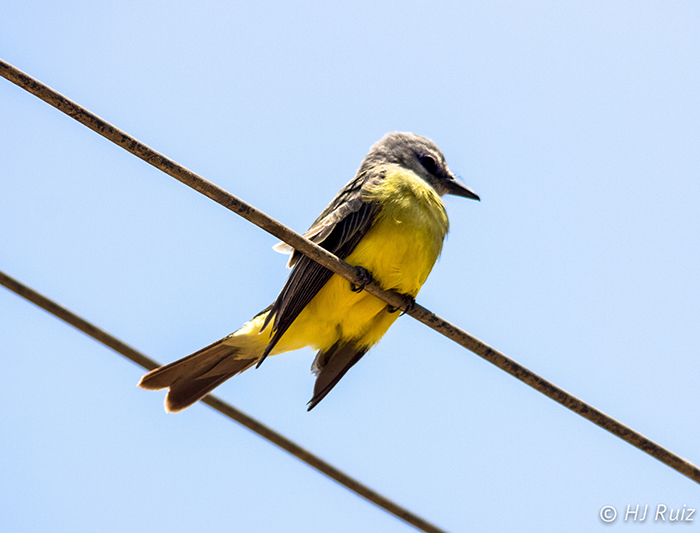
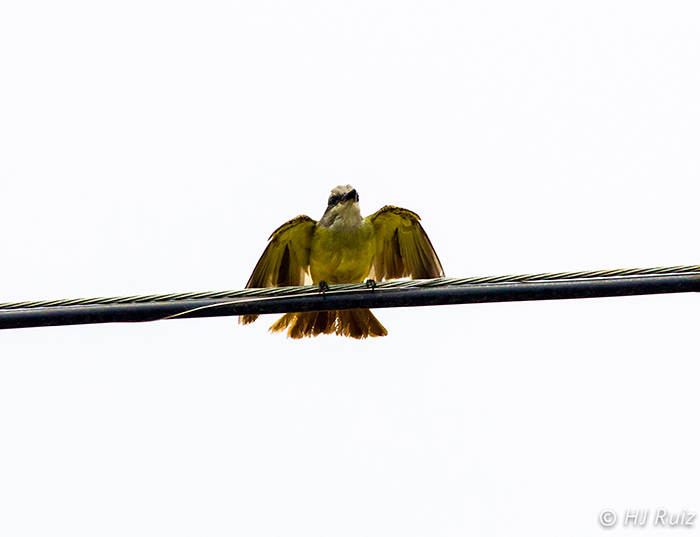
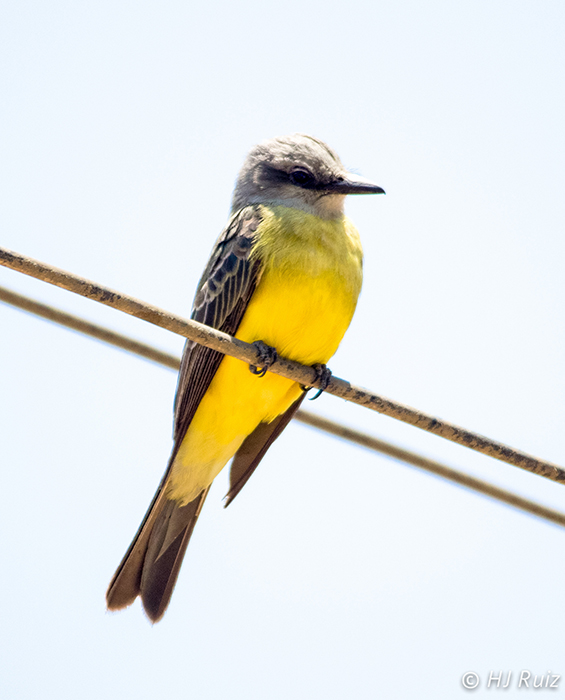
Text © Wikipedia – All photographs © H.J. Ruiz – Avian 101
Share this:

For the Birds # 17

White-throated Sparrow
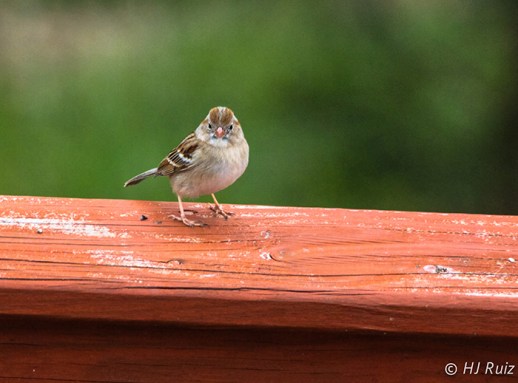
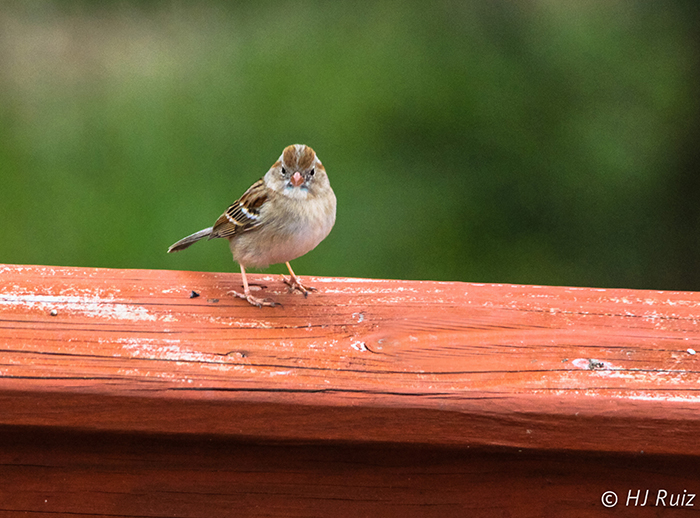
- Field Sparrow
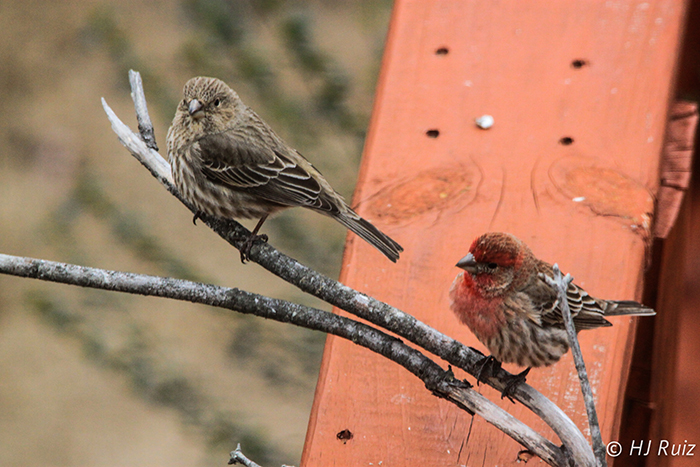
House Finch (F) & (M)

Tufted Titmouse
All photographs © H.J. Ruiz – Avian 101
Share this:


Read Past Reviews

Book # 69

Quote from the Author
“A good chuckle is healthy, it helps you break the monotony of a serious life.” ~ H.J. Ruiz


You must be logged in to post a comment.