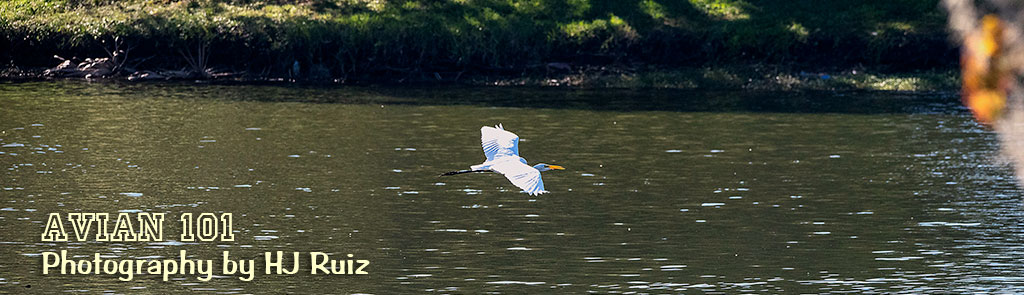
Panoramic Photography # 3

Black Skimmer
HJ Ruiz – November 15th, 2023
Share this:

Turkey Vulture
The Turkey Vulture (Cathartes aura) is the most widespread of the New World vultures. One of three species in the genus Cathartes of the family Cathartidae, the turkey vulture ranges from southern Canada to the southernmost tip of South America. It inhabits a variety of open and semi-open areas, including subtropical forests, shrublands, pastures, and deserts. Like all New World vultures, it is not closely related to the Old World vultures of Europe, Africa, and Asia. The two groups strongly resemble each other because of convergent evolution; natural selection often leads to similar body plans in animals that adapt independently to similar conditions. The turkey vulture is a scavenger and feeds almost exclusively on carrion. It finds its food using its keen eyes and sense of smell, flying low enough to detect the gasses produced by the beginnings of the process of decay in dead animals. In flight, it uses thermals to move through the air, flapping its wings infrequently. It roosts in large community groups. Lacking a syrinx—the vocal organ of birds—its only vocalizations are grunts or low hisses. A large bird, it has a wingspan of 160–183 cm (63–72 in), a length of 62–81 cm (24–32 in), and weight of 0.8 to 2.41 kg (1.8 to 5.3 lb). Birds in the northern limit of the species’ range average larger in size than the vulture from the neotropics. 124 birds from Florida averaged 2 kg (4.4 lb) while 65 and 130 birds from Venezuela were found to average 1.22 and 1.45 kg (2.7 and 3.2 lb), respectively. It displays minimal sexual dimorphism; sexes are identical in plumage and in coloration, and are similar in size. The body feathers are mostly brownish-black, but the flight feathers on the wings appear to be silvery-gray beneath, contrasting with the darker wing linings. The adult’s head is small in proportion to its body and is red in color with few to no feathers. It also has a relatively short, hooked, ivory-colored beak. The irises of the eyes are gray-brown; legs and feet are pink-skinned, although typically stained white. The eye has a single incomplete row of eyelashes on the upper lid and two rows on the lower lid.
Photo Gallery


HJ Ruiz – November 14th, 2023
Share this:

Cooper’s Hawk
The Cooper’s Hawk (Accipiter cooperii) is a medium-sized hawk native to the North American continent and found from southern Canada to Mexico. This species is a member of the genus Accipiter, sometimes referred to as true hawks, which are famously agile, relatively small hawks common to wooded habitats around the world and also the most diverse of all diurnal raptor genera. As in many birds of prey, the male is smaller than the female. The birds found east of the Mississippi River tend to be larger on average than the birds found to the west. It is easily confused with the smaller but similar sharp-shinned hawk. (A. striatus) Cooper’s hawk is a medium-sized hawk and relatively large for an Accipiter. Compared to related species, they tend to have moderate-length wings, a long, often graduated or even wedge-shaped tail and long though moderately thick legs and toes. Their eyes tend to be set well forward in the sides of the relatively large and squarish-looking head (though the head can look somewhat rounded if the feathers on the nape are held flush) and a relatively short but robust bill. They have hooked bills that are well-adapted for tearing the flesh of prey, as is typical of raptorial birds. Generally, Cooper’s hawks can be considered secretive, often perching within the canopy, but can use more open perches, especially in the western part of the range or in winter when they may use leafless or isolated trees, utility poles or exposed stumps. On perched hawks, the wing-tips tend to appear to cover less than one third of the tail, sometimes seeming to barely cover the covert feathers. As adults, they may be a solid blue-gray or brown-gray color above. Adults usually have a well-defined crown of blackish-brown feathers above a paler nape and hindneck offset against their streaked rufous cheeks. Their tail is blue-gray on top and pale underneath, barred with three black bands in a rather even pattern and ending in a rather conspicuous white tip. The adult’s underside shows a bit of whitish base color overlaid heavily with coarse, irregular rufous to cinnamon bands, though these narrow into marginal shaft streaks around the throat. Against the rich color on the rest of the underside, the pure white crissum on adults is conspicuous.
Photo Gallery


HJ Ruiz – November 12th, 2023
Share this:

Osprey
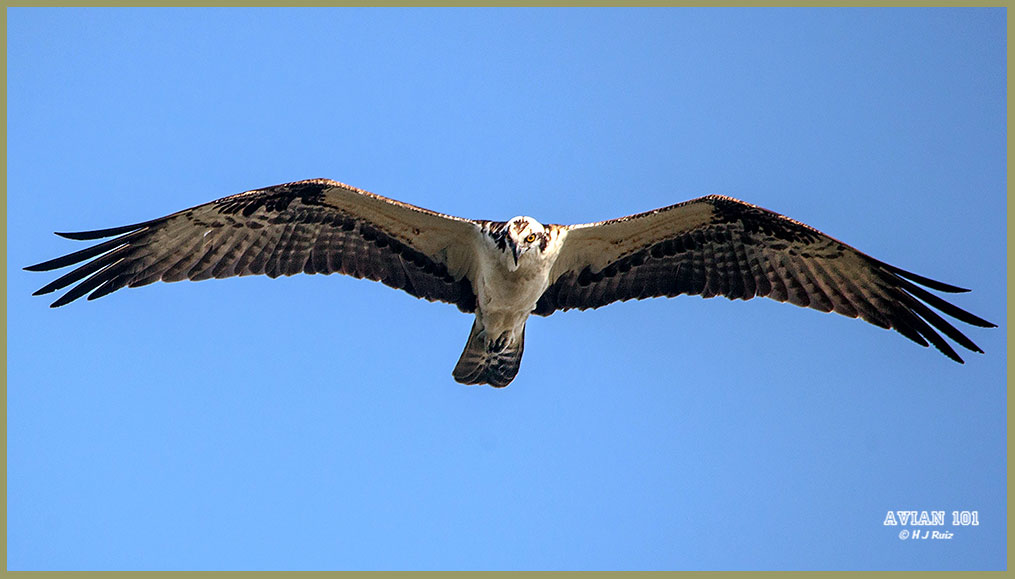
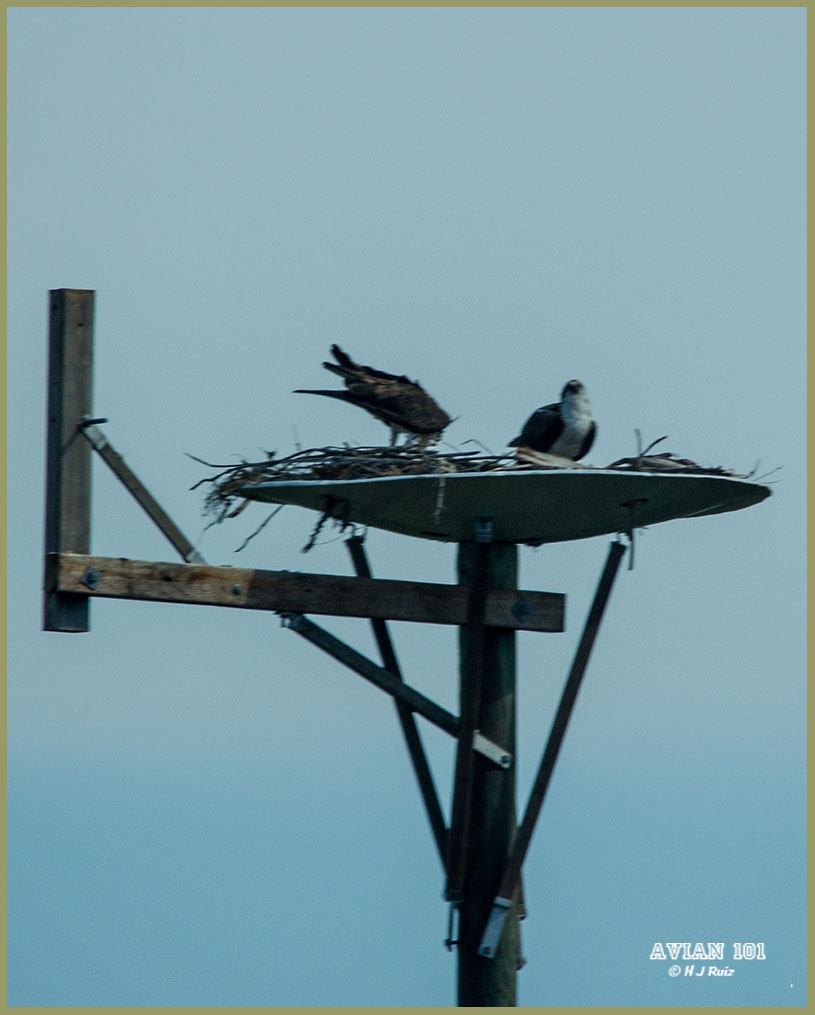
The Osprey (Pandion haliaetus), also called sea hawk, river hawk, and fish hawk, is a diurnal, fish-eating bird of prey with a cosmopolitan range. It is a large raptor, reaching more than 60 cm (24 in) in length and 180 cm (71 in) across the wings. It is brown on the upperparts and predominantly greyish on the head and underparts. The osprey tolerates a wide variety of habitats, nesting in any location near a body of water providing an adequate food supply. It is found on all continents except Antarctica, although in South America it occurs only as a non-breeding migrant.As its other common names suggest, the osprey’s diet consists almost exclusively of fish. It possesses specialised physical characteristics and unique behaviour in hunting its prey. Its unique characteristics classify it in its own taxonomic genus, Pandion, and family, Pandionidae. The osprey differs in several respects from other diurnal birds of prey. Its toes are of equal length, its tarsi are reticulate, and its talons are rounded, rather than grooved. The osprey and owls are the only raptors whose outer toe is reversible, allowing them to grasp their prey with two toes in front and two behind. This is particularly helpful when they grab slippery fish. The osprey is 0.9–2.1 kg (2.0–4.6 lb) in weight and 50–66 cm (20–26 in) in length with a 127–180 cm (50–71 in) wingspan. It is, thus, of similar size to the largest members of the Buteo or Falco genera. The subspecies are fairly close in size, with the nominate subspecies averaging 1.53 kg (3.4 lb), P. h. carolinensis averaging 1.7 kg (3.7 lb) and P. h. cristatus averaging 1.25 kg (2.8 lb). The wing chord measures 38 to 52 cm (15 to 20 in), the tail measures 16.5 to 24 cm (6.5 to 9.4 in) and the tarsus is 5.2–6.6 cm (2.0–2.6 in).
Photo Gallery


HJ Ruiz – November 10th, 2023
Share this:

Read Past Reviews

Book # 69
Quote from the Author
“A good chuckle is healthy, it helps you break the monotony of a serious life.” ~ H.J. Ruiz
 H.J. Ruiz - Avian101
You must be logged in to post a comment.