
Photo Capture # 21 – Black-necked Stilt
Black-necked Stilt
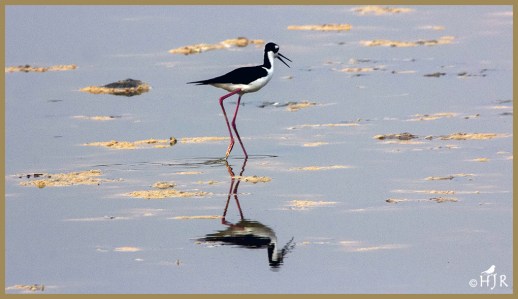
Black-necked Stilt
© HJ Ruiz – Avian101
Share this:

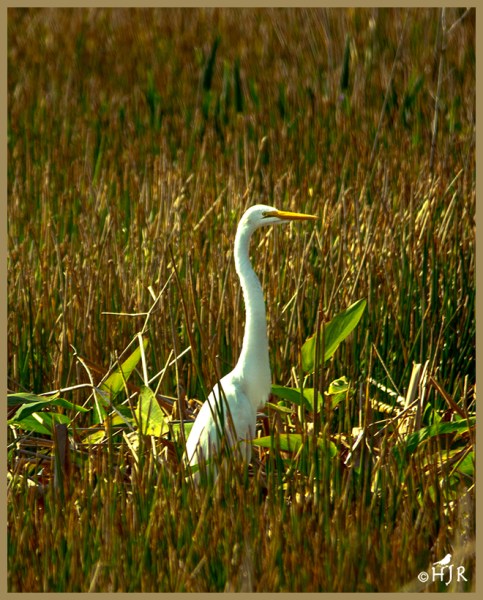
Bird’s ID – Great Egret
Great Egret
The Great Egret (Ardea alba), also known as the common egret, large egret, or (in the Old World) great white egret or great white heron is a large, widely distributed egret, with four subspecies found in Asia, Africa, the Americas, and southern Europe. Distributed across most of the tropical and warmer temperate regions of the world, it builds tree nests in colonies close to water.
The great egret is a large heron with all-white plumage. Standing up to 1 m (3.3 ft) tall, this species can measure 80 to 104 cm (31 to 41 in) in length and have a wingspan of 131 to 170 cm (52 to 67 in). Body mass can range from 700 to 1,500 g (1.5 to 3.3 lb), with an average around 1,000 g (2.2 lb). It is thus only slightly smaller than the great blue or grey heron (A. cinerea). Apart from size, the great egret can be distinguished from other white egrets by its yellow bill and black legs and feet, though the bill may become darker and the lower legs lighter in the breeding season. In breeding plumage, delicate ornamental feathers are borne on the back. Males and females are identical in appearance; juveniles look like nonbreeding adults. Differentiated from the intermediate egret (Mesophoyx intermedius) by the gape, which extends well beyond the back of the eye in case of the great egret, but ends just behind the eye in case of the intermediate egret.
It has a slow flight, with its neck retracted. This is characteristic of herons and bitterns, and distinguishes them from storks, cranes, ibises, and spoonbills, which extend their necks in flight. The great egret walks with its neck extended and wings held close.
Photo Gallery
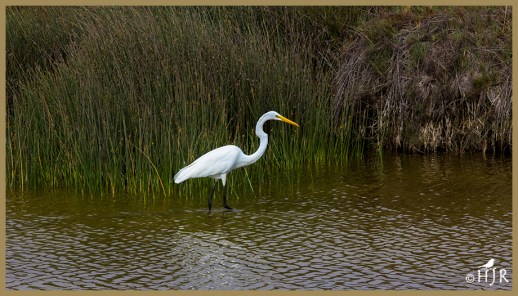
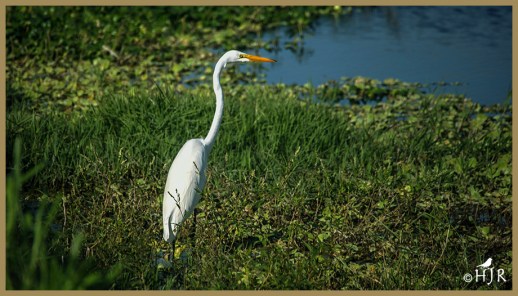
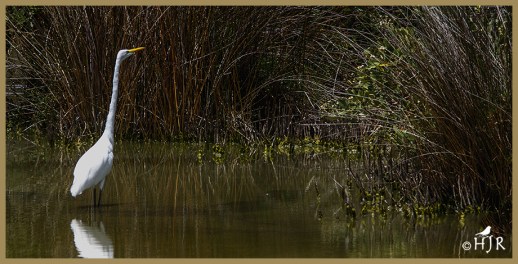

© HJ Ruiz – Avian101
Share this:

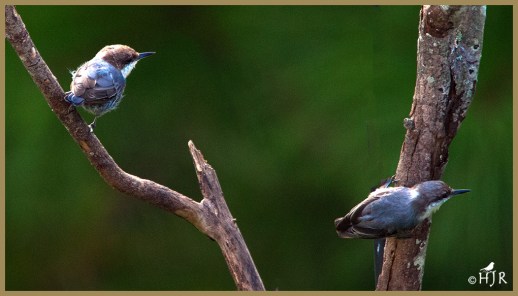
Photo Capture # 20 – Brown-headed Nuthatchs
Brown – headed Nuthatchs
© HJ Ruiz – Avian101
Share this:

What’s Up? – Cold Hands…Warm Heart
Cold Hands…Warm Heart
It has been a cold week for my area. For example, last Wednesday it was 23º F at the time we were waiting for the School bus! Daily, we have frost everywhere in the backyard.
It gets very breezy and you feel colder due to the wind chill factor. Most of my birds wait until the sun rises up over the tree line and they go looking for their meals.
I see the Carolina Chickadees are very busy going back and forth taking sunflower seeds to their nesting place…Perhaps stocking up for a harsh winter?
The Northern Mockingbird is back in service again, he chases everybody out from the feeders, to me it means one thing: The female must be incubating.
I also see my little “tenors” the Carolina Wrens, they move all over the deck area and inspect every niche or hole they can find. I guess, they are looking for insects or any other bugs.
Song Sparrows and House Finches also show up and eat but do not frolic for long.
And, of course, my Northern Cardinals, sometimes the entire clan is out to feed, they are very active and playful , they chase each other around snd flitter around the backyard. I enjoy moments like that very much. It gives me the impression that they are happy.
Photo Gallery


© HJ Ruiz – Avian101
Share this:

Read Past Reviews

Book # 69
Quote from the Author
“A good chuckle is healthy, it helps you break the monotony of a serious life.” ~ H.J. Ruiz


You must be logged in to post a comment.