
Bird’s ID – Cooper’s Hawk
Cooper’s Hawk
Cooper’s Hawk (Accipiter cooperii) is a medium-sized hawk native to the North American continent and found from Southern Canada to Northern Mexico. As in many birds of prey, the male is smaller than the female. The birds found east of the Mississippi River tend to be larger on average than the birds found to the west.
The average mass of an adult male ranges from 220 to 440 g (7.8 to 15.5 oz) with a length between 35 and 46 cm (14 and 18 in). The adult male is significantly smaller than the average female, which weighs 330 to 700 g (12 to 25 oz) and measures 42 to 50 cm (17 to 20 in) long. Its wingspan ranges from 62 to 94 cm (24 to 37 in). Individuals living in the eastern regions, where the sexes average 349 g (12.3 oz) and 566 g (20.0 oz), tend to be larger and heavier than those in the western regions, where the respective sexes average 280 g (9.9 oz) and 440 g (16 oz).
Cooper’s hawks have short rounded wings, the wing chord measuring 21.4–27.8 cm (8.4–10.9 in) long, and a relatively long tail, 17–20.5 cm (6.7–8.1 in) long, with dark bands, round-ended at the tip. As in most accipiters, the tarsus is relatively long, measuring 5.6–7.6 cm (2.2–3.0 in) long, and the bill is relatively small, with the culmen from the cere measuring only 1.5–2.1 cm (0.59–0.83 in). Adults have red eyes and have a black cap, with blue-gray upper parts and white underparts with fine, thin, reddish bars. Their tail is blue-gray on top and pale underneath, barred with black bands.
Immatures have yellow eyes and have a brown cap, with brown upper parts and pale underparts with thin black streaks mostly ending at the belly. Their tail is brown on top and pale underneath, barred with dark bands. The eyes of this hawk, as in most predatory birds, face forward, enabling good depth perception for hunting and catching prey while flying at top speeds. They have hooked bills that are well adapted for tearing flesh of prey. The crow-like size of Cooper’s hawks is sometimes distinctive from the sharp-shinned, but this can be less reliable in large female sharp-shinneds. Goshawks are usually more distinctive in their larger size and differing plumage markings, with the juvenile goshawk having broader, darker streaking below with more irregular patterns than the immature Cooper’s. The Cooper’s hawk appears long-necked in flight and has been described by birdwatchers as looking like a “flying cross”. The Cooper’s hawk is seen mostly flying with quick, consecutive wing beats and a short glide, though they may also soar.
These birds capture prey from cover or while flying quickly through dense vegetation, relying almost totally on surprise. One study showed that this is a quite dangerous hunting style. More than 300 Cooper’s hawk skeletons were investigated and 23% revealed healed fractures in the bones of the chest. Cooper’s hawks prey almost exclusively on small to mid-sized birds. Typical prey species include American robins, other thrushes, jays, woodpeckers, European starlings, quail, icterids, cuckoos, pigeons and doves.
Photo Gallery
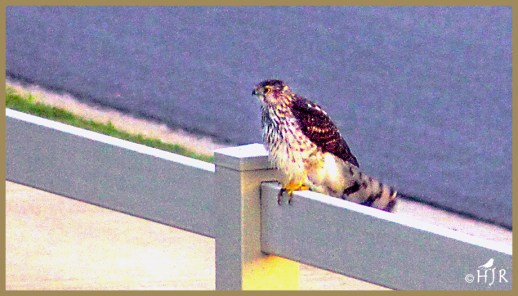
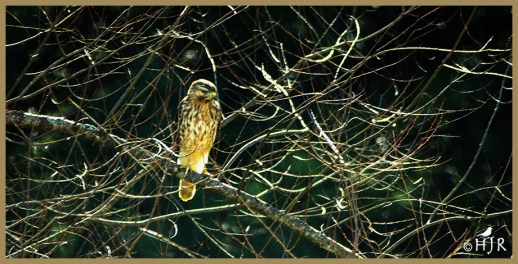
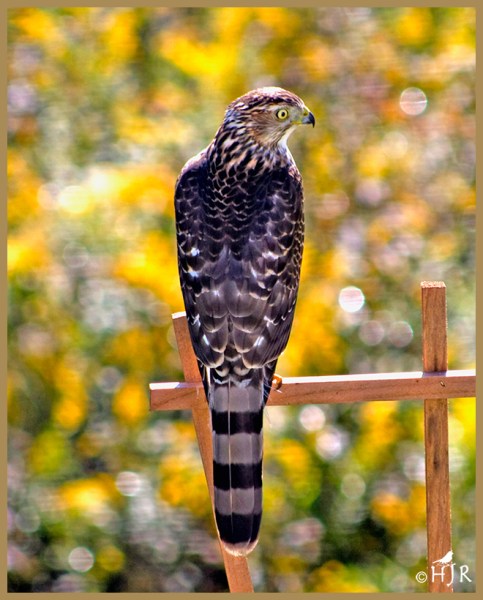
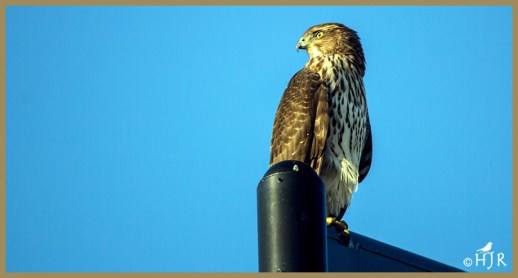
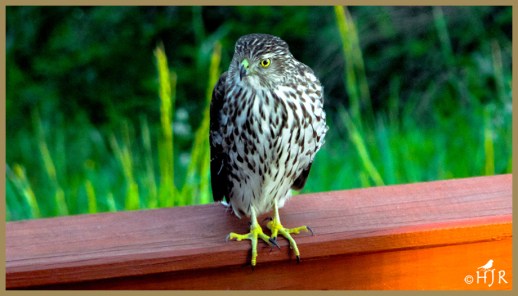
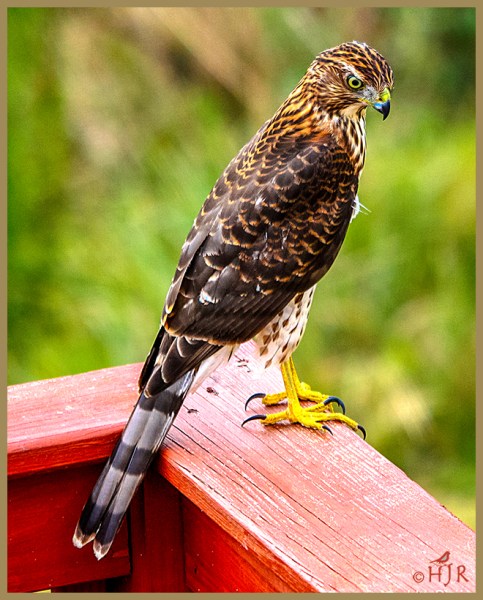
© HJ Ruiz – Avian101
Share this:

Photo Capture # 36 – Double- crested Cormorant
Double-crested Cormorants
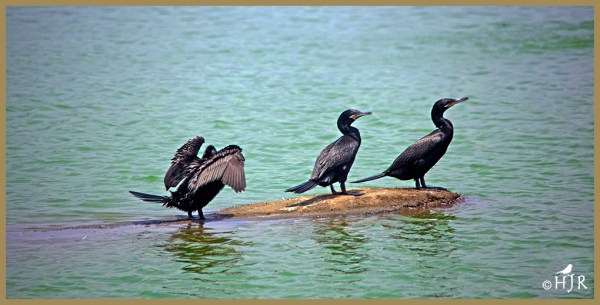
Double-crested Cormorants
© HJ Ruiz – Avian101
Share this:

Bird’s ID – Lincoln’s Sparrow
Lincoln’s Sparrow
Lincoln’s Sparrow (Melospiza lincolnii) is a medium-sized sparrow.
Adults have dark-streaked olive-brown upperparts with a light brown breast with fine streaks, a white belly, and a white throat. They have a brown cap with a grey stripe in the middle, olive-brown wings, and a narrow tail. Their face is grey with brown cheeks, a brown line through the eye, and an eye ring. They are somewhat similar in appearance to the song sparrow.
Their breeding habitat is wet thickets or shrubby bogs across Canada, Alaska, and the northeastern and western United States; this bird is less common in the eastern parts of its range. The nest is a well-concealed shallow open cup on the ground under vegetation.
These birds migrate to the southern United States, Mexico, and northern Central America; they are passage migrants over much of the United States, except in the west.
They forage on the ground in dense vegetation, mainly eating insects and seeds.
They are very secretive. Their song is a musical trill, but this bird is often not seen or heard even where they are common.
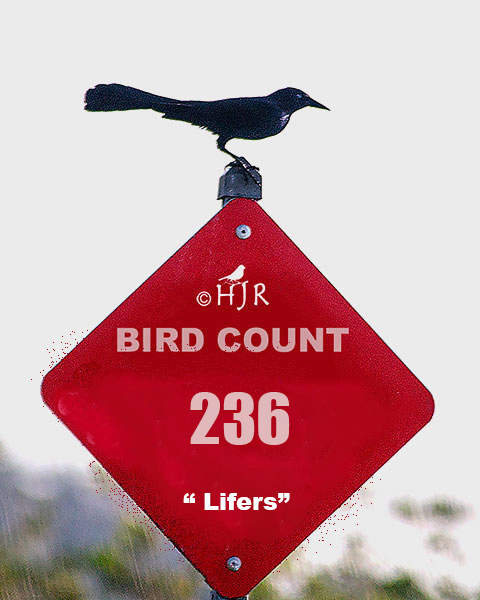
Important Note: The Lincoln’s Sparrow is listed on my “lifers” as # 217
Photo Gallery
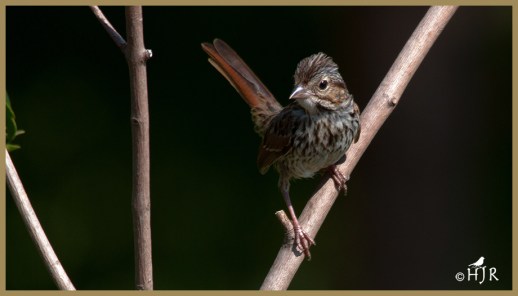
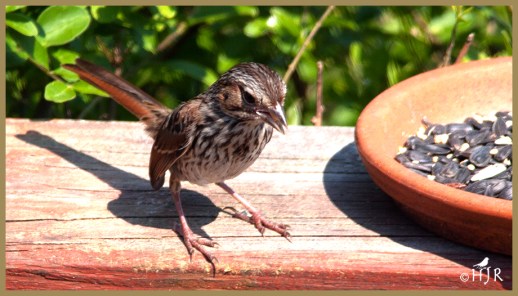
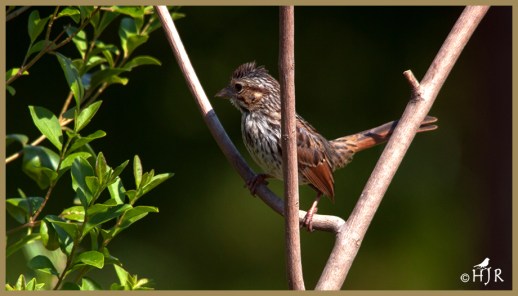

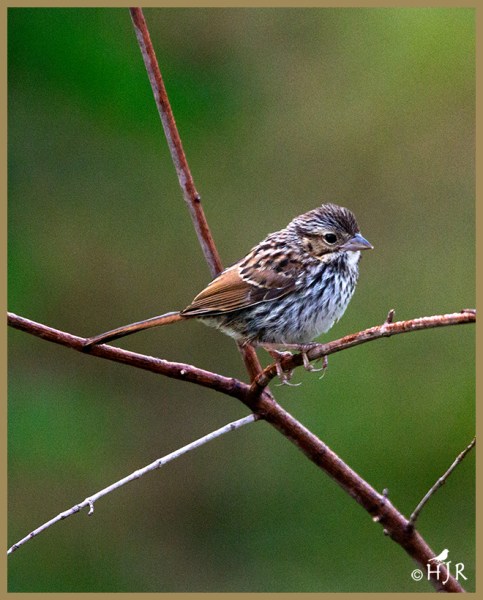
© HJ Ruiz – Avian101
Share this:

Photo Capture # 35 Great Blue Heron
Great Blue Heron
“Golden Hour”
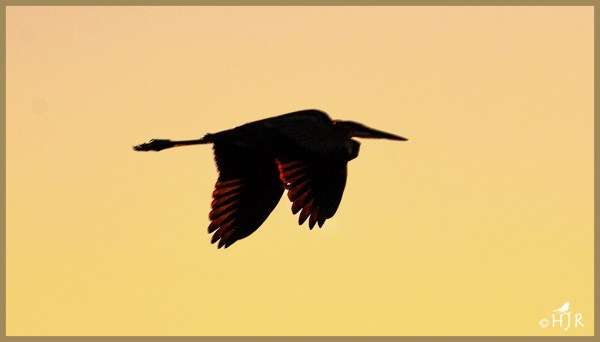
Great Blue Heron – “Golden hour”
© HJ Ruiz – Avian101
Share this:

Read Past Reviews

Book # 69

Quote from the Author
“A good chuckle is healthy, it helps you break the monotony of a serious life.” ~ H.J. Ruiz


You must be logged in to post a comment.