
Photo Capture # 38 – Red-winged Blackbird
Red-winged Blackbird (M)
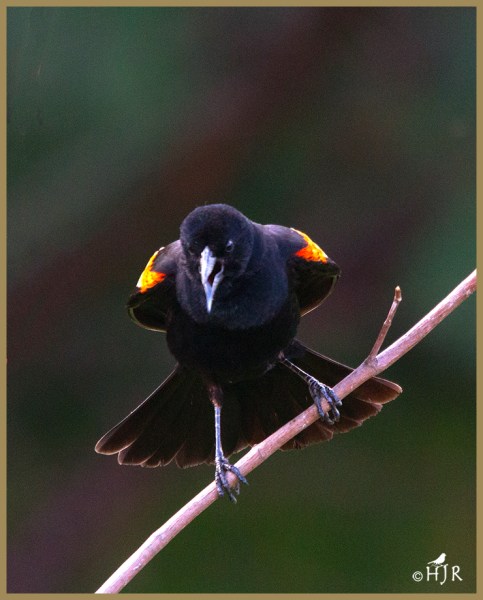
Red-winged Blackbird (M)
© HJ Ruiz – Avian101
Share this:

What’s Up? – Pleasant Days
Pleasant Days
Strange as it is the weather has made a change for the good. A rain here and there or some sudden drops in temperatures do not amount to a calamity, believe or not, some days are sunny and bright with an incredible blue sky, so much better that you can see people taking walks or jogging outdoors.
I see flocks of birds going by, high, mostly blackbirds. These birds visit my backyard sometimes and make a clean-up of my feeders… in other words, they eat everything they can!
The group left soon, but not before causing ado among the local birds. You should see the mockingbird trying to shoo away the invaders so eager to fill their crops for travel . They devoured all seeds. He gets confronted by the members of the vagrant group, but he holds up pretty well. He’s a bold bird no doubt!
My son went back to School last Monday, now he’s counting the days till his 9th birthday in May. Oy!
Photo Gallery


Eating Lunch With…
Pine Warbler
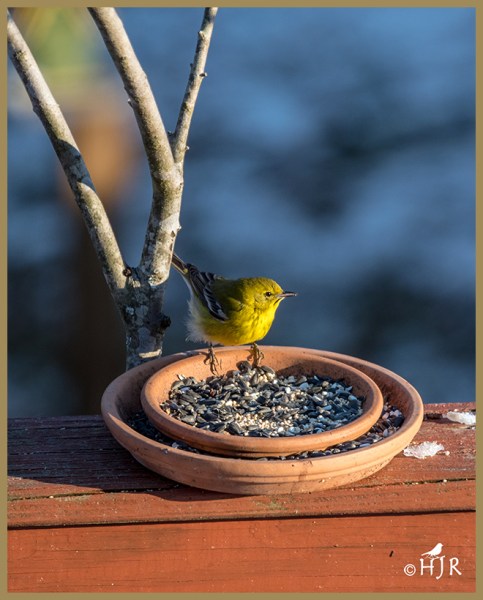
Pine Warbler
© HJ Ruiz – Avian101
Share this:

Photo Capture # 37 – Canada Geese
Canada Geese

Canada Geese
© HJ Ruiz – Avian101
Share this:

Red Gallery – Northern Cardinal
Both sexes sing clear, whistled song patterns, which are repeated several times, then varied. Some common phrases are described as “cheeeer-a-dote, cheeer-a-dote-dote-dote”, “purdy, purdy, purdy…whoit, whoit, whoit, whoit”, “what-cheer, what-cheer… wheet, wheet, wheet, wheet” and “cheer, cheer, cheer, what, what, what, what”. The northern cardinal has a distinctive alarm call, a short metallic chip sound. This call often is given when predators approach the nest, in order to give warning to the female and nestlings. In some cases it will also utter a series of chipping notes. The frequency and volume of these notes increases as the threat becomes greater. This chipping noise is also used by a cardinal pair to locate each other, especially during dusk hours when visibility wanes.
The songs of the two sexes of the northern cardinal, although not distinguishable by the human ear, are sexually dimorphic. It is suggested that this is because of the differences in levels of hormones of the two sexes.


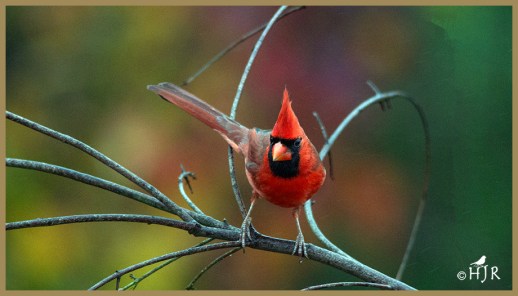
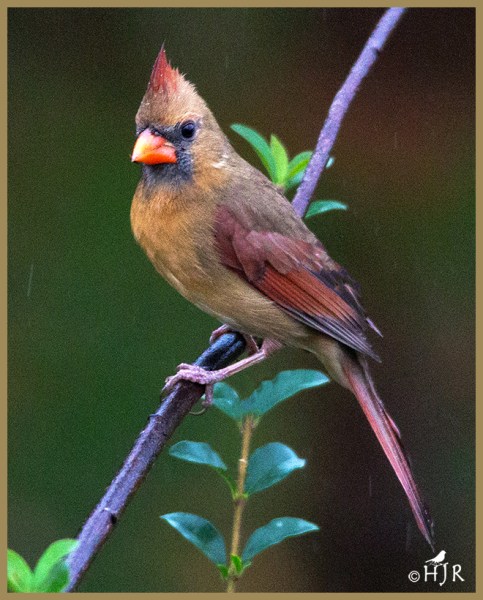
© HJ Ruiz – Avian101
Share this:

Read Past Reviews

Book # 69
Quote from the Author
“A good chuckle is healthy, it helps you break the monotony of a serious life.” ~ H.J. Ruiz


You must be logged in to post a comment.