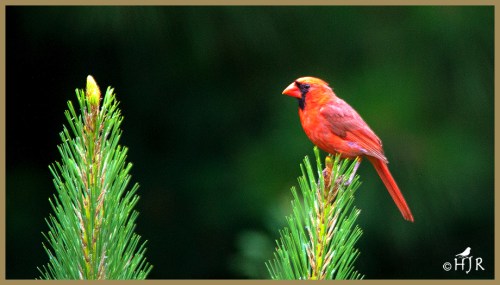
Red Gallery – Northern Cardinal
Both sexes sing clear, whistled song patterns, which are repeated several times, then varied. Some common phrases are described as “cheeeer-a-dote, cheeer-a-dote-dote-dote”, “purdy, purdy, purdy…whoit, whoit, whoit, whoit”, “what-cheer, what-cheer… wheet, wheet, wheet, wheat” and “cheer, cheer, cheer, what, what, what, what”. The northern cardinal has a distinctive alarm call, a short metallic chip sound. This call often is given when predators approach the nest, in order to give warning to the female and nestlings. In some cases it will also utter a series of chipping notes. The frequency and volume of these notes increases as the threat becomes greater. This chipping noise is also used by a cardinal pair to locate each other, especially during dusk hours when visibility wanes.
Photo Gallery



© HJ Ruiz – Avian101
Share this:

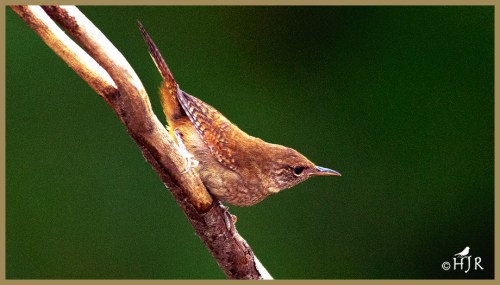
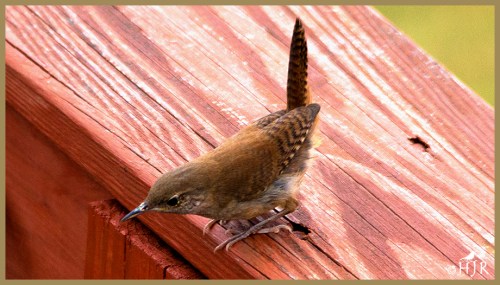
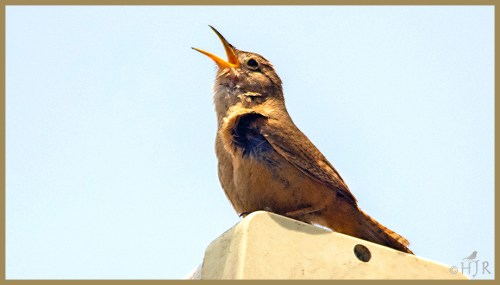
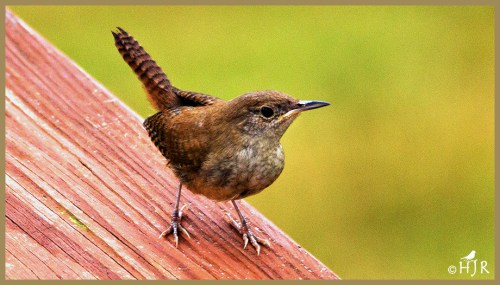
Bird’s ID – House Wren
House Wren
The House Wren (Troglodytes aedon) is a very small songbird of the wren family, Troglodytidae. It occurs from Canada to southernmost South America, and is thus the most widely distributed bird in the Americas. It occurs in most suburban areas in its range and it is the single most common wren. Its taxonomy is highly complex and some subspecies groups are often considered separate species.
Adults are 11 to 13 cm (4.3 to 5.1 in) long, with a 15 cm (5.9 in) wingspan and weigh about 10 to 12 g (0.35 to 0.42 oz). Among standard measurements, the wing chord is 4.7 to 5.3 cm (1.9 to 2.1 in), the tail is 3.9 to 4.4 cm (1.5 to 1.7 in), the culmen is 1.1 to 1.3 cm (0.43 to 0.51 in) and the tarsus is 1.6 to 1.8 cm (0.63 to 0.71 in). The subspecies vary greatly. The legs are pinkish or grey. The short tail is typically held cocked.
This bird’s rich bubbly song is commonly heard during the nesting season but rarely afterwards. There is marked geographical variation in the song, though somewhat more gradual than in the bird’s outward appearance that can strikingly differ, e.g., on neighboring islands in the Caribbean. Birds from far north and south of the species’ range nonetheless have songs that differ markedly.
The nesting habits do not seem to differ significantly between the northern and southern house wrens at least. They usually construct a large cup nest in various sorts of cavities, taking about a week to build. The nest is made from small dry sticks and is usually lined with a variety of different materials. These include: feather, hair, wool, spider cocoons, strips of bark, rootlets, moss, and trash. The male wren finds dry sticks, which he adds to the nest. Once he is done, the female inspects at the nest; but if she does not approve of the construction, she will throw any unwanted sticks to the ground. After this process, the female lines the nest. Nest cavities are usually a few meters above ground at most, but occasionally on cliffs as high up as 15 m (49 ft) and more at least in southern populations; they may be natural or man-made, often using bird houses.
Photo Gallery

© HJ Ruiz – Avian101
Share this:

Photo Capture # 39 – Snowy Egrets
Snowy Egrets

Snowy Egrets
© HJ Ruiz – Avian101
Share this:

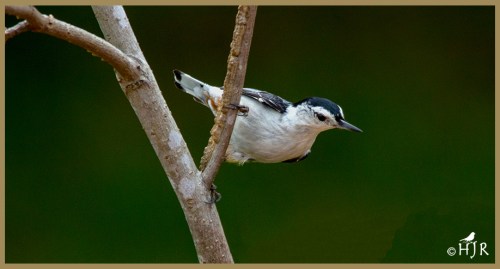
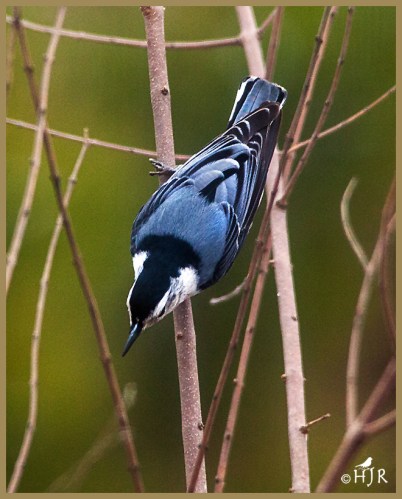
Bird’s ID – White-breasted Nuthatch
White-breasted Nuthatch
The White-breasted Nuthatch (Sitta carolinensis) is a small songbird of the nuthatch family which breeds in old-growth woodland across much of temperate North America. It is a stocky bird, with a large head, short tail, powerful bill, and strong feet. The upperparts are pale blue-gray, and the face and underparts are white. It has a black cap and a chestnut lower belly. The nine subspecies differ mainly in the color of the body plumage.
Like other nuthatches, the white-breasted nuthatch forages for insects on trunks and branches and is able to move head-first down trees. Seeds form a substantial part of its winter diet, as do acorns and hickory nuts that were stored by the bird in the fall. The nest is in a hole in a tree, and the breeding pair may smear insects around the entrance as a deterrent to squirrels. Adults and young may be killed by hawks, owls, and snakes, and forest clearance may lead to local habitat loss, but this is a common species with no major conservation concerns over most of its range.
Like other members of its genus, the white-breasted nuthatch has a large head, short tail, short wings, a powerful bill and strong feet; it is 13–14 cm (5.1–5.5 in) long, with a wingspan of 20–27 cm (7.9–10.6 in) and a weight of 18–30 g (0.63–1.06 oz).
The adult male of the nominate subspecies, S. c. carolinensis, has pale blue-gray upperparts, a glossy black cap (crown of the head), and a black band on the upper back. The wing coverts and flight feathers are very dark gray with paler fringes, and the closed wing is pale gray and black, with a thin white wing bar. The face and the underparts are white. The outer tail feathers are black with broad diagonal white bands across the outer three feathers, a feature readily visible in flight.
The female has, on average, a narrower black back band, slightly duller upperparts and buffer underparts than the male. Her cap may be gray, but many females have black caps and cannot be reliably distinguished from the male in the field.
The breeding habitat of the white-breasted nuthatch is woodland across North America, from southern Canada to northern Florida and southern Mexico. In the eastern part of its range, its preferred habitat is old-growth open deciduous or mixed forest, including orchards, parks, suburban gardens and cemeteries. Pinyon-juniper and riverside woodlands may be used locally where available. The white-breasted nuthatch is the only North American nuthatch usually found in deciduous trees; red-breasted, pygmy and brown-headed nuthatches prefer pines.
The presence of mature or decaying trees with holes suitable for nesting is essential, and trees such as oak, beech and hickory are favored in the east since they also provide edible seeds. Although suitable habitat is distributed continentally, it is discontinuous, and the separate populations of this non-migratory species have diverged to form distinct regional subspecies.
This nuthatch, like most of its genus, is non-migratory, and the adults normally stay in their territory year-round.
Photo Gallery
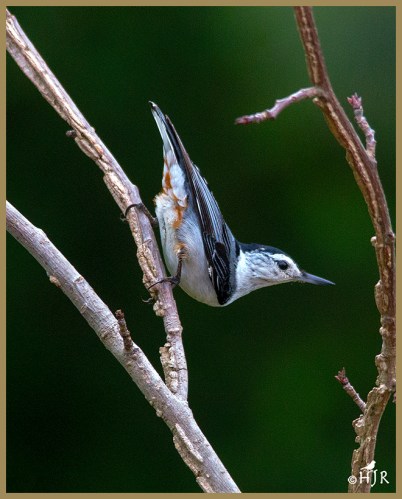

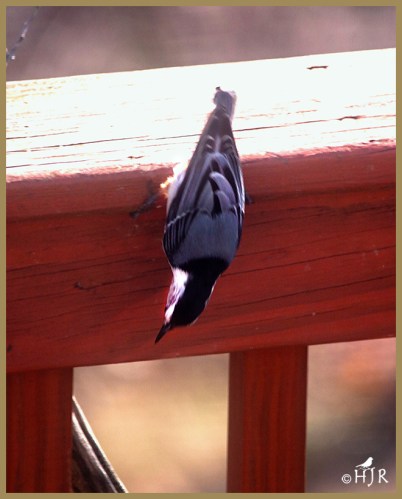
© HJ Ruiz – Avian101
Share this:

Read Past Reviews

Book # 69
Quote from the Author
“A good chuckle is healthy, it helps you break the monotony of a serious life.” ~ H.J. Ruiz


You must be logged in to post a comment.