
What’s Up? – Three glorious days, and…
Three glorious days, and…
The past week we had three glorious days of perfect weather, they had the signature of truly autumn weather. I, for one, was very happy, during those three days, this is why:
I had 21 different species of birds fleeting around my backyard! With days like that it was really inviting to be outdoors looking to the opportunity for shooting hundreds of photos.
Then, after the third day, the weather reversed from glorious to nasty, cold, gray and windy day. After a while of this kind of weather, we received weather news for tornado alarm for Alabama and Georgia. I’m sure that you have, most likely seen the news on TV. The predictions were became real when there was tornado touch down in Alabama for 65 miles and devastated many homes in that area, including 23 fatalities. The stats show that 38 tornados touched land in Alabama and Georgia combined.
Tornados caused damages in Georgia, and thankfully no fatalities. The closest tornado from my area was approximately 60 miles.
My condolences for the families that lost relatives.
Photo Gallery


Eating Lunch With…
Common Grackle
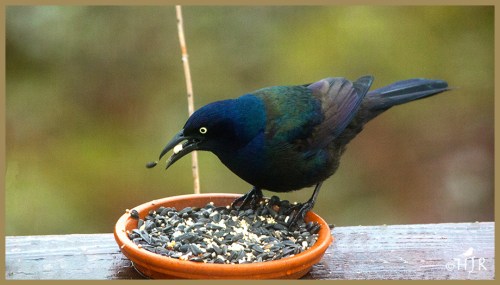
Common Grackle
© HJ Ruiz – Avian101
Share this:

Photo Capture # 58 – Ruby-throated Hummingbird
Ruby-throated Hummingbird
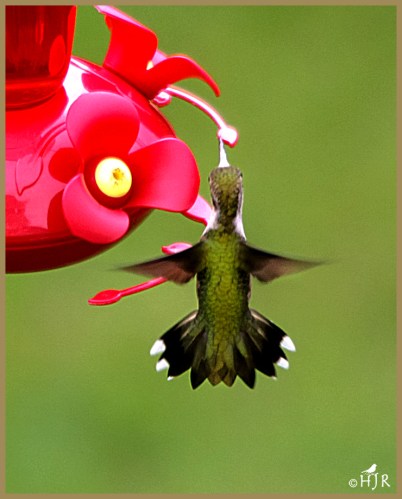
Ruby – throated Hummingbird
© HJ Ruiz – Avian101
Share this:

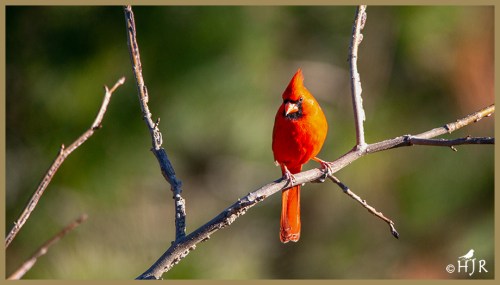
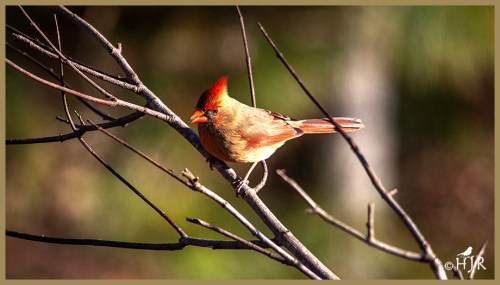
Red Gallery – Northern Cardinal
After mating, the females cardinal lay eggs, 3-4, sometimes 2-5. Whitish to pale bluish or greenish white, marked with brown, purple, and gray. Incubation is almost always by female alone, 12-13 days. Young: Both parents feed nestlings. Young leave nest about 9-11 days after hatching. Male may feed fledglings while female begins next nesting attempt. 2-3 broods per year, rarely 4.
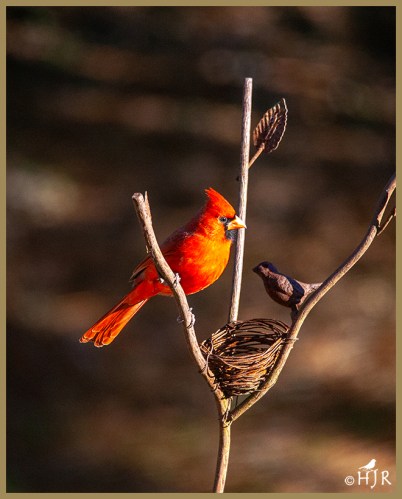
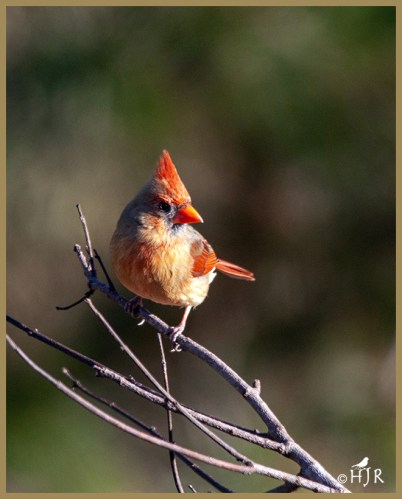
© HJ Ruiz – Avian101
Share this:

Bird’s ID – Brown Thrasher
Brown Thrasher
The Brown Thrasher (Toxostoma rufum) is a bird in the family Mimidae, which also includes the New World catbirds and mockingbirds. The dispersal of the brown thrasher is abundant throughout the eastern and central United States, southern and central Canada, and is the only thrasher to live primarily east of the Rockies and central Texas. As a member of the genus Toxostoma, the bird is a large-sized thrasher. It has brown upper parts with a white under part with dark streaks. Because of this, it is often confused with the smaller wood thrush (Hylocichla mustelina), among other species. The brown thrasher is noted for having over 1000 song types, and the largest song repertoire of birds.However, each note is usually repeated in two or three phrases.
The brown thrasher is an omnivore, with its diet ranging from insects to fruits and nuts. The usual nesting areas are shrubs, small trees, or at times on ground level. Brown thrashers are generally inconspicuous but territorial birds, especially when defending their nests, and will attack species as large as humans.
The brown thrasher is bright reddish-brown above with thin, dark streaks on its buffy underparts. It has a whitish-colored chest with distinguished teardrop-shaped markings on its chest. Its long, rufous tail is rounded with paler corners, and eyes are a brilliant yellow. Its bill is brownish, long, and curves downward. Both male and females are similar in appearance. The juvenile appearance of the brown thrasher from the adult is not remarkably different, except for plumage texture, indiscreet upper part markings, and the irises having an olive color.
The brown thrasher is a fairly large passerine, although it is generally moderate in size for a thrasher, being distinctly larger than the sage thrasher (Oreoscoptes montanus) but similar or somewhat smaller in size than the more brownish Toxostoma species found further west. Adults measure around 23.5 to 30.5 cm (9.3 to 12.0 in) long with a wingspan of 29 to 33 cm (11 to 13 in), and weigh 61 to 89 g (2.2 to 3.1 oz), with an average of 68 g (2.4 oz). Among standard measurements, the wing chord is 9.5 to 11.5 cm (3.7 to 4.5 in), the tail is 10.9 to 14.1 cm (4.3 to 5.6 in), the culmen is 2.2 to 2.9 cm (0.87 to 1.14 in) and the tarsus is 3.2 to 3.6 cm (1.3 to 1.4 in).There are two subspecies: the ‘brown thrasher’ (T. rufum rufum), which lies in the eastern half of Canada and the United States, and the ‘western brown thrasher’ (T. rufum longicauda (Baird, 1858)) which resides in the central United States east of the Rocky Mountains and southern central Canada. The western brown thrasher is distinguished by a more cinnamon upper part, whiter wing bars, and darker breast spots than T.rufum rufum.
The brown thrasher has been observed either solo or in pairs. The brown thrasher is usually an elusive bird, and maintains its evasiveness with low-level flying. When it feels bothered, it usually hides into thickets and gives cackling calls. Thrashers spend most of their time on ground level or near it. When seen, it is commonly the males that are singing from unadorned branches. The brown thrasher has been noted for having an aggressive behavior, and is a staunch defender of its nest. However, the name does not come from attacking perceived threats, but is believed to have come from the thrashing sound the bird makes when digging through ground debris. It is also thought that the name comes from the thrashing sound that is made while it is smashing large insects to kill and eventually eat.
The brown thrasher is the state bird of Georgia.
Photo Gallery


© HJ Ruiz – Avian101
Share this:

Read Past Reviews

Book # 69
Quote from the Author
“A good chuckle is healthy, it helps you break the monotony of a serious life.” ~ H.J. Ruiz


You must be logged in to post a comment.