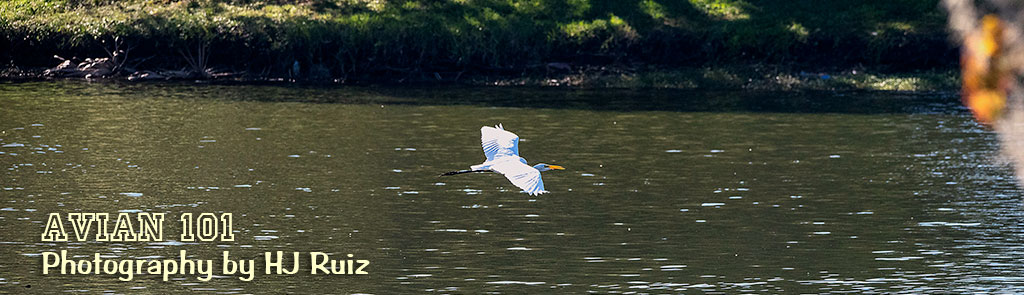
Photo Capture # 57 – American White Ibis
American White Ibis

American White Ibis
© HJ Ruiz – Avian101
Share this:

Bird’s ID – Gray Catbird
Gray Catbird
The Gray Catbird (Dumetella carolinensis), is a medium-sized North American and Central American perching bird of the mimid family. It is the only member of the “catbird” genus Dumetella.
Adults weigh from 23.2 to 56.5 g (0.82 to 1.99 oz), with an average of 35–40 g (1.2–1.4 oz) They range in length from 20.5 to 24 cm (8.1 to 9.4 in) and span 22 to 30 cm (8.7 to 11.8 in) across the wings. Among standard measurements, the wing chord is 8.4 to 9.8 cm (3.3 to 3.9 in), the tail is 7.2 to 10.3 cm (2.8 to 4.1 in), the culmen is 1.5 to 1.8 cm (0.59 to 0.71 in) and the tarsus is 2.7 to 2.9 cm (1.1 to 1.1 in). Gray catbirds are plain lead gray almost all over. The top of the head is darker. The undertail coverts are rust-colored, and the remiges and rectrices are black, some with white borders. The slim bill, the eyes, and the legs and feet are also blackish. Males and females cannot be distinguished by their looks; different behaviours in the breeding season is usually the only clue to the observer. Juveniles are even plainer in coloration, with buffy undertail coverts.
This species is named for its cat-like call. Like many members of the Mimidae (most famously mockingbirds), it also mimics the songs of other birds, as well as those of Hylidae (tree frogs), and even mechanical sounds. Because of its well-developed songbird syrinx, it is able to make two sounds at the same time. The alarm call resembles the quiet calls of a male mallard.
A gray catbird’s song is easily distinguished from that of the northern mockingbird (Mimus polyglottos) or brown thrasher (Toxostoma rufum) because the mockingbird repeats its phrases or “strophes” three to four times, the thrasher usually twice, but the catbird sings most phrases only once. The catbird’s song is usually described as more raspy and less musical than that of a mockingbird.
In contrast to the many songbirds that choose a prominent perch from which to sing, the catbird often elects to sing from inside a bush or small tree, where it is obscured from view by the foliage.
Photo Gallery


© HJ Ruiz – Avian101
Share this:

Photo Capture # 56 – Yellow-crowned Night Heron
Yellow-crowned Night Heron
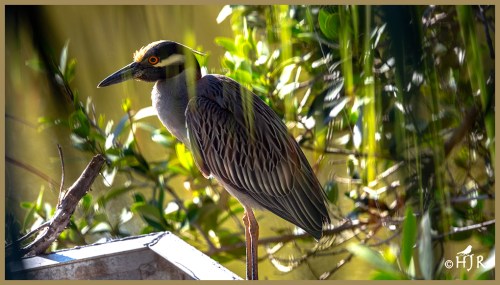
Yellow-crowned Night Heron
© HJ Ruiz – Avian101
Share this:

What’s Up? – Raindrops keep falling on my head…
Raindrops keep falling on my head…
We’re still getting rain on a daily basis. This doesn’t make birds lives any easier or us humans. The only ones taking advantage of rain are the squirrels. They are a nuisance because, not only they eat a lot of seeds, they break the feeder saucers, smash the suet mixes and leave a pile of seed shells all over the deck, and to top it, they don’t seem to mind the rain, no matter how heavy it’s raining!
Last week in Florida, the trip to Audubon – Corkscrew Swamp Sanctuary near Naples, was exciting and beneficial because it offers a good hike on the boardwalk, through the swamp, open air and great opportunity for birders and photographers to spot a variety of wildlife. We enjoyed it very much.
My son Tyler (will be 9 y.o. in May) showed great interest reading all signs about the species of birds, plants and in general wildlife. And read the map to know the location. He brought his camera but he didn’t want to use it, he feared that he would drop it in the swamp.
- Palm Warbler sitting on fence.
- This Turkey Vulture past by me only ten feet close.
- Boat-tailed Grackle posed for me like a pro.
- This Gray Catbird, was funny, after I shot the picture, he landed on the boardwalk railing very close to me, I had the long lens so I backed up to be within range and the catbird kept advancing toward me, at the end I couldn’t get the shot because he was at hand reach.
- This is Tyler, my assistant posing next to a bronze statue.
- This raccoon was part of a small group moving around the swamp area. Good looking mammal.
Photo Gallery


Eating Lunch With…
White-throated Sparrow
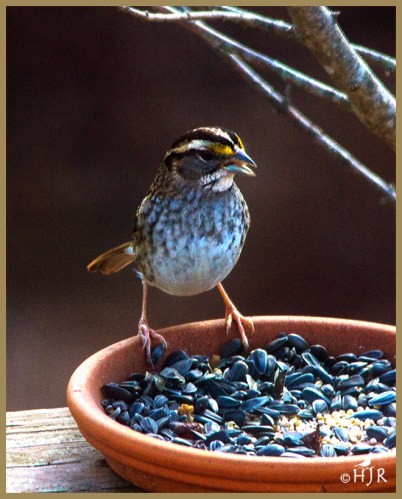
White-throated Sparrow
© HJ Ruiz – Avian101
Share this:

Read Past Reviews

Book # 69
Quote from the Author
“A good chuckle is healthy, it helps you break the monotony of a serious life.” ~ H.J. Ruiz


You must be logged in to post a comment.