
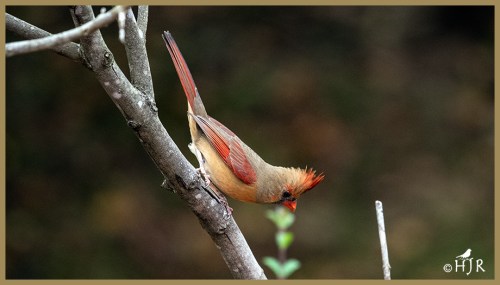
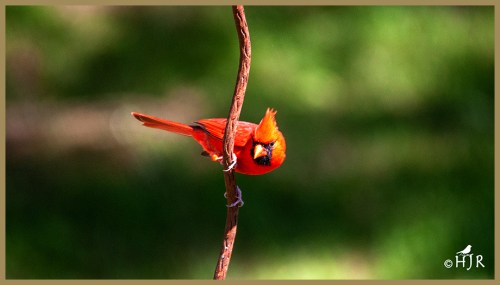
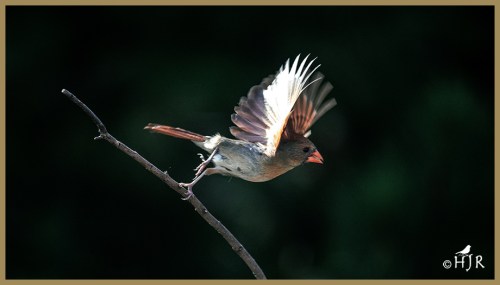
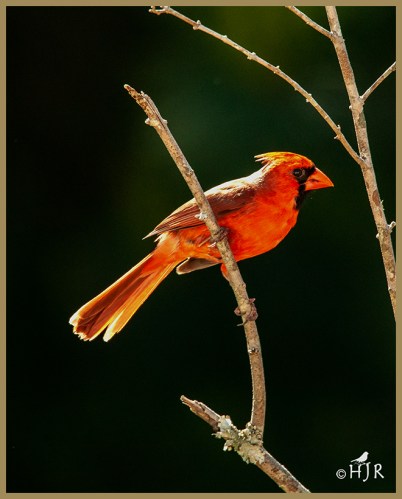
Red Gallery – Northern Cardinal
The eggs are whitish or pale green, blue, or faintly brown, with darker purple, gray, or brown splotches concentrated at the larger end. One pair of birds may raise 2-4 broods annually of 3-4 eggs each. Eggs are incubated by the female for 12-14 days, though the male may spend brief periods of time incubating as well. The young hatchlings are nearly naked at first but mature quickly and will leave the nest in 9-12 days.
Photo Gallery
© HJ Ruiz – Avian101
Share this:

Bird’s ID – Downy Woodpecker
Downy Woodpecker
The Downy Woodpecker (Dryobates pubescens) is a species of woodpecker, the smallest in North America.
Adult downy woodpeckers are the smallest of North America’s woodpeckers but there are many smaller species elsewhere, especially the piculets. The total length of the species ranges from 14 to 18 cm (5.5 to 7.1 in) and the wingspan from 25 to 31 cm (9.8 to 12.2 in). Body mass ranges from 20 to 33 g (0.71 to 1.16 oz). Standard measurements are as follows: the wing chord is 8.5–10 cm (3.3–3.9 in), the tail is 4–6 cm (1.6–2.4 in), the bill is 1–1.8 cm (0.39–0.71 in) and the tarsus is 1.1–1.7 cm (0.43–0.67 in). The downy woodpecker is mainly black on the upperparts and wings, with a white back, throat and belly and white spotting on the wings. There is a white bar above the eye and one below. They have a black tail with white outer feathers barred with black. Adult males have a red patch on the back of the head whereas juvenile birds display a red cap.
The downy woodpecker is virtually identical in plumage pattern to the larger hairy woodpecker, but it can be distinguished from the hairy by the presence of black spots on its white tail feathers and the length of its bill. The downy woodpecker’s bill is shorter than its head, whereas the hairy woodpecker’s bill is approximately equal to head length.
The downy woodpecker gives a number of vocalizations, including a short pik call. One may identify the woodpecker by pik-call, counting half a second between piks(a total of four must be heard). The rattle-call is a short burst that sounds similar to a bouncing ball, while that of the Hairy Woodpecker is a shorter burst of the same amplitude. Like other woodpeckers, it also produces a drumming sound (sounds like four taps ) with its beak as it pecks into trees. Compared to other North American species its drums are slow.
Downy woodpeckers are native to forested areas, mainly deciduous, of North America. Their range consists of most of the United States and Canada, except for the deserts of the southwest and the tundra of the north. Mostly permanent residents, northern birds may migrate further south; birds in mountainous areas may move to lower elevations.
Downy woodpeckers nest in a tree cavity excavated by the nesting pair in a dead tree or limb. In the winter, they roost in tree cavities. Downy Woodpeckers forage on trees, picking the bark surface in summer and digging deeper in winter. They mainly eat insects, also seeds and berries. They are a natural predator of the European corn borer, a moth that costs the US agriculture industry more than $1 billion annually in crop losses and population control. In winter, especially, downy woodpeckers can often be found in suburban backyards with mature trees. There, they may feed on suet and shelled peanuts provided by mesh birdfeeders.
Photo Gallery


© HJ Ruiz – Avian101
Share this:

Photo Capture # 63 – Great Egret
Great Egret
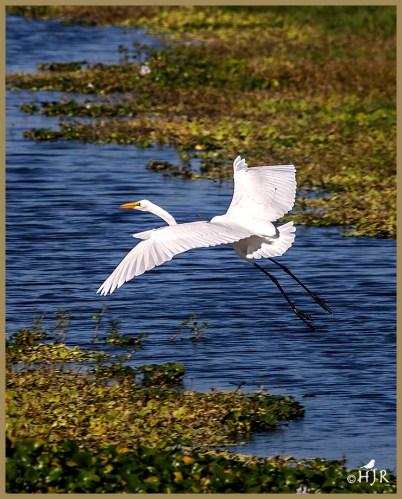
Great Egret
© HJ Ruiz – Avian101
Share this:

Bird’s ID – Canada Goose
Canada Goose
The Canada Goose (Branta canadensis) is a large wild goose species with a black head and neck, white cheeks, white under its chin, and a brown body. Native to arctic and temperate regions of North America, its migration occasionally reaches northern Europe. It has been introduced to the United Kingdom, New Zealand, Argentina, Chile, and the Falkland Islands. Like most geese, the Canada goose is primarily herbivorous and normally migratory; it tends to be found on or close to fresh water.
Extremely successful at living in human-altered areas, Canada geese have proven able to establish breeding colonies in urban and cultivated areas, which provide food and few natural predators. The success of this common park species has led to its often being considered a pest species because of their depredation of crops and their noise, droppings, aggressive territorial behavior, and habit of begging for food (caused by human hand feeding).
Canada geese range from 75 to 110 cm (30 to 43 in) in length and have a 127–185 cm (50–73 in) wingspan. Among standard measurements, the wing chord can range from 39 to 55 cm (15 to 22 in), the tarsus can range from 6.9 to 10.6 cm (2.7 to 4.2 in) and the bill can range from 4.1 to 6.8 cm (1.6 to 2.7 in). The largest subspecies is the B. c. maxima, or the giant Canada goose, and the smallest (with the separation of the cackling goose group) is B. c. parvipes, or the lesser Canada goose. An exceptionally large male of race B. c. maxima, which rarely exceed 8 kg (18 lb), weighed 10.9 kg (24 lb) and had a wingspan of 2.24 m (7.3 ft). This specimen is the largest wild goose ever recorded of any species.
The male Canada goose usually weighs 2.6–6.5 kg (5.7–14.3 lb), averaging amongst all subspecies 3.9 kg (8.6 lb). The female looks virtually identical, but is slightly lighter at 2.4–5.5 kg (5.3–12.1 lb), averaging amongst all subspecies 3.6 kg (7.9 lb), and generally 10% smaller in linear dimensions than the male counterparts. The female also possesses a different, and less sonorous, honk than the male.
Canada geese are primarily herbivores, although they sometimes eat small insects and fish. Their diet includes green vegetation and grains. The Canada goose eats a variety of grasses when on land. It feeds by grasping a blade of grass with the bill, then tearing it with a jerk of the head. The Canada goose also eats beans and grains such as wheat, rice, and corn when they are available. In the water, it feeds from aquatic plants by sliding its bill at the bottom of the body of water. It also feeds on aquatic plants, such as seaweeds. In urban areas, it is also known to pick food out of garbage bins. They are also sometimes hand-fed a variety of grains and other foods by humans in parks.
Photo Gallery


© HJ Ruiz – Avian101
Share this:

Read Past Reviews

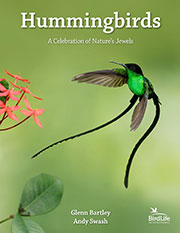
Book # 69
Quote from the Author
“A good chuckle is healthy, it helps you break the monotony of a serious life.” ~ H.J. Ruiz


You must be logged in to post a comment.