
Bird’s ID – Sanderlings
Sanderlings
The Sanderling (Calidris alba) is a small wading bird. It is a circumpolar Arctic breeder, and is a long-distance migrant, wintering south to South America, South Europe, Africa, and Australia. It is highly gregarious in winter, sometimes forming large flocks on coastal mudflats or sandy beaches.
The sanderling is a small plump sandpiper, 18–20 cm (7.1–7.9 in) in length. Its weight ranges from 40–100 g (1.4–3.5 oz). The winter bird is very pale, almost white apart from a dark shoulder patch. This is the source of the specific name, alba, which is the Latin for “white”. Later in the summer, the face and throat become brick-red. The juvenile bird is spangled black and white, and shows much more contrast than the adult.
Sanderlings feed on invertebrate prey buried in the sand in the upper intertidal zone. In North America, this diet largely consists of the isopods Excirolana linguifrons, Excirolana kincaidii, and the mole crab, Emerita analoga. When the tide is out, these crustaceans live in burrows some way beneath the surface. When the tide comes in, they move into the upper layers of sand and feed on the plankton and detritus that washes over them with each wave. They then burrow rapidly down again as the water retreats. They leave no marks on the surface, so the sanderlings hunt for them by plunging their beaks into the sand at random, consuming whatever they find. Their bills can penetrate only 2 or 3 cm (0.79 or 1.18 in) and as the water swirls around and retreats, the sand is softer; this makes it easier for the birds’ beaks to penetrate further. In the spring, when much breeding activity is taking place in the benthic community, there may be as many as 4000 invertebrates per square metre, but their average size is smaller than later in the year. The birds appear to rush madly around at the edge of the surf, but in reality they are maximizing their chances of catching as many prey animals as possible when they are at their most vulnerable near the surface.
Photo Gallery


© HJ Ruiz – Avian101
Share this:

Photo Capture # 65 – Royal Terns
Royal Terns
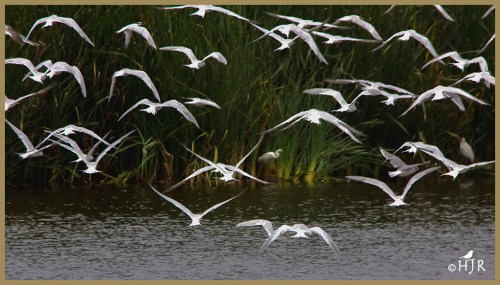
Royal Terns
© HJ Ruiz – Avian101
Share this:

What’s Up? – Trouble in Paradise…
Trouble in Paradise…
Although our weather remains erratic, we are presented with cold mornings that in the afternoon get warm and sunny.
The official first day of spring, At 7:00 am. was 31º F and gradually the temperature increased, the sky was clear, by noon it was already over 50º F. and sunny. I had the great pleasure to see approximately 5 Eastern Bluebirds arrived. They looked around and then one couple (M&F) stayed, the rest just took off. Within minutes they were picking twigs and nest material for the cedar box bird house I installed some years back. These birds were totally into building the nest.


Some time later, I saw a male and female American Robins walking around picking worms from the ground. I shot some pictures of them too! … Then I noticed some commotion going on under the trees. It was the male robin chasing and fighting with the male bluebird. The robin was a better contender but after 2 or 3 minutes of fight and chases. Suddenly, out of the trees the other 3 bluebirds showed up and attacked the robin, the latter, made the smart decision to retreat.


The bluebirds are tough fighters, no doubt. After all the ado there was peace. The couple of bluebirds continued their task to have their nest ready. No more problems after that.
As you can see, there are problems even in paradise!
Short Photo Gallery


Eating Lunch With…
Yellow-Rumped Warbler
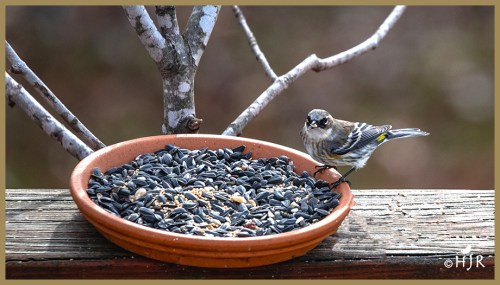
Yellow-Rumped Warbler
© HJ Ruiz – Avian101
Share this:

Photo Capture # 64 – Anhinga
Anhinga
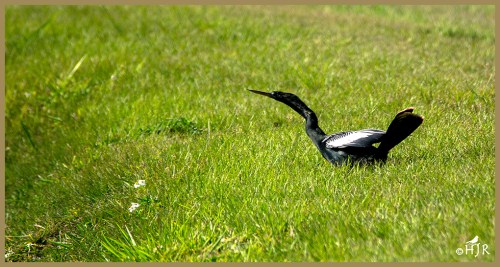
Anhinga
© HJ Ruiz – Avian101
Share this:

Read Past Reviews

Book # 69
Quote from the Author
“A good chuckle is healthy, it helps you break the monotony of a serious life.” ~ H.J. Ruiz


You must be logged in to post a comment.