Bird’s ID – Savannah Sparrow
Savannah Sparrow
The Savannah Sparrow (Passerculus sandwichensis) is a small American sparrow. It was the only member of the genus Passerculus and is typically the only widely accepted member.
The common name comes from Savannah, Georgia, where one of the first specimens of this bird was collected.
This species has a typically sparrow-like dark-streaked brown back, and whitish underparts with brown or blackish breast and flank streaking. It has whitish crown and supercilium stripes, sometimes with some yellow (more often near the beak). The cheeks are brown and the throat white. The flight feathers are blackish-brown with light brown or white border. The eyes are dark. The feet and legs are horn-colored, as is the lower part of the bill, with the upper part being dark grey.
The Savannah sparrow is a very variable species, with numerous subspecies, several of which have been split as separate species at various times. The different forms vary principally in the darkness of the plumage. The variation generally follows Gloger’s rule, with Alaskan and interior races the palest, and southwestern coastal forms the darkest. There are some exceptions, though, most conspicuously in some island populations that presumably were strongly affected by founder effects. The general pattern of variation has a fairly clear divide, southwest of which the birds become notably darker; this agrees quite well with the limit between P. sandwichensis and P. (s.) rostratus. Savannah sparrows show some variation in size across subspecies. The total length can range from 11 to 17 cm (4.3 to 6.7 in), wingspan ranges from 18 to 25 cm (7.1 to 9.8 in) and body mass from 15 to 29 g (0.53 to 1.02 oz). In the nominate subspecies, the body weight averages 20.1 g (0.71 oz).
These birds forage on the ground or in low bushes; particularly in winter they are also found in grazed low-growth grassland. They mainly eat seeds, but also eat insects in the breeding season. They are typically encountered as pairs or family groups in the breeding season, and assemble in flocks for the winter migration. The flight call is a thin seep. Sensu lato, the Savannah sparrow is considered a threatened species by the IUCN
Photo Gallery


© HJ Ruiz – Avian101
Share this:

Photo Capture # 76 – Chilean Pintail
Chilean Pintail

Chilean Pintail
© HJ Ruiz – Avian101
Share this:

What’s Up? – Melange of Things…
Melange of Things…
The Sunday before yesterday, we had another weather alert for a big storm approaching from the West, (it was kind of odd weather alert because at that time, our weather was sunny, bright and almost 80º F) The warning also included that the storm most likely bring possible tornados to our region in Georgia.
When the storm reached our area was in a way more electric and windy but not so much ,rain. The thunder and the flashing of lightening were amazing! Never ending it seemed.
The wind picked up speed and came in strong gusts. One of those gusts of wind made the house shake and we heard noise outside, a patio wrought iron chair had been blown and landed in the lawn. Luckily did not crash against the house. The storm passed over us after a while, but there was no tornado. After a couple of hours, the tornado alert was cleared.
The following day, the temperature dropped considerately in the morning was 40ºF increasing later to sunny and high 70º’s.
–o–
The opossum keeps on being a nuisance, It’s raiding the suet mix I set for my birds every night.
I went to the store and bought a metal case for the suet with a chain, attached to another iron contraption to allow only the birds to eat the suet. I hooked it to an iron stand.
The next day, I got a surprise! The whole contraption was gone! Can you believe that? I looked all over my backyard and couldn’t find it!
Added to that, I also have three squirrels that are eating at least half of all seeds!
Photo Gallery


Eating Lunch With…
Eastern Towhee (M)
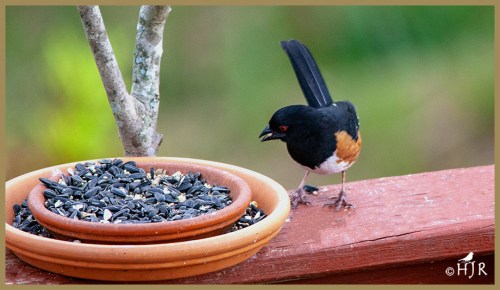
Eastern Towhee (M)
What© HJ Ruiz – Avian101
Share this:

Photo Capture # 75 – Turkey Vultures
Turkey Vultures
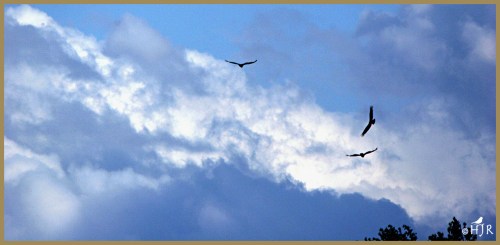
Turkey Vultures
© HJ Ruiz – Avian101
Share this:

Read Past Reviews

Book # 69
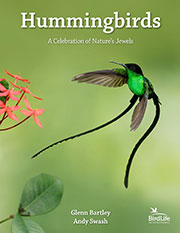
Quote from the Author
“A good chuckle is healthy, it helps you break the monotony of a serious life.” ~ H.J. Ruiz
 H.J. Ruiz - Avian101
You must be logged in to post a comment.