
Bird’s ID – Purple Martin
Purple Martin
The Purple Martin (Progne subis) is the largest North American swallow. They are known for their speed and agility in flight, and when approaching their housing, will dive from the sky at great speeds with their wings tucked.
Purple martins are a kind of swallow, of the genus Progne. Like other members of this genus, they are larger than most of the other swallows. The average length from bill to tail is 20 cm (7.9 in). Adults have a slightly forked tail. Adult males are entirely black with glossy steel blue sheen, the only swallow in North America with such coloration. Adult females are dark on top with some steel blue sheen, and lighter underparts. Subadult females look similar to adult females minus the steel blue sheen and browner on the back. Subadult males look very much like females, but solid black feathers emerge on their chest in a blotchy, random pattern as they molt to their adult plumage.
Purple martins’ breeding range is throughout temperate North America. Their breeding habitat is open areas across eastern North America, and also some locations on the west coast from British Columbia to Mexico. Martins make their nests in cavities, either natural or artificial. In many places, humans put up real or artificial hollow gourds, or houses for martins, especially in the East, where purple martins are almost entirely dependent on such structures. As a result, this subspecies typically breeds in colonies located in proximity to people, even within cities and towns. This makes their distribution patchy, as they are usually absent from areas where no nest sites are provided. Western birds often make use of natural cavities such as old woodpecker holes in trees or saguaro cacti.
Wintering in South America, purple martins migrate to North America in spring to breed. Spring migration is somewhat staggered, with arrivals in southern areas such as Florida and Texas in January, but showing up in the northern United States in April and in Canada as late as May. Males usually arrive at a site before females.
Purple martins are aerial insectivores, meaning that they catch insects from the air. The birds are agile hunters and eat a variety of winged insects. Rarely, they will come to the ground to eat insects. They usually fly relatively high, so, contrary to popular opinion, mosquitoes do not form a large part of their diet. Recent research, however, does indicate that the Purple Martin feeds on invasive fire ants (Solenopsis invicta) and that they may make up a significant portion of their diet.
Photo Gallery


© HJ Ruiz – Avian101
Share this:

Photo Capture # 89 – Dark-eyed Junco
Dark-eyed Junco
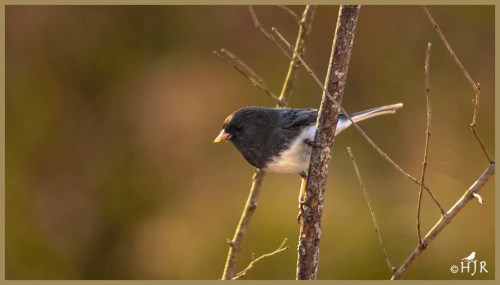
Dark-eyed Junco
© HJ Ruiz – Avian101
Share this:

What’s Up? – A Story to Remember
A Story to Remember
I have the most compelling story to tell you.
On May 16th: I was late afternoon, I was in my kitchen talking with my wife Lucy and I happened to look outside to the backyard and I saw something on the grass. It looked strange, so I decided to investigate…I found a dead young Northern Mockingbird, I checked it, he was cold already, intact, no wounds or any kind of trauma that would indicate violence or attack of any kind. First thing I thought, where are the parents? I looked around, none of the parents was around…Very strange.
On May 17th: At early morning, after I cleaned the area and utensils, I proceeded to refill all feeders and officially open the daily meals for the birds. That’s when I get my camera ready, it’s the moment when all birds find their way to the feeders, for me, is also a good time to get excellent lighting on my photos.
Suddenly I see a mockingbird perched in a branch, it was a young one, similar the bird I picked up from the ground the day before. I said to myself. What?
Photo Gallery
(Please press the first frame on left upper side)


Eating Lunch With…
White-breasted Nuthatch
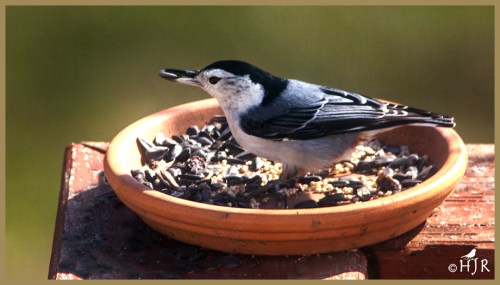
White-breasted Nuthatch
© HJ Ruiz – Avian101
Share this:

Photo Capture # 88 – Field Sparrow
Field Sparrow
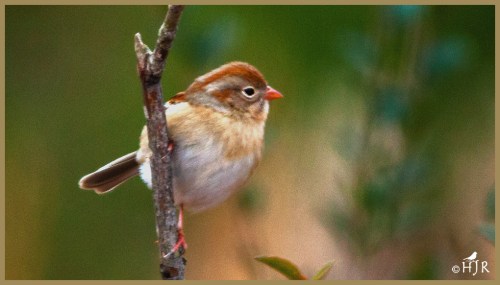
Field Sparrow
© HJ Ruiz – Avian101
Share this:

Read Past Reviews

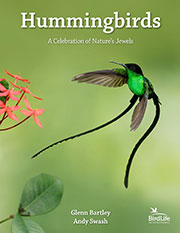
Book # 69
Quote from the Author
“A good chuckle is healthy, it helps you break the monotony of a serious life.” ~ H.J. Ruiz


You must be logged in to post a comment.