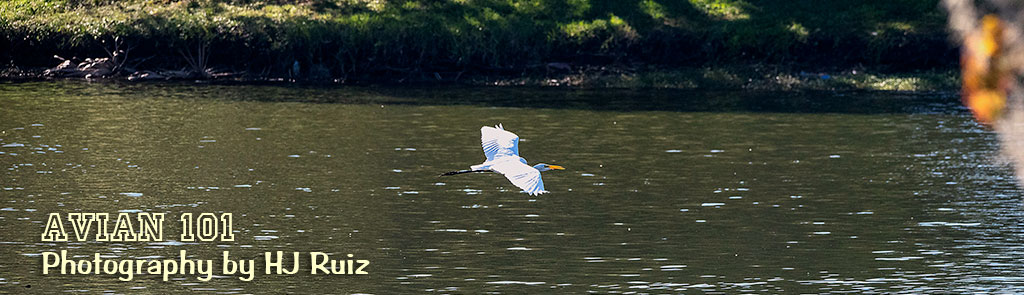
Bird’s ID – American Crow
American Crow
The American Crow (Corvus brachyrhynchos) is a large passerine bird species of the family Corvidae. It is a common bird found throughout much of North America. American crows are the New World counterpart to the carrion crow and the hooded crow. Although the American crow and the hooded crow are very similar in size, structure, and behavior, their calls are different. The American crow, nevertheless, occupies the same role that the hooded crow does in Eurasia.
From beak to tail, an American crow measures 40–50 cm (16–20 in), almost half of which is tail. Mass varies from about 300 to 600 g (11 to 21 oz). Males tend to be larger than females. The most usual call is CaaW!-CaaW!-CaaW!.
The American crow is all black, with iridescent feathers. It looks much like other all-black corvids. They can be distinguished from the common raven (C. corax) because American crows are smaller, from the fish crow (C. ossifragus) because American crows do not hunch and fluff their throat feathers when they call and from the carrion crow (C. corone) by the enunciation of their calls.
The American crow is a large, distinctive bird with iridescent black feathers all over. Its legs, feet, and bill are also black. They measure 40–53 cm (16–21 in) in length, of which the tail makes up about 40%. The wing chord is 24.5 to 33 cm (9.6 to 13.0 in), with the wingspan ranging from 85 to 100 cm (33 to 39 in). The bill length can be from 3 to 5.5 cm (1.2 to 2.2 in), varying strongly according to location. The tarsus is 5.5 to 6.5 cm (2.2 to 2.6 in) and the tail is 13.5 to 19 cm (5.3 to 7.5 in). The body mass can vary from 316 to 620 g (11.1 to 21.9 oz). Males tend to be larger than females.
The American crow is omnivorous. It will feed on invertebrates of all types, carrion, scraps of human food, seeds, eggs and nestlings, stranded fish on the shore and various grains. American crows are active hunters and will prey on mice, frogs, and other small animals. In winter and autumn, the diet of American crows is more dependent on nuts and acorns. Occasionally, they will visit bird feeders. The American crow is one of only a few species of bird that has been observed modifying and using tools to obtain food.
Photo Gallery


© HJ Ruiz – Avian101
Share this:

Photo Capture # 108 – Mourning Dove – Happy 4th of July
Mourning Dove
“I bring you, the latest fashion!”
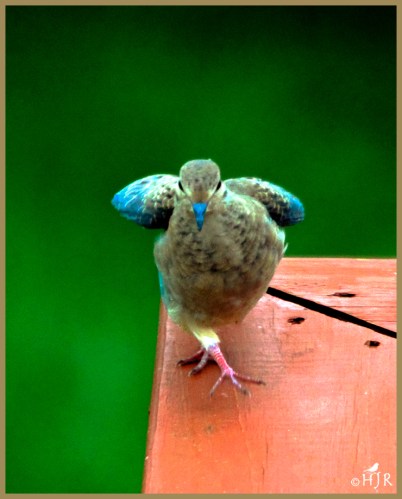
Mourning Dove – “I bring you, the latest fashion!”
“Let’s celebrate, our 4th of July! Our Independence Day!”
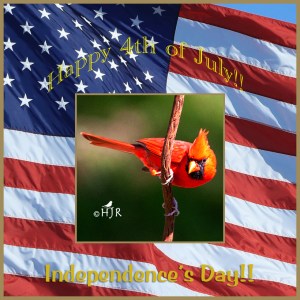
Happy 4th of July
© HJ Ruiz – Avian101
Share this:

Bird’s ID – Mute Swan
Mute Swan
The Mute Swan (Cygnus olor) is a species of swan and a member of the waterfowl family Anatidae. It is native to much of Eurasia, and (as a rare winter visitor) the far north of Africa. It is an introduced species in North America, Australasia, and southern Africa. The name ‘mute’ derives from it being less vocal than other swan species. Measuring 125 to 170 cm (49 to 67 in) in length, this large swan is wholly white in plumage with an orange beak bordered with black. It is recognizable by its pronounced knob atop the beak, which is larger in males.
Adults of this large swan typically range from 140 to 160 cm (55 to 63 in) long, although can range in extreme cases from 125 to 170 cm (49 to 67 in), with a 200 to 240 cm (79 to 94 in) wingspan. Males are larger than females and have a larger knob on their bill. On average, this is the second largest waterfowl species after the trumpeter swan, although male mute swans can easily match or even exceed a male trumpeter in mass. Among standard measurements of the mute swan, the wing chord measures 53–62.3 cm (20.9–24.5 in), the tarsus is 10–11.8 cm (3.9–4.6 in) and the bill is 6.9–9 cm (2.7–3.5 in).
Mute swans nest on large mounds that they build with waterside vegetation in shallow water on islands in the middle or at the very edge of a lake. They are monogamous and often reuse the same nest each year, restoring or rebuilding it as needed. Male and female swans share the care of the nest, and once the cygnets are fledged it is not uncommon to see whole families looking for food. They feed on a wide range of vegetation, both submerged aquatic plants which they reach with their long necks, and by grazing on land. The food commonly includes agricultural crop plants such as oilseed rape and wheat, and feeding flocks in the winter may cause significant crop damage, often as much through trampling with their large webbed feet, as through direct consumption.
Photo Gallery


© HJ Ruiz – Avian101
Share this:

Photo Capture # 107 – Palm Warbler
Palm Warbler
“The shade is much cooler!”
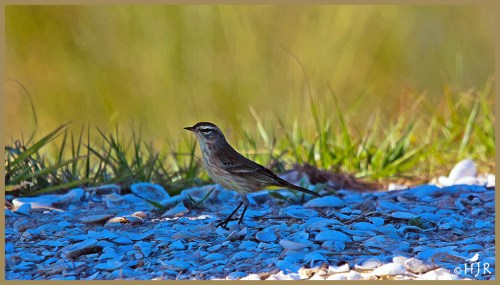
Palm Warbler – “The shade is much cooler!”
© HJ Ruiz – Avian101
Share this:

Read Past Reviews

Book # 69
Quote from the Author
“A good chuckle is healthy, it helps you break the monotony of a serious life.” ~ H.J. Ruiz


You must be logged in to post a comment.