What’s Up? – Heatwave, Juveniles
Heatwave, Juveniles…
Very soon we’ll be hit by a heatwave going through the country, from the West to East Coast. Our forecast calls for that and additional will be summer showers, I just imagine it will be charged with humidity. Yuck!
Next, I’m making some comments about what has been happening with birds in my backyard.
- I’ve seen many Common Grackles lately. Males, females and their broods. I had the opportunity to photograph a father and juvenile sharing their meals.
-
- I also photographed a mother Brown-headed Cowbird feeding her juvenile.
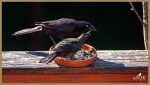


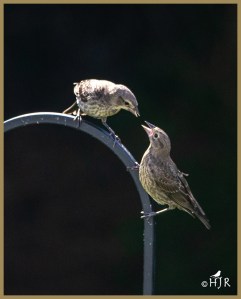
Photo Gallery
-
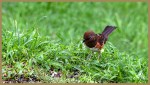
- Eastern Towhee (F) looking for worms or insects.
-
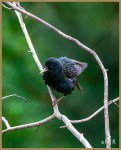
- Immature E. Starling
-
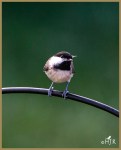
- Carolina Chickadee taking a short rest from work.
-
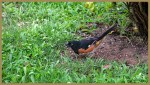
- E. Towhee (M) also looking for a delicious meal.
-
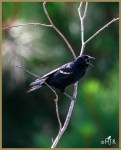
- Red-winged Blackbird giving the most expected call: Chow Time!
© HJ Ruiz – Avian101
Share this:

Photo Capture # 106 – House Finches
House Finches
” Remembering Father’s Day”

House Finches – “Remembering Father’s Day”
© HJ Ruiz – Avian101
Share this:

Red Gallery – Northern Cardinal
Quoting my Friend’s Comments…
“I wish we had them over here in England! “ ~ John Knifton
Photo Gallery

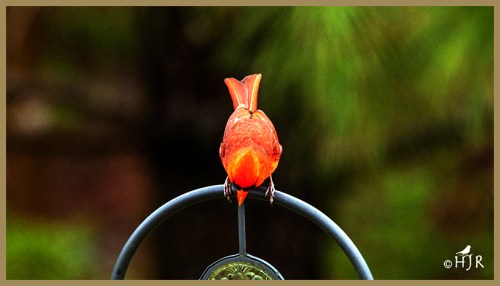
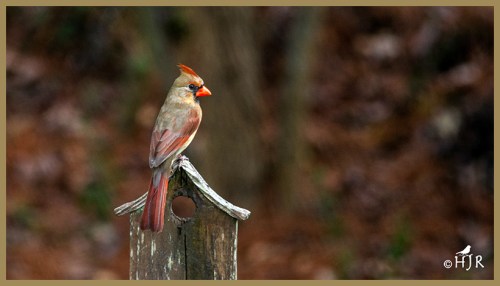
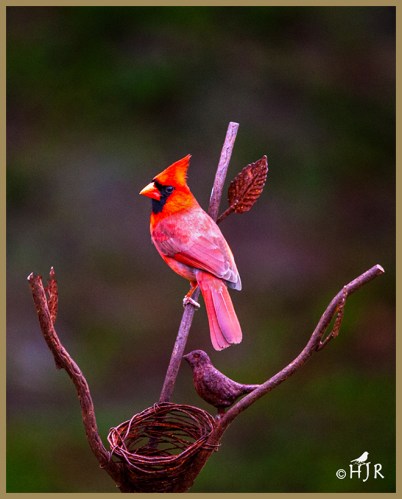
© HJ Ruiz – Avian101
Share this:

Bird’s ID – West Peruvian Dove
West Peruvian Dove
The West Peruvian Dove (Zenaida meloda) was first described in 1843 by the Swiss naturalist Johann Jakob Baron von Tschudi. It is closely related to the North American White-winged Dove (Zenaida asiatica) but is now considered a separate species by ornithologists due to genetic and behavioral differences. Specimens are brownish-gray above and gray below, with a bold white wing patch that appears as a brilliant white crescent in flight and is also visible at rest. Adults have a bright blue (almost indigo), a featherless patch of skin around each eye. The legs and feet of adults are red, but unlike Z. asiatica, their eyes are brown. Both sexes are similar, but juveniles have a lighter color than adults, they do not have blue eye rings, and their legs and feet are brownish-pink.
Its native range extends along the Pacific coastal plains from southern Ecuador to northern Chile. Contrary to unscientific internet sources, the species is not found in San Andrés. This species has a large range, with an estimated global Extent of Occurrence of 187,000 km. Its global population has not been calculated but is believed to be large as the species is described as ‘common’ in at least parts of its range. This dove’s cooing calls have earned it the name Cuculí in Peru, from the dove’s syncopated cooing, transcribed as coo-coo-LEE
Photo Gallery


© HJ Ruiz – Avian101
Share this:

Read Past Reviews

Book # 69
Quote from the Author
“A good chuckle is healthy, it helps you break the monotony of a serious life.” ~ H.J. Ruiz


You must be logged in to post a comment.