What’s Up? – Growing generation and Welcome Back
Growing generation and welcome back…
This week I will not talk about weather. I’ll describe instead what goes on in my backyard most of these days. As I explained last week, great part of the birds nesting in my backyard are under the process of molting, which is not the most appropriated part of their lives when they look at their worst; molting requires birds to shed their plumage and be replaced (grow) by new one. This process takes away a lot of their energy and makes them more vulnerable to other factors.
Let’s start by presenting some of the new generation, going through the growing their new plumage (growing, not molting)
-
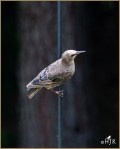
- E. Starling getting adult plumage, piece by piece.
-

- See the new adult patches of feathers.
-
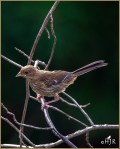
- E. Towhee, its adult plumage pattern starting to show.
-

- Notice its eyes irises are not red, yet.
-
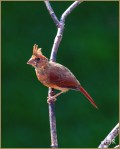
- N. Cardinal (F) colors patterns are showing.
-
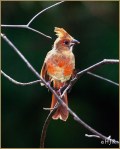
- Notice the beak color still dark.
- Ruby-throated Hummingbird.
Every year they return to make me happy and amuse me.
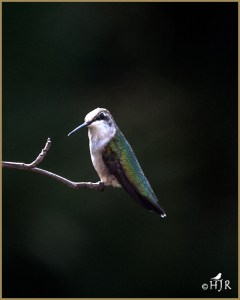
Ruby-throated Hummingbird
- Blue Gray Gnatcatcher.
One has been showing up for the past five years, he is hanging out with a bunch of Carolina Chickadees. I counted 5 of them on Friday. He’s also friends with a Brown-headed Nuthatch. As you can see they get along very well.
-
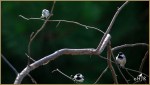
- Blue Gray Gnatcatcher with two C.Chickadees
-
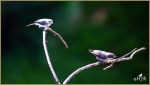
- Blue Gray Gnatcatcher with Brown-headed Nuthatch this time.
-
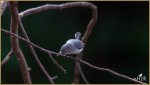
- Blue Gray Gnatcatch
© HJ Ruiz – Avian101
Share this:

Photo Capture # 118 – Purple Martins
Purple Martins
“We have to stop meeting like this.”
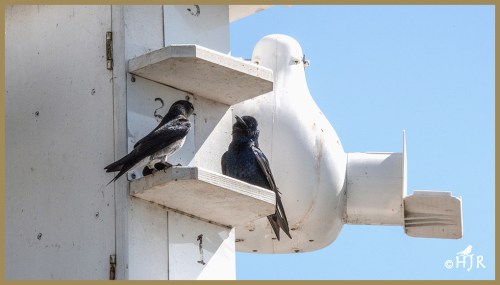
Purple martins – “We have to stop meeting like this”
© HJ Ruiz – Avian101
Share this:

Red Gallery – Northern Cardinal
Northern Cardinal
Photo Gallery


© HJ Ruiz – Avian101
Share this:

Bird’s ID – Amazilia Hummingbird
Amazilia Hummingbird
The Amazilia Hummingbird (Amazilia amazilia) is a species of hummingbird, a family of small near passerine birds. The Loja hummingbird (A. alticola), with less rufous to the underparts, is sometimes considered a subspecies of the amazilia hummingbird.
The amazilia hummingbird occurs in western Peru and south-western Ecuador. It is generally common, and can regularly be seen even in major cities such as Lima and Guayaquil. It prefers dry, open or semi-open habitats, but also occurs in forest. In its range it is easily recognized by the combination of a black-tipped red bill and mainly rufous underparts. It is a territorial species.
Its diet consists of small insects and nectar of flowering Erythrina, Psittacanthus, and other flower corollas of medium length. It can spend roughly 80% of its time resting, using the rest of its time to forage, hunt, and defend its territory (often against Coereba flaveola). It breeds year round with cup like nests only ~3cm above the ground.
There is currently academic discussion on if Amazilia alticola should be labeled as a separate species or a subspecies of Amazilia amazilia..
Photo Gallery


© HJ Ruiz – Avian101
Share this:

Read Past Reviews

Book # 69
Quote from the Author
“A good chuckle is healthy, it helps you break the monotony of a serious life.” ~ H.J. Ruiz
 H.J. Ruiz - Avian101
You must be logged in to post a comment.