Photo Capture # 117 – Tricolored Heron
Tricolored Heron
“You call this… a fish?”
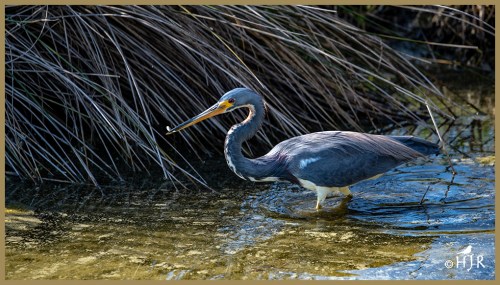
Tricolored Heron – “You call this…a fish?”
© HJ Ruiz – Avian101
Share this:

Bird’s ID – Vermillion Flycatcher
Vermillion Flycatcher
The Vermilion Flycatcher (Pyrocephalus obscurus) is a small passerine bird in the Tyrannidae, or tyrant flycatcher family. Most flycatchers are rather drab, but the vermilion flycatcher is a striking exception. It is a favorite with birders, but is not generally kept in aviculture, as the males tend to lose their vermilion coloration when in captivity.
The vermilion flycatcher is a small bird, measuring 13–14 cm (5.1–5.5 in) in length, with a mass between 11 and 14 g (0.39 and 0.49 oz). It is strongly dimorphic; males are bright red, with dark brown plumage. Females have a peach-colored belly with a dark gray upperside.
Vermilion flycatchers generally prefer somewhat open areas, and are found in trees or shrubs in savannah, scrub, agricultural areas, riparian woodlands, and desert as well, but usually near water. Their range includes almost all of Mexico; it extends north into the southwestern United States, and south to scattered portions of Central America, parts of northwestern and central South America. It has ranged as far north as Canada.
The flycatchers feed mostly on insects such as flies, grasshoppers and beetles. These are usually taken in mid-air, after a short sally flight from a perch. It is an opportunistic feeder, and has been observed eating small fish.Bees may also be taken as forage. Non-digestible insect parts are regurgitated as pellets.
Photo Gallery


© HJ Ruiz – Avian101
Share this:

Photo Capture # 116 – Mourning Doves
Mourning Doves
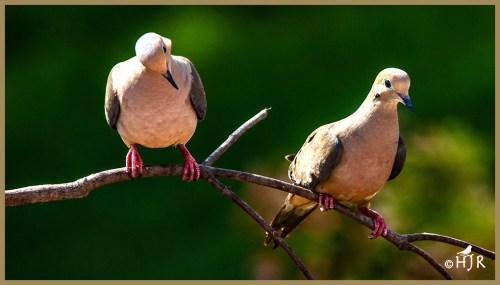
Mourning Doves
© HJ Ruiz – Avian101
Share this:

What’s Up? – Hot with Possibility of…
Hot, with Possibility of…
Other than mere summer storms with half hour downpours every two days we have had the entire past week with temperatures over 90º F. I’m sure that many of you have been in the same situation.
My birds always manage to come to the feeders and get their meals. And, return back to the shade and shelter in the trees.
Many of them are in the process of molting their feathers and get new ones. I’ve seen a Ruby-throated Hummingbird drinking some nectar, but I haven’t gotten a photograph of it yet.
Photo Gallery


© HJ Ruiz – Avian101
Share this:

Read Past Reviews

Book # 69
Quote from the Author
“A good chuckle is healthy, it helps you break the monotony of a serious life.” ~ H.J. Ruiz


You must be logged in to post a comment.