
Photography of Birds – Set # 77
Set # 77
American Flamingo

American Flamingo
Courtship is most often seen among individuals that change partners often or are promiscuous. A spectrum of pairing relationships is seen. Some birds have a long-term partner throughout the year; others form pairs during periods of courtship and nest attendance. How long a relationship lasts is affected by many factors, including addition and removal of adults, maturation of juveniles, and occurrence of trios and quartets. In most pairs, both individuals usually construct and defend the nest site. In rare cases, one individual undertakes both duties. Within trios, the dominant pair begins the nesting process by choosing and then defending the site.
Chilean Flamingo

Chilean Flamingo
Males and females co-operate in building a pillar-shaped mud nest, and both incubate the egg laid by the female. Both parents also take turns incubating the egg. Upon hatching, the chicks have gray plumage; they do not gain the typical pink adult coloration for 2-3 years. Both male and female flamingos can produce a nutritious milk-like substance in their crop gland to feed their young.
© HJ Ruiz – Avian101
Share this:

Red Gallery – Northern Cardinal

Photo Gallery


Red
Share this:

Photography of Birds – Set # 76
Set # 76
Carolina Wren
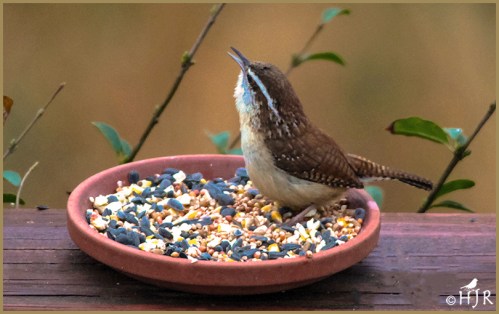
Carolina Wren
Carolina Wrens spend the majority of their time on or near the ground searching for food, or in tangles of vegetation and vines. They also probe bark crevices on lower tree levels, or pick up leaf-litter in order to search for prey. Their diet consists of invertebrates, such as beetles, true bugs, grasshoppers, katydids, spiders, ants, bees, and wasps. Small lizards and tree frogs also make up the carnivorous portion of their diet. Vegetable matter, such as fruit pulp and various seeds, makes up a small percentage of their diet. In the northern portion of their range, they frequent bird feeders.
House Wren
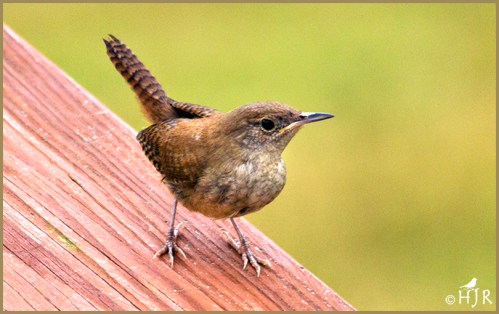
House Wren
They are known to occasionally destroy the eggs of other birds nesting in their territory by puncturing the eggshell. Females that sang more songs to conspecifics that were simulated by playback lost fewer eggs to ovicide by other wrens. Female bird song in this species is therefore thought to have a function in competition and is not only displayed by males. They are also known to fill up other birds’ nests within its territory with sticks to make them unusable.
© HJ Ruiz – Avian101
Share this:

Photography of Birds – Set # 75
Set # 75
American Goldfinch (F)

American Goldfinch (F)
American Goldfinch (M)

American Goldfinch (M)
Once a male has found a mate, he selects a territory, marking the boundaries by warbling as he flies from perch to perch. After circling the perimeter, he performs two flight displays, first repeating a low, flat flight, then flying in an exaggerated version of normal flight, tucking his wings close to his body, plummeting earthwards and catching himself as he spreads his wings to glide upward in a series of loops. Two or three pairs may group their territories together in a loose colony, perhaps to aid in defense against predators.
© HJ Ruiz – Avian101
Share this:

Read Past Reviews

Book # 69
Quote from the Author
“A good chuckle is healthy, it helps you break the monotony of a serious life.” ~ H.J. Ruiz


You must be logged in to post a comment.