
Scientific Classification – Example: Song Sparrow
The Song Sparrow (Melospiza melodia) is a medium-sized American sparrow. Among the native sparrows in North America, it is easily one of the most abundant, variable and adaptable species.This bird will be our subject for this explanation about Scientific Classification.
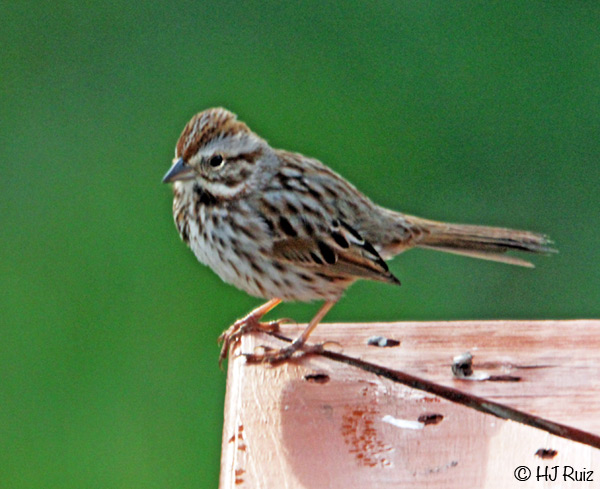 Song Sparrow |
| Scientific classification | |
| Kingdom: | 1- Animalia |
| Phylum: | 2- Chordata |
| Class: | 3- Aves |
| Order: | 4- Passeriformes |
| Family: | 5- Emberizidae |
| Genus: | 6- Melospiza |
| Species: | M. melodia |
Each one of the classifications is explained in more detail below
1- Animals are a major group of multicellular, eukaryotic organisms of the kingdom Animalia or Metazoa. Their body plan eventually becomes fixed as they develop, although some undergo a process of metamorphosis later on in their life. Most animals are motile, meaning they can move spontaneously and independently. All animals are also heterotrophs, meaning they must ingest other organisms or their products for sustenance.
2- The Chordates are animals that comprise the phylum Chordata. Taxonomically the phylum Chordata includes three subphyla: Tunicata; Cephalochordata, comprising the lancelets; and the Craniata, or Vertebrata. The common attributes of the Chordata include having, for at least some period of their life cycles, a notochord, a hollow dorsal nerve cord, pharyngeal slits, an endostyle, and a post-anal tail. The phylum Hemichordata has been presented as a fourth chordate subphylum, but it now is usually treated as a separate phylum.
3- Birds (class Aves) are feathered, winged, bipedal, endothermic (warm-blooded), egg-laying, vertebrate animals. With around 10,000 living species, they are the most speciose class of tetrapod vertebrates. All present species belong to the subclass Neornithes, and inhabit ecosystems across the globe, from the Arctic to the Antarctic. Extant birds range in size from the 5 cm (2 in) Bee Hummingbird to the 2.75 m (9 ft) Ostrich. The fossil record indicates that birds emerged within theropod dinosaurs during the Jurassic period, around 160 million years (Ma) ago. Paleontologists regard birds as the only clade of dinosaurs to have survived the Cretaceous–Paleogene extinction event 65.5 Ma ago.
4- A passerine is a bird of the order Passeriformes, which includes more than half of all bird species. Sometimes known as perching birds or, less accurately, as songbirds, the passerines form one of the most diverse terrestrial vertebrate orders: with over 5,000 identified species, it has roughly twice as many species as the largest of the mammal orders, the Rodentia. It contains over 110 families, the second most of any order of vertebrates (after the Perciformes).
The names “passerines” and “Passeriformes” are derived from Passer domesticus, the scientific name of the eponymous species—the House Sparrow—and ultimately from the Latin term passer for Passer sparrows and similar small birds.
5- The Emberizidae are a large family of passerine birds. They are seed-eating birds with a distinctively shaped bill.
In Europe, most species are called buntings. In North America, most of the species in this family are known as (American) sparrows, but these birds are not closely related to the (Old World) sparrows, the family Passeridae. The family also includes the North American birds known as juncos and towhees.
The Emberizidae family probably originated in South America and spread first into North America before crossing into eastern Asia and continuing to move west. This explains the comparative paucity of emberizid species in Europe and Africa when compared to the Americas.
As with several other passerine families the taxonomic treatment of this family’s members is currently in a state of flux. Many genera in South and Central America are in fact more closely related to several different tanager clades, and at least one tanager genus (Chlorospingus) may belong here in the Emberizidae.
6- Melospiza is a genus of passerine birds in family Emberizidae. The genus, commonly referred to as “song sparrows,” contains currently three species, all of which are native to North America.
Members of Melospiza are medium-sized sparrows with long tails, which are pumped in flight and held moderately high on perching. They are not seen in flocks, but as a few individuals or solitary. They prefer brushy habitats, often near water.
I sure hope that some of this information will clarify some of the questions that you might have wondered when you read about birds.


 H.J. Ruiz - Avian101
You should write a book (if you haven’t already!)
No thank you! I’m ok like this! 🙂
Wow, this is great info. I agree your post are book worthy!!
Thanks for your comment! 🙂
I really struggle with scientific classification but an applied example really helps 🙂
Thank you! I’m glad that my post helped you! 🙂
YOUR COMMENTS ARE INTERESTINGIT HELPED ME A LOT!!!XOXO
Thank you for your comment and visit! 🙂
THANK YOU SO MUCH for this! I’m in high school and I have a project due soon about Linnaeus’s classification of living things and this helped soooooooooo much! It’s perfect!!! 😀
You’re most welcome Cherith, I just hope that you get a good mark! 🙂
One of my all time favorites! I love hearing their song anytime of the day but at sunset it is spectacular.
Thank you for sharing Julie! 🙂
Such a happy little singer!
Thank you Cindy! 🙂
great info I want to do some birdwatching as the weather gets better… your blog always inspires me to do that whenever I am here 🙂
Thank you Neha, I liked it to know that! 🙂
Interesting, thank you.
Thanks Cynthia! 🙂