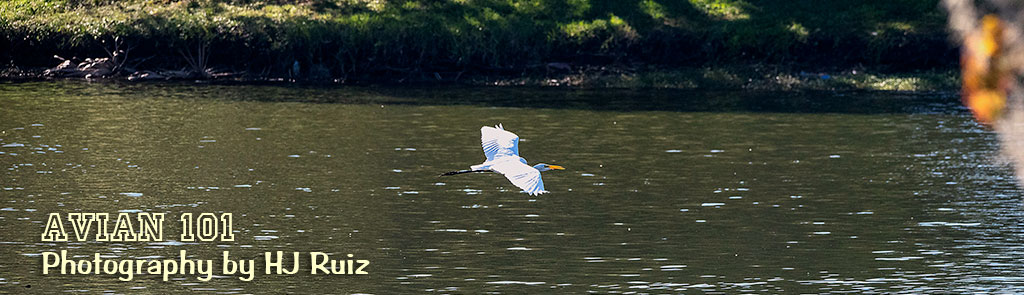
Common Grackle
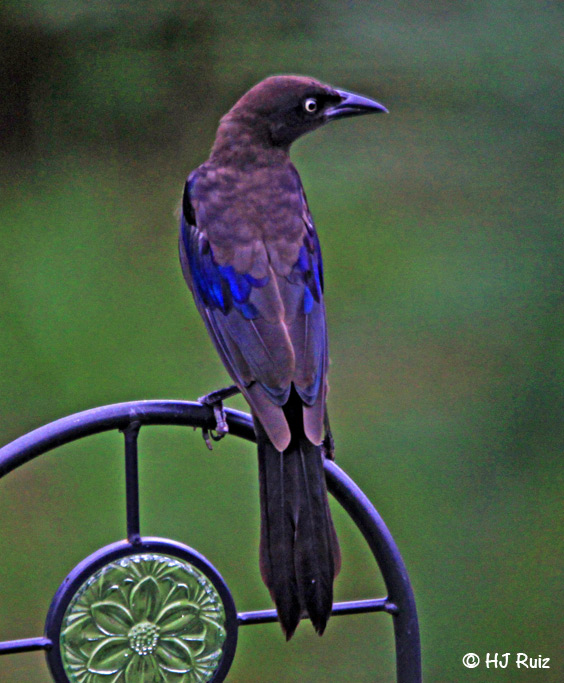
Common grackles are less sexually dimorphic than larger grackle species but the differences between the sexes can still be noticeable. The male is larger than the female,. When adult has a long dark bill, pale yellowish eyes and a long tail; its feathers appear black with purple, green or blue iridescence on the head, and primarily bronze shine in the body plumage. The adult female, beyond being smaller, is usually less iridescent; her tail in particular is shorter. The juvenile is brown with dark brown eyes.
They fly in large flocks when returning from their southern migration and spread almost everywhere in the Country. They make their nest high in trees especially pines.
These grackles are omnivores and feed in almost everything, they forage in urban areas too, from garbage bins to discarded food in parks.
They also practice “anting” which is rubbing ants on their body feathers to use it as repellent for mites or other bird’s parasites.
My backyard gets visited by these “vandals” once in a while, they raid the feeders and cause a ruckus knocking feeders and seeds all over, chasing other birds out and after a while, once the food is gone they leave their mess!
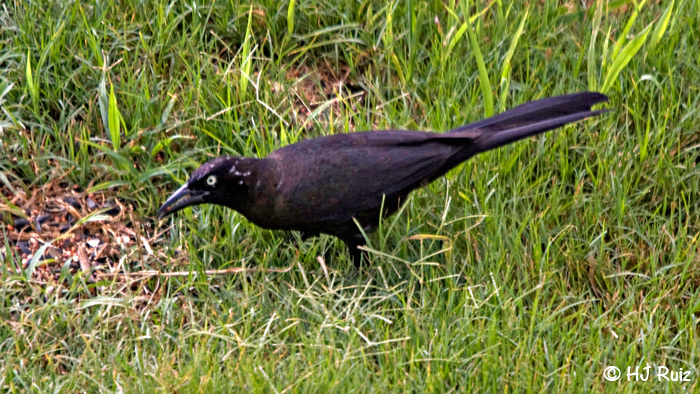
Common Grackle (M)
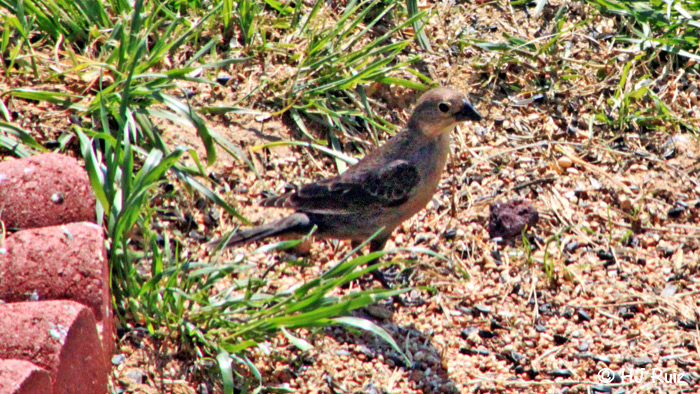
Common Grackle (F)
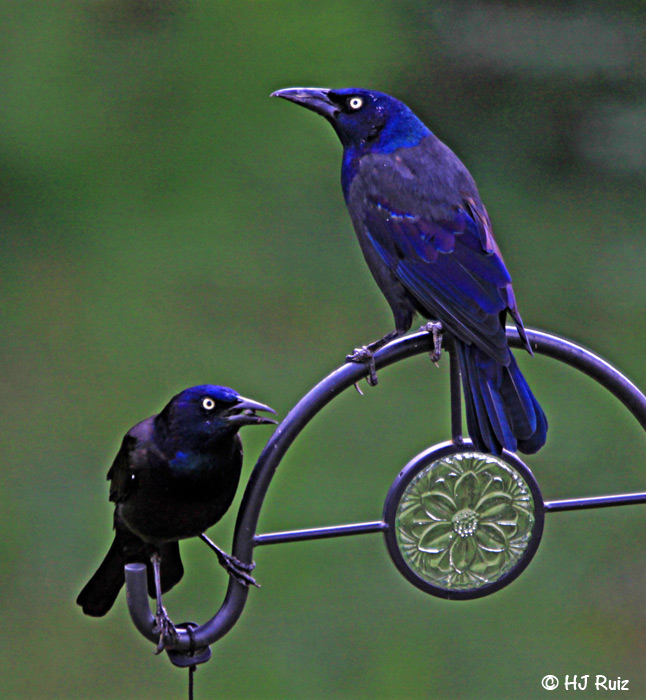
Common Grackle (M)
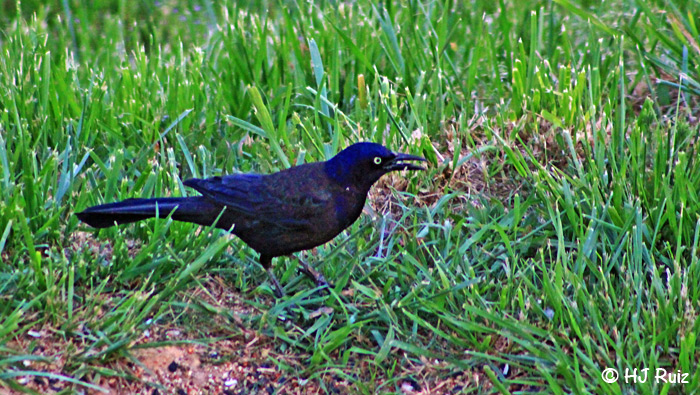
Common Grackle (M)
Common Grackle (M)
Click on images to see enlargements
Text and photographs © H.J. Ruiz – Avian 101


 H.J. Ruiz - Avian101
These birds have amazing color! Nice picture-taking 🙂
Thank you very much Ava! 🙂
Wonderful pictures!
Thanks Julie, you’re very kind! 🙂
And you are very good!
What a beautiful bird! Great photos..
Thank you very much! 🙂
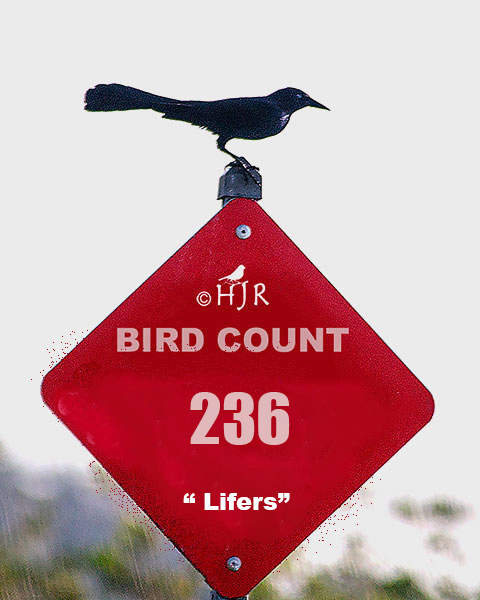
The last one is my fav! He’s positively posing for you.
All birds pose for me! 🙂
…or is that the female? I should know this.
I’m sorry the female is #2 from top! Thanks for the visit and comments. 🙂
I thought pretty interesting about the ‘anting’. I love learning about birds from you H.J. :O) These are great photos. I’ve never seen them in my neck of the woods.
Thank you for your nice comment BD! 🙂
I’ve been able to get rid of the grackles at my feeders. First, in summer when they migrate back to my area, I fill the feeders with 100% safflower. Blackbirds do not like it but all my favorite birds like chickadees and cardinals still enjoy it. Most of the time it causes the grackles to look elsewhere for food. Second, I got a different kind of feeder that has two features they don’t like: a “roof” with a bit of an overhang that makes it difficult for them to perch on the hopper feeder and the perches can be set so heavier birds make the hopper close when they land so they cannot feed. Given seeds they don’t like and a feeder that makes it difficult for them to land, perch and feed….they can still take advantage of the bird bath. They mostly leave my place alone now.
Thanks for the nice pictures, though!
I’m not discouraging any birds from feeding because I wish to observe all species. Grackles, Red-winged Blackbirds, Cowbirds, Blue Jays they all are a mixed group. They come once in a while but they don’t hang out just pass by. In your case you are more dedicated to Bluebirds, that’s a different story. thanks for your input Annie! 🙂
I do enjoy your non discriminating, all inclusive philosophy
Thanks Christine! 🙂
I had never heard of ‘anting’, pretty cool the way nature works. That last photo is fantastic, what a perfect pose he did for you! 🙂
I love that picture! I was lucky I guess! 🙂
Common grackles are birds that I also get confused with other birds like ravens and crows.
It’s all in the eyes! 🙂
Great photos but I really question #2. Doesn’t look like a Common Grackle, either male or female, but I can’t say what it might be!
You’re right! I haven’t noticed until now. It was filed as one female common grackle in my files. I’ll have to rectify that asap. thank you very much!:)