New generation
This week has been very gratifying to me by the fact that I’ve seen a great deal of new generation of birds. Most of them have left the nest and already are able to fly but still lack the skills that adults develop with more age.
Amongst the species are some that are the new generation of Northern Cardinals that are local, from nests within my back yard or next to.
We have a bunch of Cardinals all year round and we know that are nesting on the Southern Pines near us. They are like as if were our kids.
If you take a look at the two photographs inserted to this blog, note the color of the beak on the female and the male is starting to change to the color of maturity, That goes for the male youngster showing bright red patches or new feathers. The female will also get some of the red. Later they both will boast a dark mask very peculiar. I’m glad that they made it into a normal life and I wish they stay with us for many generations.
-

- Northern Cardinal (Male, young)

-

- Northern Cardinal (Female, young)

-

- Northern Cardinal (Male, adult)

-

- Northern cardinal (Female, adult)

Share this:

Responsibility and Parasitism
In my sporadic observations to birds visiting my backyard I have encounter several instances of variety of behavior for the different species, some of these were just confirmations of known habitual actions. But once in a while I find and document certain behavior that hints a contradiction of a general concept.
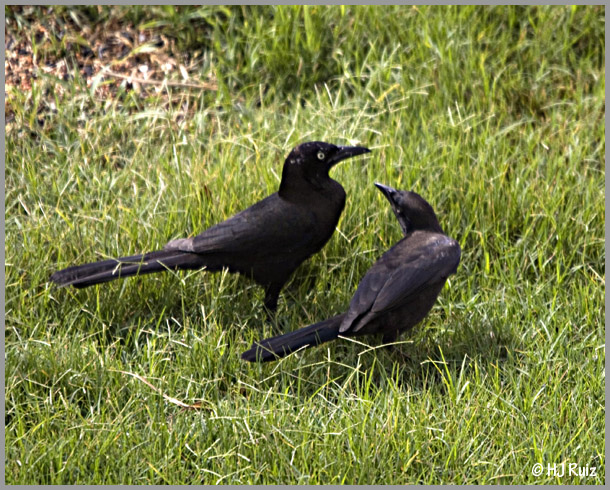
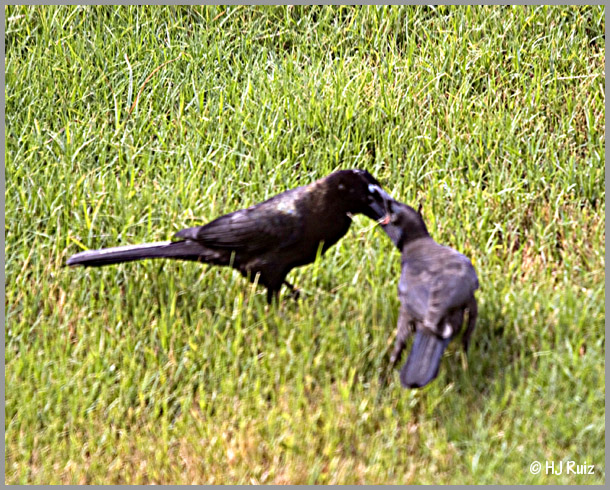
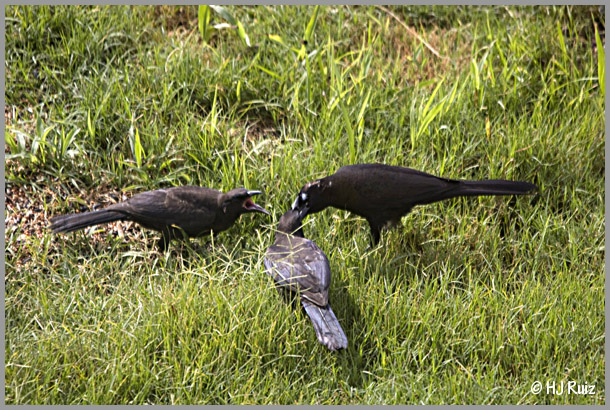
I have families of Common Grackles visiting my feeders and I have seen male and female grackles mouth feeding their little ones (Regurgitating pre-digested food).
My impression was that all classified Blackbird species were Parasitic. What I inferred from seeing grackles feeding their brood makes them birds that had nested and are being responsible for their own families. Doing some research I found that in fact this specie doesn’t frequently accepts Parasitism. Please read the abstract quoted below.
-
- Common Grackle, adult and young
-
- Common Grackle feeding the young
-
- Common Grackle, adult and young ones.
EXPLANATIONS FOR THE INFREQUENT COWBIRD PARASITISM ON COMMON GRACKLE
By Brian D. Peer and Eric K. Bollinger
Department of Zoology Eastern Illinois University, Charleston, IL
Abstract:
We determined the factors responsible for the lack of parasitism on Common Grackles (Quiscalus quiscula) by Brown-headed Cowbirds (Molothrus ater). We found no evidence of parasitism on the 401 grackle nests we monitored in east-central Illinois. By the time cowbirds began laying eggs, 88.5% of all grackle nests were beyond the point of successful parasitism. Grackles rejected cowbird eggs more frequently during the prelaying stage of the nesting cycle (38.2%) compared to later stages (12.3%). Thirty-three cowbird eggs and nestlings were cross-fostered into grackle nests. Data were collected on 15 cowbird nestlings, of which three fledged. The cross-fostered cowbird eggs that did not hatch appeared to have been incubated ineffectively. These eggs were in clutches that contained four to six eggs, whereas the cowbird eggs that hatched were in clutches of three eggs or less. Grackles also responded more aggressively toward female cowbird models than to Fox Sparrow (Passerella iliaca) models in five of seven response categories. Cowbirds avoid parasitizing grackles even though the opportunity existed. Nest abandonment and infestation of grackle nests with ectoparasitic mites may decrease the suitability of grackles as hosts; however the primary reason for the infrequent cowbird parasitism on grackles appears to be past rejection behavior. Grackles likely rejected cowbird eggs at a higher frequency in the past and as a consequence grackles were avoided by cowbirds. Rejection apparently decreased in the absence of parasitism due to the high degree of intraclutch egg variability exhibited by grackles which would increase the chances of them mistakenly rejecting their own discordant eggs.
Share this:

“The Young Ones”
As I was saying yesterday, I miss some of the birds that used to hang out in my backyard. Then on the other hand I’m getting a bunch of birds of the new generation, mostly young and inexperienced, fighting for the seeds at the feeders.
They can hardly hang on the perch but they are very feisty when it comes to food. Their plumagel look funny, with their feathers not fully developed, colors not defined yet and fuzzy down feathers flying all over. These bunch are what I call “The young ones”. (See photo samples)
-

- Purple Finch (Male, young)

-

- Chipping Sparrow (Male, young)

-

- Northern Cardinal (Female, young)

-

- Brown-headed Cowbird (Female, young)

So the cycle continues and life goes on. It’s remarkable to see a living specie go through a life span in such a short period of time. I’m getting more fascinated by the day about the whole birding thing. Observing birds makes me think more about humans and their lives.
Life per se it’s all about order of things and setting priorities. That’s the key that we should get our young ones to understand.
Share this:

That’s life!
Believe it or not I feel that I miss some of the birds that I saw many times in my backyard or feeders, such as the Blue Grosbeak (See insert photo). Or the couple of Carolina Chickadee that had their nest on one of the bird houses that we have. They are gone, the whole family, parents and kids. Same happened to the couple of Northern Mockingbird that lost a chick prey to an American Crow. They’re gone too.

Blue Grosbeak (Male)
……………………
If I make a comparison with humans it is exactly the same situation. Our children grow under our care until they go to College or get married and then they go their own way. I know, I know, That’s life! But don’t you miss those precious moments you spent with your small children?
I think that this feeling was prompted not only because the birds alone but because I was talking to my next door neighbor that have four beautiful children being the oldest merely eight years old. I was holding the baby only eight months old. You get the picture! 🙂
Oh wel… As I mentioned before, that’s life!
Have a great day all of you young parents!
Share this:


Read Past Reviews

Book # 69

Quote from the Author
“A good chuckle is healthy, it helps you break the monotony of a serious life.” ~ H.J. Ruiz


You must be logged in to post a comment.