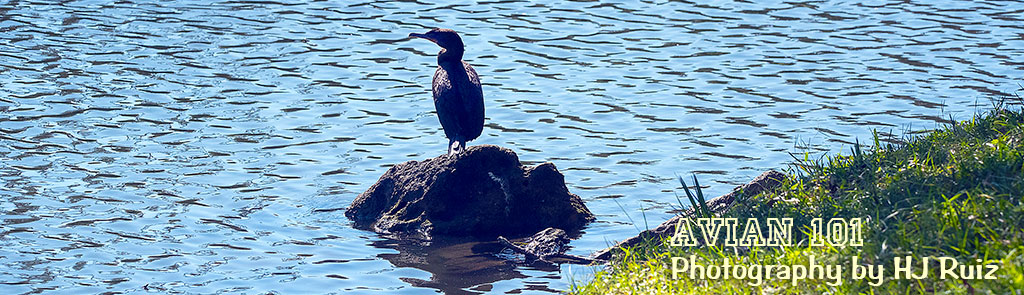
Eared Dove (Tortola Orejuda)
Eared Dove – Spec. Name: Zenaida Auriculata
This a New World tropical dove. It is a resident breeder throughout South America from Colombia to southern Argentina and Chile, and on the offshore islands from the Grenadines southwards. It may be a relatively recent colonist of Tobago and Trinidad. It appears to be partially migratory, but details are little known, although migration may be driven by food supplies.
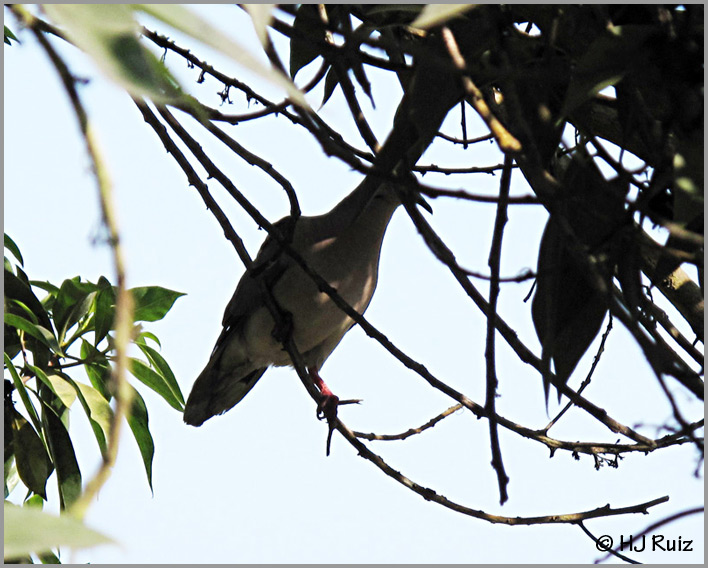
Eared Dove (Tortola Orejuda)
It is a close relative of the North American Mourning Dove. With that species, the Socorro Dove, and possibly the Galápagos Dove it forms a superspecies. The latter two are insular offshoots, the Socorro birds from ancestral Mourning Doves, the Galápagos ones from more ancient stock.
The Eared Dove is 8 inches long with a long wedge-shaped tail, and weighs normally about 112 g. Adult males have mainly olive-brown upperpart plumage, with black spots on the wings. The head has a grey crown, black line behind the eye, and the blue-black on the lower ear coverts. These black markings give the species its English and specific name. The underparts are vinous, and the tail is tipped with cinnamon. The bill is black and the legs dark red.
The female is duller than the male, and immatures are greyish-brown, very dull, with pale barring. The species’ call is a deep soft oo-ah-oo.
These particular photographs where taken in Peru, South America.

Share this:

Lost in a Black Hole
Today I feel like rambling about things:
Being in contact with Nature, traveling to different places, admiring G_d’s creation has been an important part in my life. Art & Photography gave me the opportunity to record many of those moments. I wish I could have kept all the pictures I shot through the years since I got my first camera!
Like many things that mysteriously vanish from our possession, photographs also fall into that unforgiving black hole of lost stuff.
How many times have you asked yourself for example: What happened to my Meccano Set that I had when I was a kid? Where did it go?
Unfortunately nobody can give you a concrete answer to those kind of questions.
One thing I know, I think I remember every photo I’ve taken, the images are engraved in my mind. I treasure my experiences and preserve intact all the good ones. Memories are the only things that we really possess, all the rest goes right into that bottomless black hole I was talking about.
When I have a camera in my hands I set my mind in the scanning mode and shoot all different subjects that click as potentially good shots. I’d like to share some of them with you also. Thank you for your patience.
-
- Swallow-Tailed Tiger

-
- Black Swallowtail

Share this:

Common Raven
Common Raven – Spec. Name: Corvus Corax
Not just large but massive, with a thick neck, shaggy throat feathers, and a Bowie knife of a beak. In flight, ravens have long, wedge-shaped tails. They’re more slender than crows, with longer, narrower wings, and longer, thinner “fingers” at the wingtips.
Common Ravens are entirely black, right down to the legs, eyes, and beak.
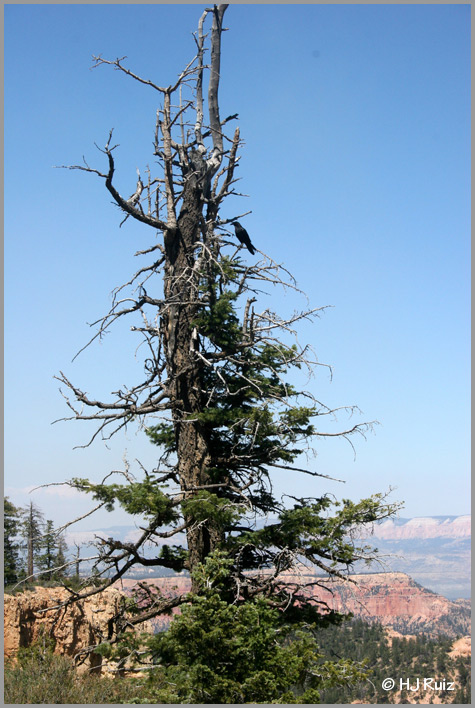
Common Raven
Common Ravens aren’t as social as crows; you tend to see them alone or in pairs except at food sources like landfills. Ravens are confident, inquisitive birds that strut around or occasionally bound forward with light, two-footed hops. In flight they are buoyant and graceful, interspersing soaring, gliding, and slow flaps.
Common Ravens live in open and forest habitats across western and northern North America. This includes deciduous and evergreen forests up to treeline, as well as high desert, sea coast, sagebrush, tundra, and grasslands. They do well around people, particularly rural settlements but also some towns and cities.
The photographs on display were taken at Bryce Canyon National Park in Utah.

Share this:

Helping the ground feeders
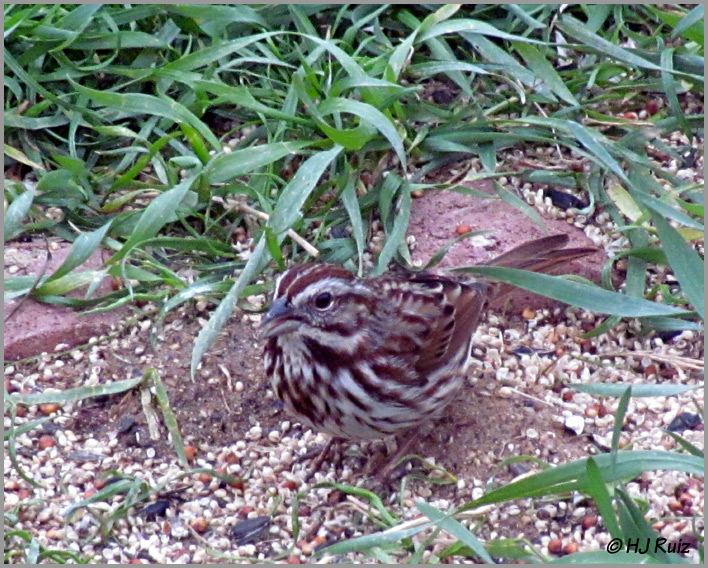
Now that Spring is here, we all get busy preparing our lawns for the grass to grow nice, healthy and try to get the greenest one for beautiful landscaping sight. Plants and flowers, mulch, plucking out bad weeds, cleaning,etc. Are just some of the many tasks needed to be done around the house. I for one have a very long list of things to do already.
The number one will be mainly for the birds that eat seeds from the ground. The weed surrounding the base were the feeders are located is overgrown, looks like a small jungle and these birds are having a hard time to get to the fallen seeds.
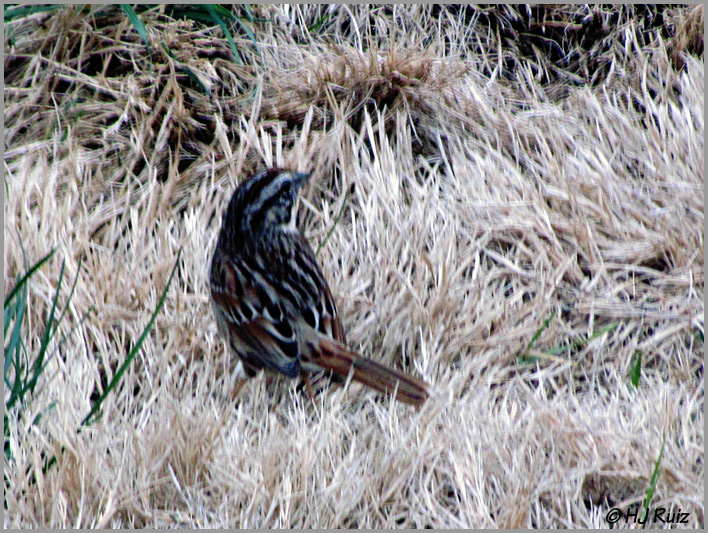
Song Sparrow
I’m going to fix that problem today. I’ll get my weed whacker and that should do it. 🙂
Song sparrows are the birds having the hardest time to get the seed, of course they are eating but they put up a greater unnecessary effort for it, so I’ll help them!
Share this:


Read Past Reviews

Book # 69

Quote from the Author
“A good chuckle is healthy, it helps you break the monotony of a serious life.” ~ H.J. Ruiz


You must be logged in to post a comment.