The Crossley ID GUIDE – Book Review
Just a few days ago I received the book “The Crossley ID GUIDE” – Eastern Birds written by Richard Crossley.
“Richard Crossley, the author has put in use his field savvy, years of experience birding and photographing knowhow when he structured the contents of his ID Guide. He’s included a whopping 10,000 images of 660 species of birds! He’s managed to create a close to reality way of seeing birds of the same specie in different positions, stages of maturity and genders all on the same plate which by the way are wonderfully done in great colors as well as neat sharpness.  This ID Guide is the “mother lode” of bird images, great reference help for any birder in ways of brief but concise information such as size comparison, colors, shape, plumage, gender and geographic habitats of all species displayed. I like Richard’s simple philosophy, being a doer and getting his hands dirty, to get closely involved with what you try to do. Indeed, he did get the job done. The Crossley ID GUIDE is a winner!”
Review made by H.J. Ruiz – “My Backyard Visitors”
Take a peek at one sample image out of hundreds displayed in this guide and what the plates look like. Amazing!
Share this:

Do you know what guano is?
Guano(from the Quechua ‘wanu’, (dung) via Spanish) is the excrement (feces and urine) of seabirds, cave dwelling insectivorous bats, and seals. Guano manure is an effective fertilizer due to its high levels of phosphorus and nitrogen and also its lack of odor. It was an important source of nitrates for gunpowder. Soil that is deficient in organic matter can be made more productive by addition of this manure.
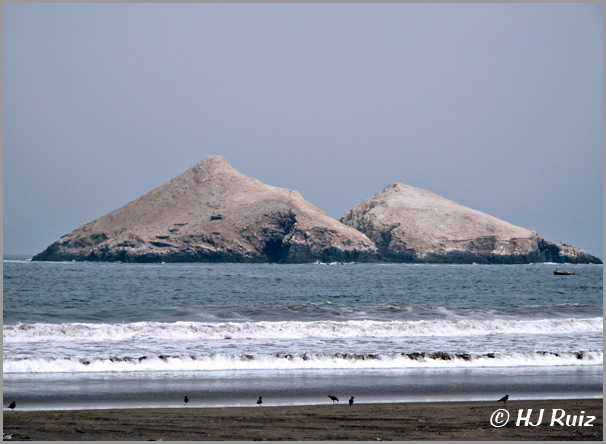
Guano islands
Guano consists of ammonium oxalate and urate, phosphates, as well as some earth salts and impurities. Guano also has a high concentration of nitrates. Bird guano has a fertilizer analysis of 11 to 16 percent nitrogen, 8 to 12 percent equivalent phosphoric acid, and 2 to 3 percent equivalent potash. Bat and seal guano are lower in fertilizer value than bird guano.
The word “guano” originates from the Quichua language of the Inca civilization and means “the droppings of sea birds”. Incas collected guano from the coast of Peru for use as soil enricher. The Incas assigned great value to guano, restricting access to it and punishing any disturbance to the birds with death.
Guano has been harvested over several centuries along the coast of Peru, where islands and rocky shores have been sheltered from humans and predators. The Guanay Cormorant has historically been the most important producer of guano; its guano is richer in nitrogen than guano from other seabirds. Other important guano producing species off the coast of Peru are the Peruvian Pelican and the Peruvian Booby.
In November 1802, Alexander von Humboldt studied guano and its fertilizing properties at Callao in Peru, and his subsequent writings on this topic made the subject known in Europe.
The high concentration of nitrates also made guano an important strategic commodity. The War of the Pacific(1879 to 1883) between the Peru-Bolivia alliance and Chile was primarily based upon Bolivia’s attempt to tax Chilean guano harvesters and over control of a part of the Atacama Desert that lies between the 23rd and 26th parallels on the Pacific coast. The discovery during the 1840s of the use of guano as a fertilizer and its Chile saltpetre content as a key ingredient in explosives made the area strategically valuable.
In this context the US passed the Guano Islands Act in 1856 giving citizens discovering a source of guano the right to take possession of unclaimed land and entitlement to exclusive rights to the deposits. However, the guano could only be removed for the use of citizens of the United States. This enabled US citizens to take possession of unoccupied islands containing guano.
By the end of the 19th century, the importance of guano declined with the rise of artificial fertiliser, although guano is still used by organic gardeners and farmers. Superphosphate made from guano is used for aerial topdressing.
In agriculture and gardening guano has a number of uses, including as: soil builder, lawn treatments, fungicide (when fed to plants through the leaves), nematicide (decomposing microbes help control nematodes), and as composting activator (nutrients and microbes speed up decomposition).
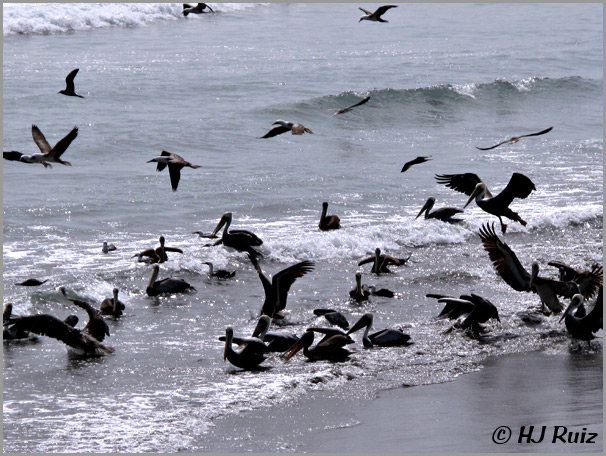
Guano producing birds
All photographs are © H.J. Ruiz – “My Backyard Visitors”
Text is available under the Creative Commons Attribution-ShareAlike License; additional terms may apply. See Terms of use for details.
Share this:

Humboldt Penguin
Humboldt Penguin, a.k.a. Peruvian Penguin, or Patranca – Spec. Name: Spheniscus Humboldti
This is a South American penguin, that breeds in coastal Peru and Chile. Its nearest relatives are the African Penguin, the Magellanic Penguin and the Galápagos Penguin. The penguin is named after the cold water current it swims in, which is itself named after Alexander von Humboldt, an explorer.
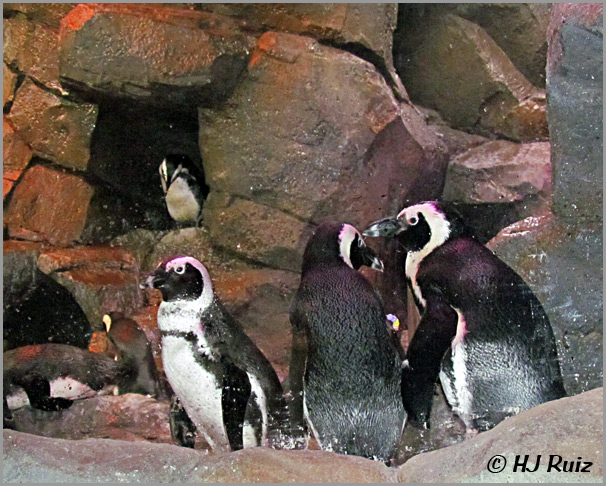
Humboldt Penguin
Humboldt Penguins are medium-sized penguins, growing to 65-70 cm (26-28 in) long and a weight of 3.6-5.9 kg (8-13 lbs). They have a black head with a white border that runs from behind the eye, around the black ear-coverts and chin, and joins at the throat. They have blackish-grey upperparts and whitish underparts, with a black breast-band that extends down the flanks to the thigh. They have a fleshy-pink base to the bill. Juveniles have dark heads and no breast-band. They have spines on their tongue which they use to hold their prey.
Humboldt Penguins nest on islands and rocky coasts, burrowing holes in guano and sometimes using scrapes or caves. In South America the Humboldt Penguin is found only along Pacific coast, and the range of the Humboldt Penguin overlaps that of the Magellanic Penguin on the central Chilean coast.
The current status of this penguin is threatened, due to a declining population caused in part by over-fishing, climate change, and ocean acidification. Historically it was the victim of guano over-exploitation. Penguins are also declining in numbers due to habitat destruction. The current population is estimated at between 3,300 and 12,000. In August 2010 the Humboldt penguin of Chile and Peru, was granted protection under the U.S. Endangered Species Act.
Photograph © H.J. Ruiz – “My Backyard Visitors”
Text is available under the Creative Commons Attribution-ShareAlike License; additional terms may apply. See Terms of use for details.
Share this:

Sanderling
Sanderling – Spec. Name: Calidris Alba or Erolia Alba
This is a small wader. It is a circumpolar Arctic breeder, and is a long-distance migrant, wintering south to South America, South Europe, Africa, and Australia. It is highly gregarious in winter, sometimes forming large flocks on coastal mudflats or sandy beaches.

Sanderling
It is somewhat unlike other sandpipers in appearance, which has led to the suggestion that it should be placed into a monotypic genus Crocethia. A more recent review (Thomas et al., 2004) indicates, however, that the sanderling is a fairly typical “stint” or small sandpiper and should be separated from the large knots with its closest relatives in a distinct genus.
This bird is similar in size to a Dunlin, but stouter, with a thick bill. It shows a strong white wingbar in flight, and runs along the sandy beaches it prefers with a characteristic “bicycling” action, stopping frequently to pick small food items. It eats small crabs and other small invertebrates. In spring, birds migrating north from South America consume large numbers of horseshoe crab eggs in the Delaware Bay area.
In spring, the birds arrive on the High Arctic breeding grounds (see map), where they lay 3–4 eggs in a ground scrape. On the nesting grounds, these birds mainly eat insects and some plant material.
The Sanderling is one of the species to which the Agreement on the Conservation of African-Eurasian Migratory Waterbirds (AEWA) applies.
The Sanderling is a small plump sandpiper, 18–20 cm in length. Its weight ranges from 40-100 gm. The winter bird is very pale, almost white apart from a dark shoulder patch. This is the source of the specific name, alba, which is the Latin for “white”. Later in the summer, the face and throat become brick-red. The juvenile bird is spangled black and white, and shows much more contrast than the adult. Sanderling behavior is distinctive, but visually, if the size is misjudged, a breeding plumage sanderling can be mistaken for some varieties of stint, or a winter plumage sanderling can be mistaken for a Dunlin or Red Knot. It can be told from other small wading birds, given good views, by its lack of a hind toe.
Sanderling begin arriving on Florida coasts in August and winter here through April, when they begin their migration northward to Artic breeding grounds.
Photograph is © H.J. Ruiz – “My Backyard Visitors”
Text is available under the Creative Commons Attribution-ShareAlike License; additional terms may apply. See Terms of use for details.
Share this:


Read Past Reviews

Book # 69

Quote from the Author
“A good chuckle is healthy, it helps you break the monotony of a serious life.” ~ H.J. Ruiz


You must be logged in to post a comment.