
Canada Warbler Portrait – Video
Relax and enjoy the melodious singing of the Canada Warbler, courtesy and © Lang Elliott.
Share this:

Release of Nihoa Millerbirds on Laysan Island – (Follow-up)
Project Action Offers New Hope for Critically Endangered Species
In a historic and collaborative effort to save a species from extinction, 24 critically endangered Nihoa Millerbirds were released on Laysan Island in Papahānaumokuākea Marine National Monument on September 10. The release was the result of many years of research and detailed planning by biologists and resource managers, led by a partnership between the U.S. Fish and Wildlife Service (FWS) and American Bird Conservancy (ABC).
Millerbirds have been absent from Laysan for nearly 100 years after a closely related subspecies went extinct in the early 20th Century. As part of a decades-long restoration effort, this translocation restores this insect-eating songbird to Laysan’s ecosystem.
“This project, which restores Millerbirds to Laysan Island, will reduce the chances that catastrophic events such as hurricanes or the introduction of invasive predators will extirpate the species, since there will be independent populations of Millerbirds on two islands, 650 miles apart,” said Loyal Mehrhoff, Field Supervisor for the Pacific Islands Fish and Wildlife Office.
“It is thrilling to see Millerbirds back on Laysan once more, not simply because they have been a missing piece of the island’s native ecosystem for so long, but also because this marks a potential turning point in the recovery of the species,” said George Wallace, ABC’s Vice President for Oceans and Islands. “It is hard to imagine a project of this complexity going any more smoothly. From the capture of birds on Nihoa, the three-day trip to Laysan, and finally the release of birds. We have subsequently re-sighted all of the radio-tagged birds on Laysan and several of the others; all are looking healthy and behaving normally – a very encouraging sign for the future,” he said.
Biologists from FWS and ABC, avian husbandry experts, and a wildlife veterinarian took special care to ensure the safe transport and arrival of the Millerbirds at Laysan after their three-day voyage from Nihoa. The birds were kept in specially designed cages for 6 days between their capture on Nihoa and their release on Laysan. Each bird carries a unique combination of colored leg bands to allow identification in the field, and half the birds were fitted with temporary radio transmitters so that their locations can be determined during their first three weeks in their new home. Biologists will remain on Laysan for the next year to monitor the birds’ movements and behaviors, including, the team hopes, their first nesting attempts.
“Translocation is an important tool for the conservation of endangered island birds, and the Millerbird translocation stands on the shoulders of previous efforts,” said Holly Freifeld, biologist with the Fish and Wildlife Service. “This project also breaks a lot of new ground, and has been a model of teamwork and innovation for the past five years. Twenty-two people – the Millerbird team, the crew of the M/V Searcher, and the FWS restoration team on Laysan – worked very hard and with high energy and spirits to make this trip a success.”
The Millerbird, which weighs less than an ounce, is a lively brown song bird that forages for insects among low shrubs and bunch-grasses. On Laysan, the Millerbird joins other endangered species, such as the Laysan Finch, Laysan Duck, Hawaiian monk seal, and several plant species, as well as millions of nesting seabirds.
At 1,023 acres Laysan is the second largest of the Northwestern Hawaiian Islands, and is located in the Papahānaumokuākea Marine National Monument, approximately 790 miles northwest of Honolulu.

A Nihoa Millerbird perches on the hand of Dr. George Wallace, ABC's Vice President for Oceans and Islands. Photo, USFWS
American Bird Conservancy (ABC) is a 501(c)(3) not-for-profit membership organization whose mission is to conserve native birds and their habitats throughout the Americas.
Share this:

Red-shouldered Hawk in FL
At Celery Fields in Sarasota I had been shooting pictures by the weeded swamp and was returning to were my wife and grandson were waiting for me. They themselves had hiked a hill cover with grass and had trails going to the top. So while I was walking back carrying my tripod and camera, at one point I had to cross a road and that’s when I saw a Red-shouldered Hawk flying and then later perched on top of a utility pole. I just grabbed the camera and handheld shot the series of pictures I’m showing you today.
It was nice to see this hawk in a clear day. 🙂

Red-shouldered Hawk


All photographs are © H.J. Ruiz – Avian 101
Share this:

Tree Swallow
When I visited the Celery Fields in Sarasota, FL. I saw flocks of different species on the move. One of them was the Tree Swallow another “lifer” for me. This large flock was flying high and then going around and around over the swampy area (I imagine that they were feedings on insects caught in the fly, these are abundant on the swamps or wet areas). Here I have some more information about this birds: Too bad I could not photograph any swallows standing but I limited myself to doing shots while they flew. It was exciting to see so many moving so fast.
Tree Swallow – Spec. Name: Tachycineta bicolor,
This is a migratory passerine bird that breeds in North America and winters in Mexico, Central America and the Caribbean. It is a very rare vagrant to western Europe.
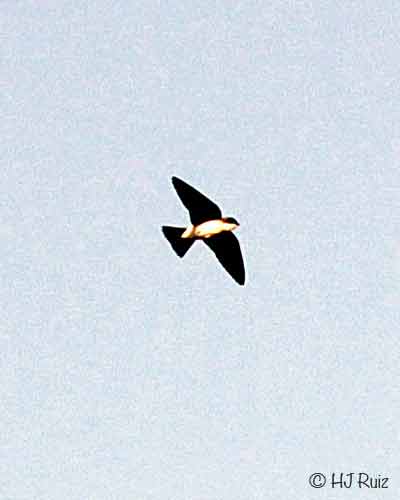
Tree Swallow
This swallow averages 13.5 cm (5 inches) long and weighs about 20 g. The bill is tiny. The adult Tree Swallow has iridescent blue-green upper-parts, white underparts, and a very slightly forked tail. The female usually has duller colors than the male, often more greenish than the more bluish male. The juvenile plumage is dull grey-brown above and may have hint of a gray breast band.
Being highly social outside of the breeding season, tree swallows may form flocks of several thousand birds near roost sites. Flocks near Vacherie, Louisiana were estimated to contain well over 1 million birds during December 2009.
Tree Swallows nest in natural or artificial cavities near water and are often found in large flocks. They readily use nest boxes, including those built for bluebirds. Declines in cavity-builder populations are resulting in fewer natural nesting sites for Tree Swallows, although the swallow population remains healthy.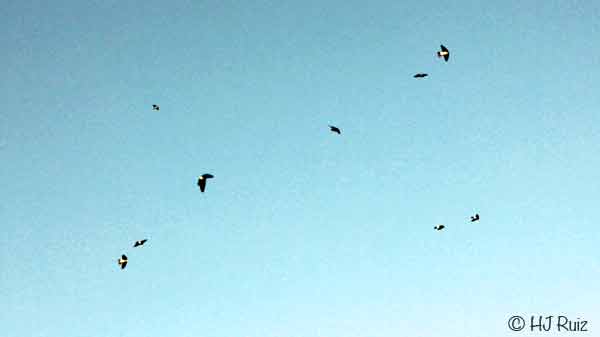
The Tree Swallow nest consists of multiple layers of grasses and thin twigs, and is lined with large feathers from other species. The female lays 4 to 7 white eggs and incubates them by herself. The eggs hatch in about 14 days and the hatchlings are altricial. The hatchlings typically fledge in 16–24 days. While there are young or eggs in the nest, adults frequently dive bomb intruders (including curious humans) and attempt to drive them from the area. Tree Swallows are known to “fight” over feathers in mid-air for reasons which are still under investigation. There is some speculation that this is a form of play.
Tree Swallows are typically single-brooded, although they may attempt a second nest if the first fails early in the season. There are records of parents raising two successful broods in a season. They subsist primarily on a diet of insects, sometimes supplemented with small quantities of fruit. They are excellent fliers and take off from their perch and acrobatically catch insects in their bills in mid-air.
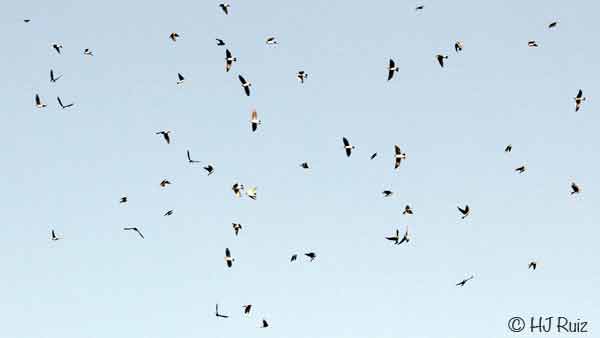
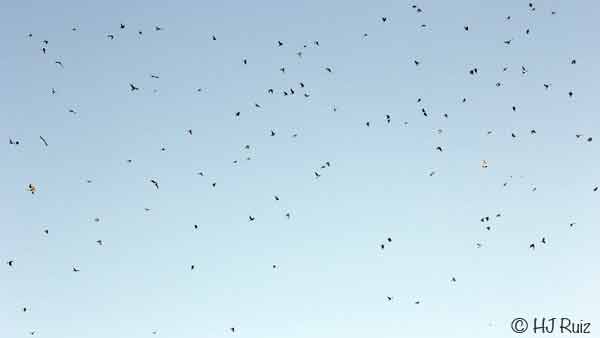
All photographs are © H.J. Ruiz – Avian 101
Text is available under the Creative Commons Attribution-ShareAlike License; additional terms may apply. See Terms of use for details.
Share this:


Read Past Reviews

Book # 69

Quote from the Author
“A good chuckle is healthy, it helps you break the monotony of a serious life.” ~ H.J. Ruiz


You must be logged in to post a comment.