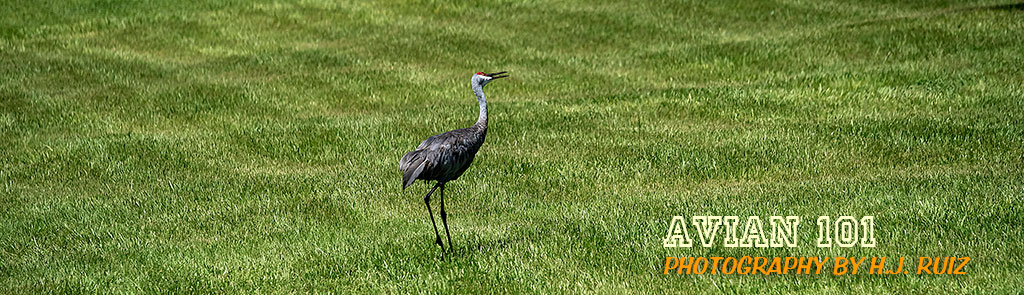
Swainson’s Warbler – Video
This is a beautiful video courtesy of © Carl Gerhardt Enjoy it!
Share this:

Petrels, Albatrosses and Storm-Petrels of North America – Book Review
Petrels, Albatrosses and Storm-Petrels of North America
A Photographic Guide by Steve N.G. Howell
“For some people, even if they are involved to the hobby of birding or bird-photography_ the title of this guide might not sound very impressive just being only three kinds of birds which are not entirely well known, you might think it wouldn’t amount to much ado, however, you’d be surprised about how misinformed you’ve been about this: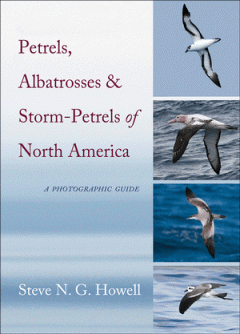
From the 140 known tubenoses species in the world, 50% of them occur in North America.
Mr. Howell has compiled the most informative guide in both text and visual form into a book, 483 pages of detailed and intelligent descriptions, Geographic variations, field identifications, scientific data, comparisons, Conservation, Migrations, Oceanic currents maps, strategies of migrations, habitats and behavior. And the list would be too long to mention in a paragraph. The photographic plates are impeccable and they visually self describe the intended textual description or observation made by the author. This is a guide well structured as much as well written. It had all my attention and educated me about those magnificent birds of the sea. This guide will be happily added to my Book Library!”
Review made by: H.J. Ruiz – Avian 101 – January 26, 2012
Share this:

Birds are starting to show up!
Last Wednesday I went food shopping with Lucy and Tyler to the super market. There were a lot of cars in the parking lot so I decided to park a little farther instead of looking for an empty space closer to the market’s entrance. This way we have a chance to give Tyler some space to walk. We all need the exercise! I turned my head and I saw a large bird flying toward us and then perched up on top of the lamp post near us. I’m almost sure it was an Osprey. I called Lucy to take a look and she was surprised to see one so close. Then the bird took off flying away toward the woods nearby.
Since the weather has improved some and got slightly warmer I’ve seen a lot of birds flying in my backyard, birds such as:
- C. Crows
- N. Mockingbirds
- H. Finches
- C. Chickadees
- M. Doves
- F. Sparrows
- N. Cardinals
Then I placed bird seeds in clay dishes on my deck table and I had the opportunity to shoot some pictures from inside my kitchen, through the glass door. I felt good to use my camera again.
Here I’m posting some of them.
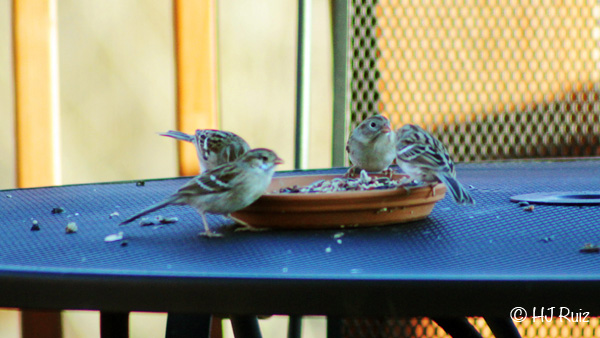
Field Sparrows


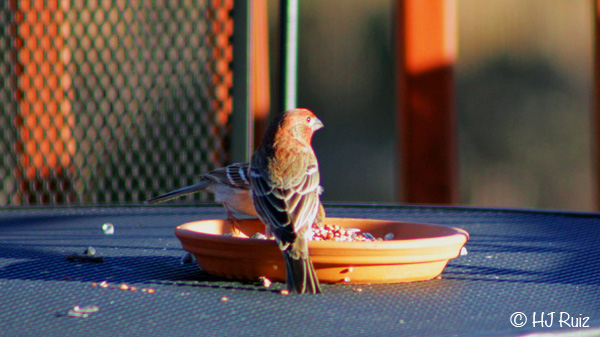
House Finch and F. Sparrow
All photographs are © H.J. Ruiz – Avian 101
Share this:

Bizarre Incident in Utah
| 1,500 Waterbirds Killed – December 2011Officials in Utah are estimating that about 1,500 Eared Grebes were killed late Monday night, possibly as a result of confusing a Wal-Mart parking lot in Cedar City with a body of water and landing on the asphalt during a storm. An additional 3,500 apparently dazed and confused grebes were rounded up through the night by hand by volunteers and staff of the Utah Department of Wildlife, and eventually released into a nearby lake.
It appears that a storm and associated cloud cover was a key factor in causing the birds’ confusion, as well as a glistening parking lot surface that may have looked like a water body in conditions of poor visibility. 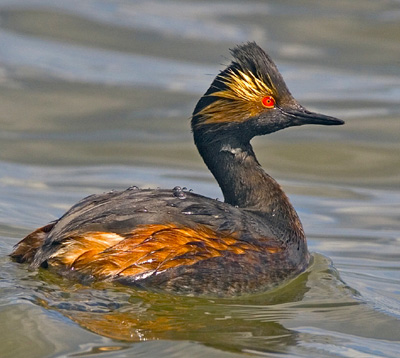 Eared Grebe © Alan Wilson According to American Bird Conservancy (ABC), the nation’s leading bird conservation organization, several traits of this bird likely played a role in this incident. Grebes are only able to land and take off from water so a shimmering parking lot on a stormy night may have looked like a natural landing area. The Eared Grebe carries out the latest fall migration of any bird species in North America, putting it in this storm at a time when other migrating birds likely have already arrived South. The Eared Grebe only migrates at night, which increases the risk of the bird getting confused by city lighting and cloud cover. “Night-flying birds use dim light from the moon and stars and the earth’s magnetic field for navigation. Adverse conditions on Monday night may have caused the same kind of disorientation that can afflict pilots in fog – the birds may have flown directly into the ground, not realizing they were descending. Urban lights attract and confuse birds, so when you bring the storm into play, I think this is a serious possibility,” said Dr. Christine Sheppard, Bird Collision Program Director for ABC. “However, we will probably never know for sure exactly what happened, so it may be very hard to know if it is something that can be mitigated. Large kills of night-migrating birds are unfortunately not unusual, and are generally related to man-made light sources—from spotlights to cell phone towers. Even light from office windows, street lights, and decorative lighting can attract birds to land in cities, where they are at high risk of colliding with glass on buildings as they try to feed the next day. Reducing unnecessary lighting can reduce this type of mortality, but in the case of the grebes, we simply don’t know if they took tarmac for a body of water or lost orientation,” Sheppard said. Eared Grebes are the most abundant grebe in the world. They breed in shallow wetlands in western North America. The Eared Grebe occurs in greatest numbers on Mono Lake and the Great Salt Lake in fall, where it doubles its weight in preparation for a nonstop flight to its wintering grounds in the southwestern United States and Mexico. It is a small waterbird – about 9-12 inches long – with a wingspan of about 23 inches. The bird’s diet consists of mostly aquatic insects and crustaceans, occasionally tadpoles, small frogs, and small fish. |
American Bird Conservancy (ABC) is a 501(c)(3) not-for-profit membership organization whose mission is to conserve native birds and their habitats throughout the Americas.
Share this:


Read Past Reviews

Book # 69

Quote from the Author
“A good chuckle is healthy, it helps you break the monotony of a serious life.” ~ H.J. Ruiz


You must be logged in to post a comment.