
Miscellaneous
GREAT EGRET – Ardea alva


All photographs © H.J. Ruiz – Avian 101
Share this:

Birds – religion, folklore and culture
Religion, Folklore and Culture
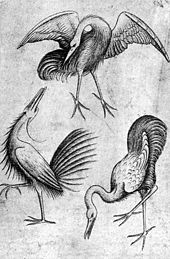
“The 3 of Birds” by the Master of the Playing Cards, 15th century Germany
Birds play prominent and diverse roles in folklore, religion, and popular culture. In religion, birds may serve as either messengers or priests and leaders for a deity, such as in the Cult of Makemake, in which the Tangata manu of Easter Island served as chiefs; or as the rooster(cock) serves as a tangible vessel of Christ as in the gospel of –Matthew, Mark and Luke in the New Testament with Christ speaking through the cock; or as attendants, as in the case of Hugin and Munin, two Common Ravens who whispered news into the ears of the Norse god Odin. In several civilizations of ancient Italy, particularly Etruscan and Roman religion, priests were involved in augury, or interpreting the words of birds while the “auspex” (from which the word “auspicious” is derived) watched their activities to foretell events. They may also serve as religious symbols, as when Jonah (Hebrew: יוֹנָה, dove) embodied the fright, passivity, mourning, and beauty traditionally associated with doves. Birds have themselves been deified, as in the case of the Common Peacock, which is perceived as Mother Earth by the Dravidians of India. Some birds have also been perceived as monsters, including the mythological Roc and the Māori’s legendary Pouākai, a giant bird capable of snatching humans.
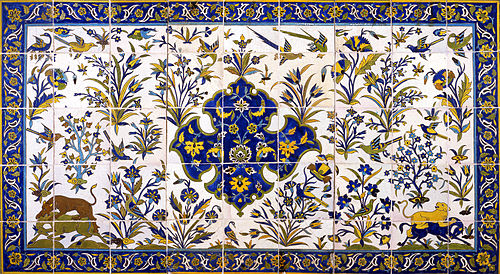
Painted tiles with design of birds from Qajar dynasty
Birds have been featured in culture and art since prehistoric times, when they were represented in early cave paintings. Birds were later used in religious or symbolic art and design, such as the magnificent Peacock Throne of the Mughal and Persian emperors. With the advent of scientific interest in birds, many paintings of birds were commissioned for books. Among the most famous of these bird artists was John James Audubon, whose paintings of North American birds were a great commercial success in Europe and who later lent his name to the National Audubon Society. Birds are also important figures in poetry; for example, Homer incorporated Nightingales into his Odyssey, and Catullus used a sparrow as an erotic symbol in his Catullus 2. The relationship between an albatross and a sailor is the central theme of Samuel Taylor Coleridge’s The Rime of the Ancient Mariner, which led to the use of the term as a metaphor for a ‘burden’. Other English metaphors derive from birds; vulture funds and vulture investors, for instance, take their name from the scavenging vulture.
Perceptions of various bird species often vary across cultures. Owls are associated with bad luck, witchcraft, and death in parts of Africa, but are regarded as wise across much of Europe. Hoopoes were considered sacred in Ancient Egypt and symbols of virtue in Persia, but were thought of as thieves across much of Europe and harbingers of war in Scandinavia.
Text and illustrations © Wikipedia
Share this:

Gray-headed Gull
Grey-headed Gull – Latin name: Chroicocephalus cirrocephalus
This is a small gull which breeds patchily in South America and Africa south of the Sahara. It is not truly migratory, but is more widespread in winter. This species has occurred as a rare vagrant to North America and Spain. It is also known as the Grey-hooded Gull. As is the case with many gulls, it has traditionally been placed in the genus Larus.
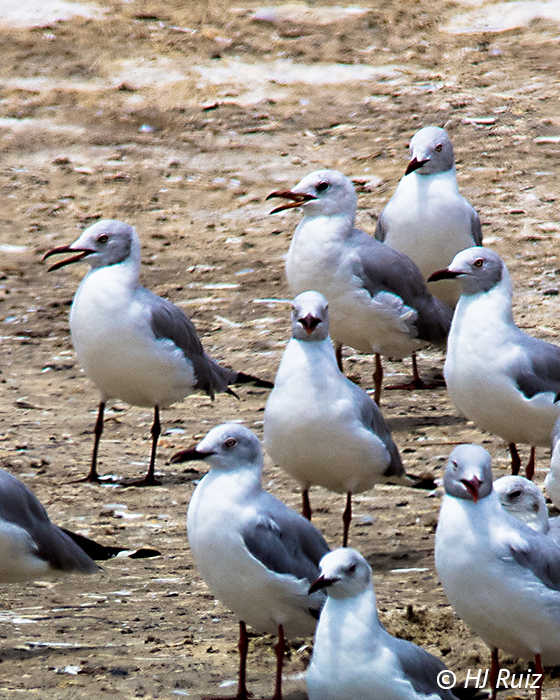
Gray-headed Gull
Note: These photographs shown on this post were shot in Peru.
This locally abundant gull breeds in large colonies in reed beds and marshes, and lays two or three eggs in a nest, which can be on the ground or floating. Like most gulls, it is highly gregarious in winter, both when feeding and in evening roosts. Although it is predominantly coastal or estuarine, it is not a pelagic species, and is rarely seen at sea far from land.
Flocks numbering hundreds or thousands of these gulls can form when the feeding conditions are appropriate.
The Grey-headed Gull is slightly larger than the Black-headed Gull at 42 cm length. The summer adult has a pale grey head, a grey body, darker in tone than the Black-headed, and red bill and legs. The black tips to the primary wing feathers have conspicuous white “mirrors”. The underwing is dark grey with black wingtips. The grey hood is lost in winter, leaving just dark streaks.
Sexes are similar. The South American race is slightly larger and paler-backed than the African subspecies.
This gull takes two years to reach maturity. First year birds have a black terminal tail band, and more dark areas in the wings.
In flight, the wings are broader and held flatter than those of Black-headed Gull.
This is a noisy species, especially at colonies. The call is a raucous crow-like caw, caw.
The species was recently found at Coney Island on August 1, 2011. Scientist say this is extremely rare as it only breed in parts of Africa.
NOTE: The Gray-headed Gull is a new addition to my Bird List as: #182


Text © Wikipedia – All photographs © H.J. Ruiz – Avian 101
Share this:

Elegant Tern
Elegant Tern – Latin name: Sterna elegans
This is a seabird of the tern family Sternidae. It breeds on the Pacific coasts of the southern USA and Mexico and winters south to Peru, Ecuador and Chile.
This species breeds in very dense colonies on coasts and islands, including Montague Island (Mexico), and exceptionally inland on suitable large freshwater lakes close to the coast. It nests in a ground scrape and lays one to two eggs. Unlike some of the smaller white terns, it is not very aggressive toward potential predators, relying on the sheer density of the nests (often only 20–30 cm apart) and nesting close to other more aggressive species such as Heermann’s Gulls to avoid predation.

Elegant Tern (Yellow beak)
The Elegant Tern feeds by plunge-diving for fish, almost invariably from the sea, like most Thalasseus terns. It usually dives directly, and not from the “stepped-hover” favoured by the Arctic Tern. The offering of fish by the male to the female is part of the courtship display.
Surprisingly, this Pacific species has wandered to western Europe as a rare vagrant on a number of occasions, and has interbred with the Sandwich Tern in France; there is also one record from Cape Town, South Africa in January 2006, the first record for Africa.
This is a medium-large tern, with a long, slender orange bill, pale grey upperparts and white underparts. Its legs are black. In winter, the forehead becomes white. Juvenile Elegant Terns have a scalier pale grey back. The call is a characteristic loud grating noise like a Sandwich Tern.
This bird could be confused with the Royal Tern or Forster’s Tern, but the elegans is larger and thicker-billed and shows more white on the forehead in winter.
NOTE: The Elegant Tern is a new addition to my Bird List as: # 181


Text © Wikipedia – All photographs © H.J. Ruiz – Avian 101
Share this:


Read Past Reviews

Book # 69

Quote from the Author
“A good chuckle is healthy, it helps you break the monotony of a serious life.” ~ H.J. Ruiz


You must be logged in to post a comment.