
Glossy Ibis
Glossy Ibis – Latin name: Plegadis falcinellus
This is a wading bird in the ibis family Threskiornithidae.The most widespread ibis species, breeding in scattered sites in warm regions of Europe, Asia, Africa, Australia, and the Atlantic and Caribbean region of the Americas. It is thought to have originated in the Old World and spread naturally from Africa to northern South America in the 19th century, from where it spread to North America. This species is migratory; most European birds winter in Africa, and in North America birds from north of the Carolinas winter farther south. Birds from other populations may disperse widely outside the breeding season. While generally declining in Europe it has recently established a breeding colony in Southern Spain, and there appears to be a growing trend for the Spanish birds to winter in Britiain and Ireland, with at least 22 records in 2010.
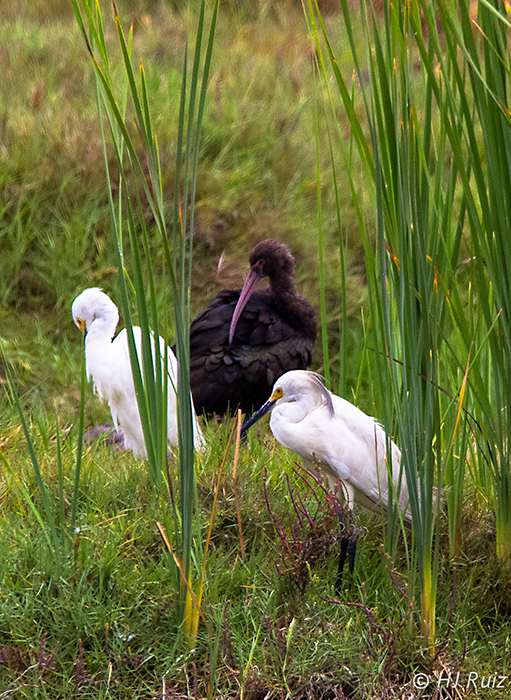
Glossy Ibis
Glossy Ibises undertake dispersal movements after breeding and are very nomadic. The more northerly populations are fully migratory and travel on a broad front, for example across the Sahara Desert. Populations in temperate regions breed during the local spring, while tropical populations nest to coincide with the rainy season. Nesting is often in mixed-species colonies. When not nesting flocks of over 100 individuals may occur on migration, and during the winter or dry seasons the species is usually found foraging in small flocks. Glossy Ibis often roosts communally at night in large flocks, with other species, occasionally in trees which can be some distance from wetland feeding areas.
Glossy Ibis feed in very shallow water and nest in freshwater or brackish wetlands with tall dense stands of emergent vegetation such as reeds, papyrus or rushes) and low trees or bushes. They show a preference for marshes at the margins of lakes and rivers but can also be found at lagoons, flood-plains, wet meadows, swamps, reservoirs, sewage ponds, paddies and irrigated farmland. It is less commonly found in coastal locations such as estuaries, deltas, salt marshes and coastal lagoons. Preferred roosting sites are normally in large trees which may distant from the feeding areas.
The nests are usually a platform of twigs and vegetation positioned at least 1m above water, sometimes up to 7 m in tall, dense stands of emergent vegetation, low trees or bushes.
NOTE: The Glossy Ibis is a new addition to my Bird List as: # 184


Text © Wikipedia – All photographs © H.J. Ruiz – Avian 101
Share this:

Blue and white Swallow
Blue-and-white Swallow – Latin name: Notiochelidon cyanoleuca peruviana
This is a passerine bird that breeds from Nicaragua south throughout South America, except in the deserts and the Amazon Basin. The southern race is migratory, wintering as far north as Trinidad, where it is a regular visitor. The nominate northern race may have bred on that island.

Blue and white Swallow
Sometimes placed in the genus Pygochelidon, it was first formally described as Hirundo cyanoleuca by French ornithologist Louis Vieillot in 1817, based on a specimen he believed to be from Paraguay. The scientific names mean the same as the English common name.
The adult Blue-and-white Swallow averages 11–12 cm long and weighs about 10g. It has dark blue upperparts and white underparts, and its underwings and the undersurface of its short forked tail are blackish. The juvenile is brown above, buff-tinted below, and has a less forked tail. The call is a buzzing dzzzhreeee.
There are three subspecies. The nominate N. c. cyanoleuca occurs from Nicaragua and Trinidad south to northwestern Argentina, Paraguay and Uruguay. The migratory southern race N. c. patagonica is larger (13.5 cm), has paler underwings, and white basal undertail coverts. N. c. peruviana is restricted to coastal Peru up to 2500 m altitude. It is smaller than patagonica, has less white in the undertail, darker underwings and duskier flanks.
This is a swallow of open areas including villages and towns, farms, and forest clearings. In Central America it is a highland bird, but elsewhere in its range it can occur from the lowlands to an altitude of 4000 m.
This species is often found in small flocks when not breeding. The Blue-and-white Swallow subsists primarily on a diet of insects, caught in the air; they have been seen to gather where termites swarm.The flight is typically fluttery, and this swallow frequently perches on wires or branches.
The Blue-and-white Swallow’s shallow straw nest is built by both adults in a wide range of natural or man-made cavities include tree holes, rock crevices and bridges. The clutch is up to six white eggs in the south of the range, two or three in the north, which are incubated by both parents for 15 days to hatching. The nestlings are fed by both parents for 26 days to fledging, bur return to the nest to sleep with the parents for up to two months. There may be two broods.
This common and popular species has benefited greatly from deforestation and human settlement which have increased the amount of suitable habitat and food. Consequently, it is not considered threatened by the IUCN.
NOTE: The Blue and white Swallow is a new addition to my Bird List as: # 183


Text © Wikipedia – All photographs © H.J. Ruiz – Avian 101
Share this:

Panoramic View of Birds


Vermillion Flycatcher (M)
© H.J. Ruiz – Avian 101
Share this:

For the Birds # 23
For the Birds # 23


All photographs © H.J. Ruiz – Avian 101
Share this:


Read Past Reviews

Book # 69

Quote from the Author
“A good chuckle is healthy, it helps you break the monotony of a serious life.” ~ H.J. Ruiz


You must be logged in to post a comment.