Birds of the Week # 33
American Robin
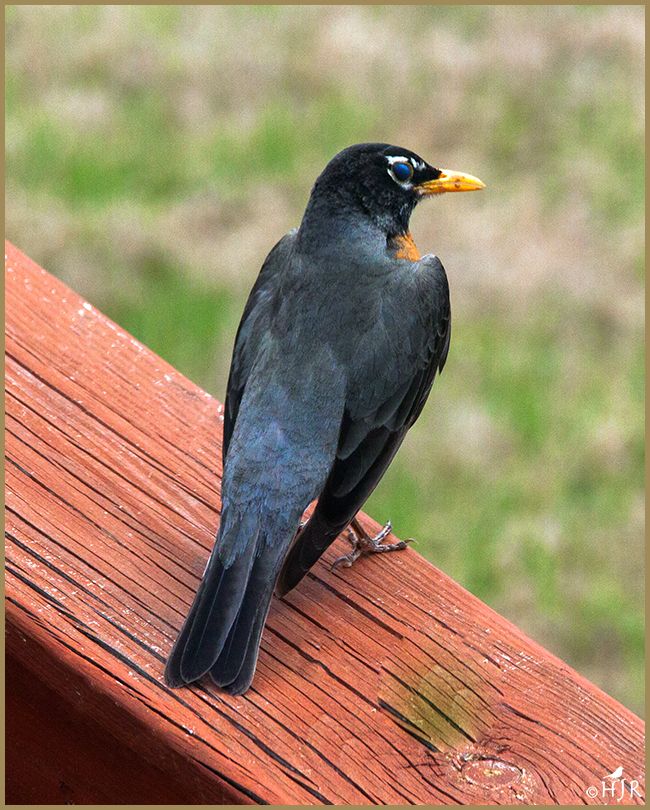
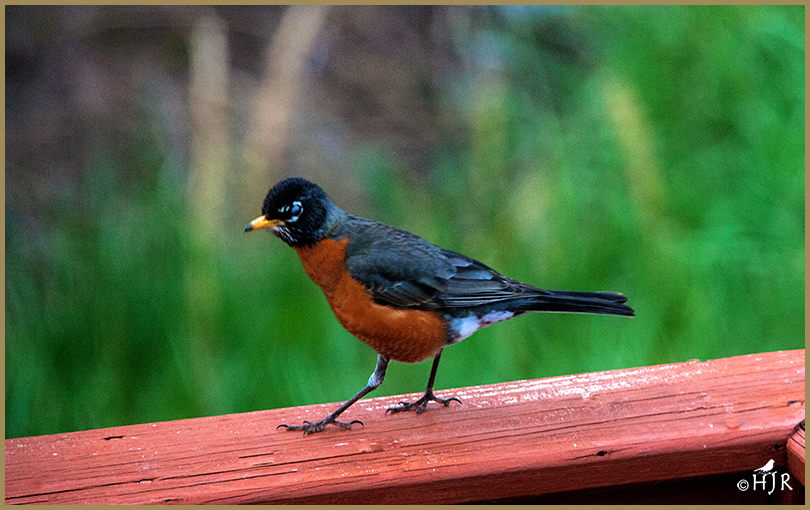
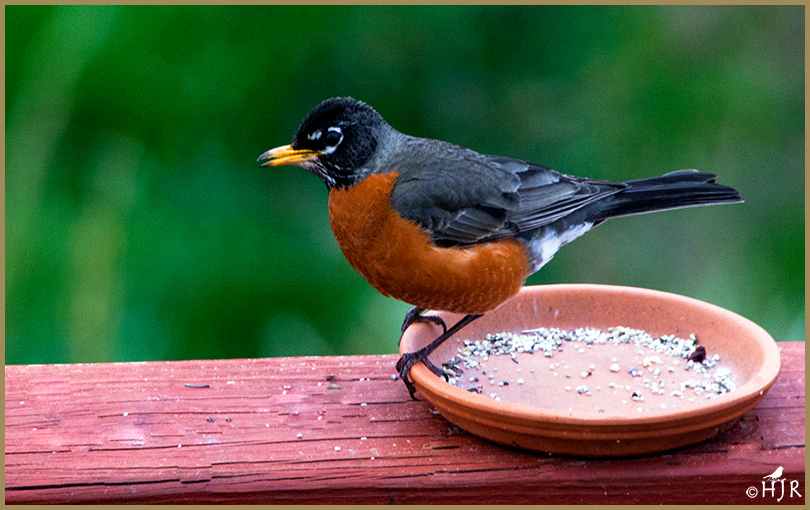
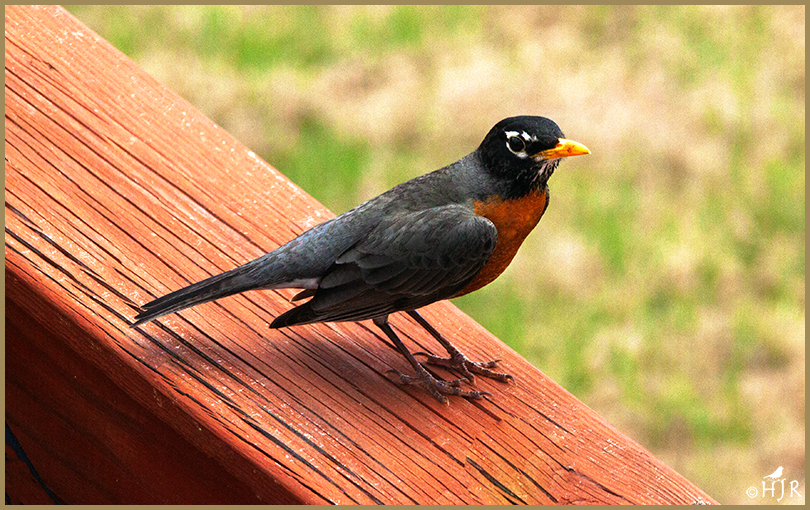
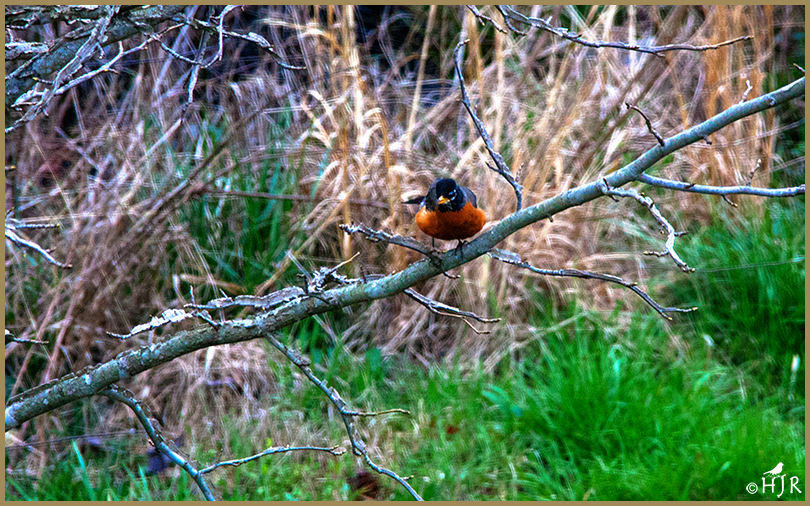
The American Robin (Turdus migratorius) is a migratory songbird of the true thrush genus and Turdidae, the wider thrush family.This bird breeds throughout most of North America, from Alaska and Canada southward to northern Florida and Mexico. While robins occasionally overwinter in the northern part of the United States and southern Canada, most migrate to winter south of Canada from Florida and the Gulf Coast to central Mexico, as well as along the Pacific Coast. Most depart south by the end of August and begin to return north in February and March (exact dates vary with latitude and climate). The distance by which robins migrate varies significantly depending on their initial habitat; a study found that individual robins tagged in Alaska are known to travel as much as 3.5x further across seasons than robins tagged in Massachusetts.
Brown-headed Nuthatch
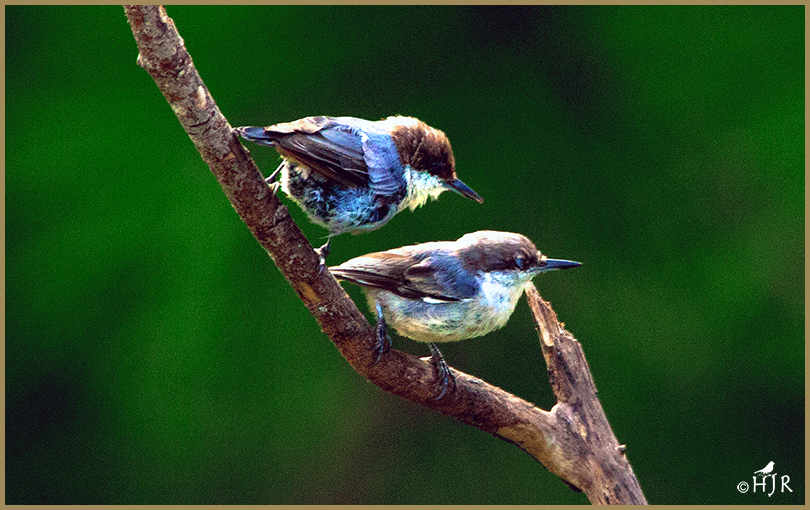

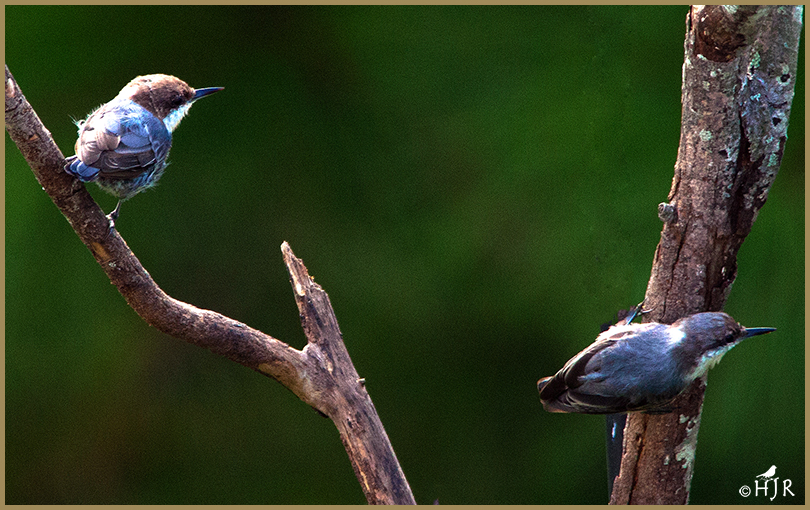
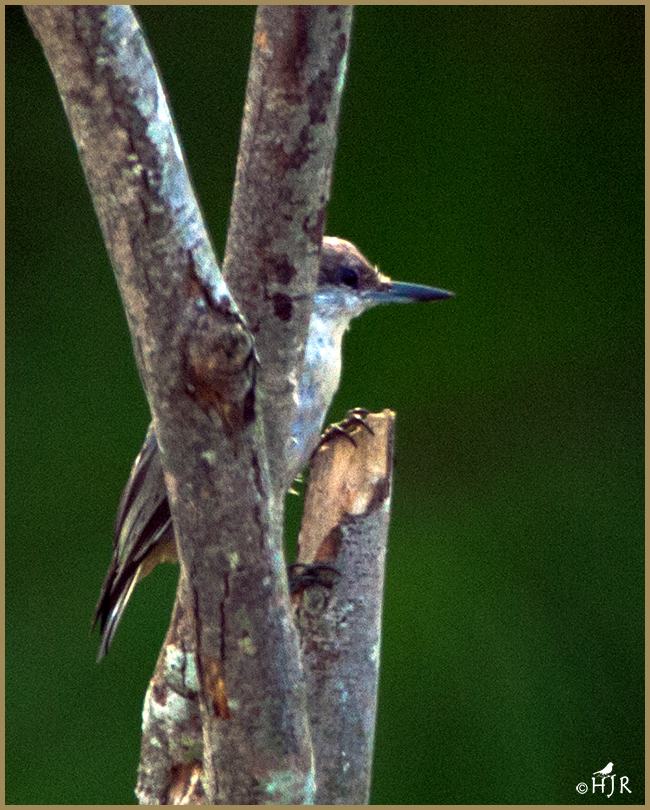
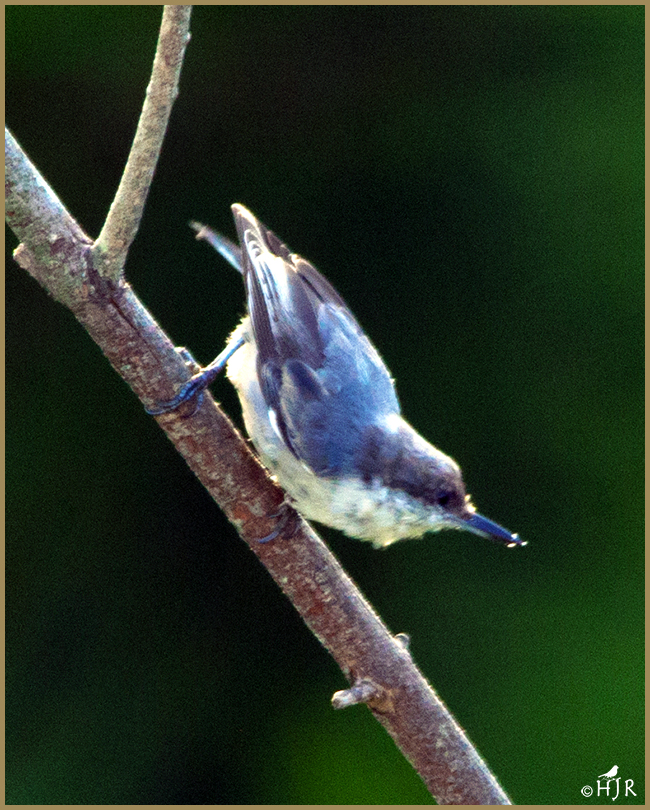
The Brown-headed Nuthatch (Sitta pusilla) is a small songbird found endemic to pine forests throughout the Southeastern United States. Genetic analyses indicated low differentiation between northern and southern populations in Florida, but the study also found lower genetic diversity among south Florida populations that may be a result of the increased habitat fragmentation that was documented. The Bahama nuthatch was formerly considered a subspecies (S. p. insularis), has since been reclassified as its own separate species. Two recent studies assessing vocalizations in Bahama and continental nuthatch populations found important differences. One of the studies also demonstrated that continental and Bahama populations did not respond aggressively to calls of the other population. This type of call-response study is often used to help define cryptic species. The bird, like other nuthatches, possesses a sharp black nail-like beak, which it uses to pound open seeds. It is a frequent visitor to feeding stations and is highly fond of sunflower seeds and suet cakes. Bold and inquisitive, this bird is readily approachable by humans. The bird is regularly observed using a small chips of bark, small twigs, and pine needles held in its beak as tools to dig for insects. The nuthatch exhibits other curious behaviors such a cooperative groups where groups of 3-5 adults provide care at a single nest. Recent genetic assessments suggest some of the putatively non-breeding adults associated with these groups may actually breed with individuals in neighboring territories. This nuthatch also exhibits a wide range of other social behaviors that include social grooming and male-female duets similar to those observed for the Pygmy Nuthatch.
© HJ Ruiz – Avian101
Share this:

Special Places # 49
B & W and Sepia Photography
Photo Gallery





1 – Top Left – First tier: Solitary wooden bench at the edge of a lake. Somewhere in Georgia.
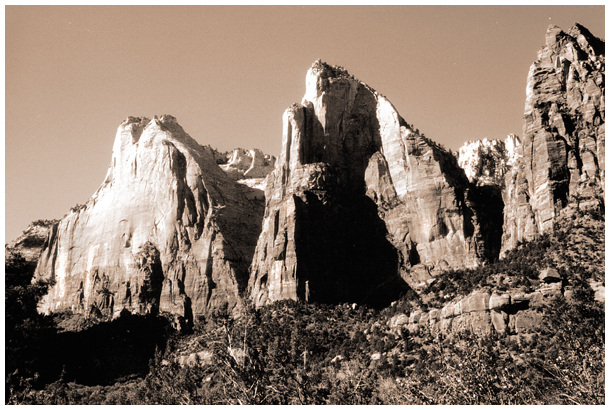
2 – Top Left – Second tier: The Patriarchs are three neighboring sandstone peaks on the west side of Zion Canyon. Each is named after biblical fathers. From left to right (south to north) they are Abraham Peak, Isaac Peak, and Jacob Peak. Abraham Peak is the tallest at 6,890 feet. The white top of Jacob Peak rises behind the orange rock of Mount Moroni. The Patriarchs were named by Frederick Vining Fisher, a Methodist minister who ventured into Zion in 1916, labeling numerous prominent points in Zion Canyon. He decided to name these three peaks after Old Testament daddies, and the titles stuck.
3 – Top Right: An old pier (No longer existent) at White Meadow Lake in New Jersey. The new snow creates a contrasting effect to make this shot dramatic and cold.
4 – Bottom Left: This shot was made between a long corridor among buildings quarters for research workers.
5 – Bottom Right – Upper tier: Winter time in north New Jersey. The lake is totally frozen and temperatures were real low. However, our hero is the tree, standing up to the wind.
6 – Bottom Right – Lower tier: Water in motion always makes a good subject for a photograph, no matter the temperature at the moment.
© HJ Ruiz – Avian101
Share this:

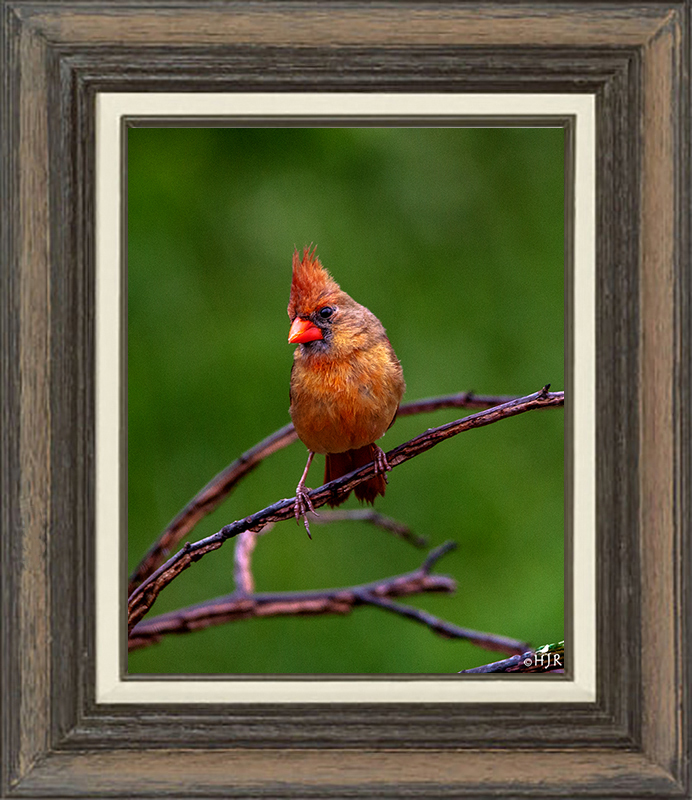
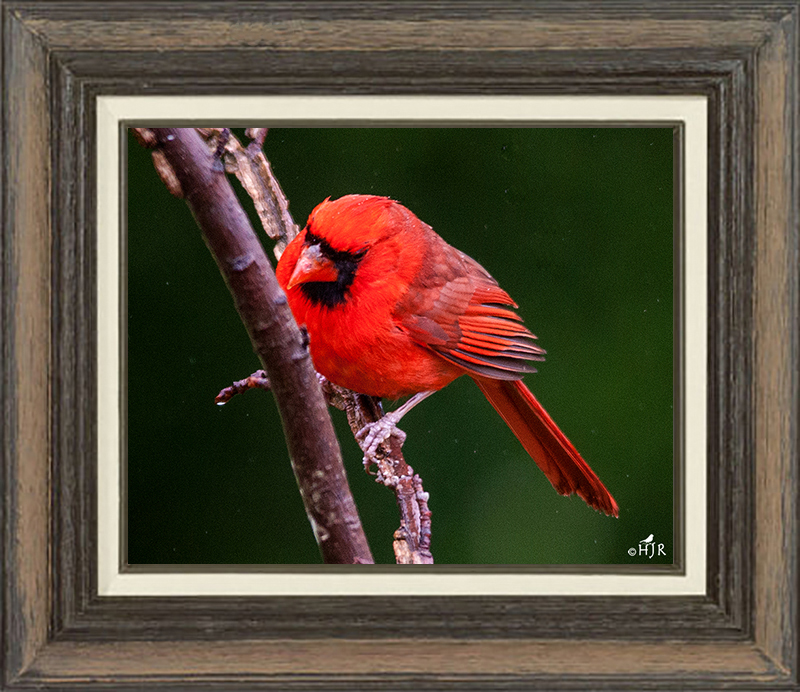
Happy New Year, 2022 – Northern Cardinal # 59
Have a Happy New Red Art Year, filled with Love, Prosperity and Good Health!
Photo Gallery
© HJ Ruiz – Avian101
Share this:

Birds of the Week # 32
Mourning Dove
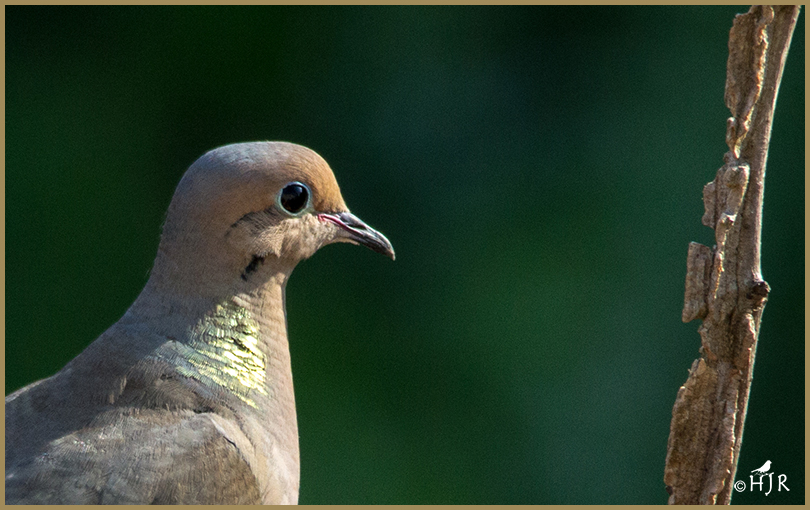
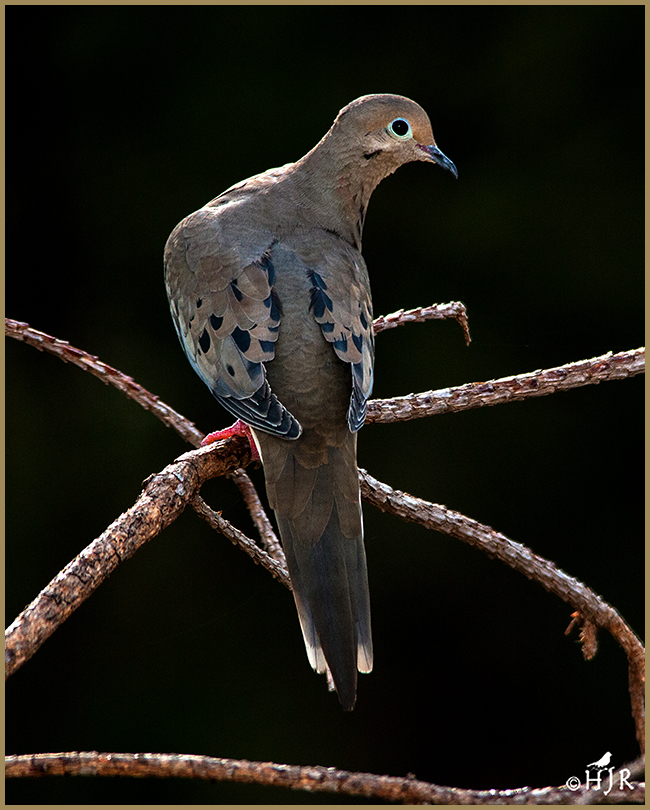
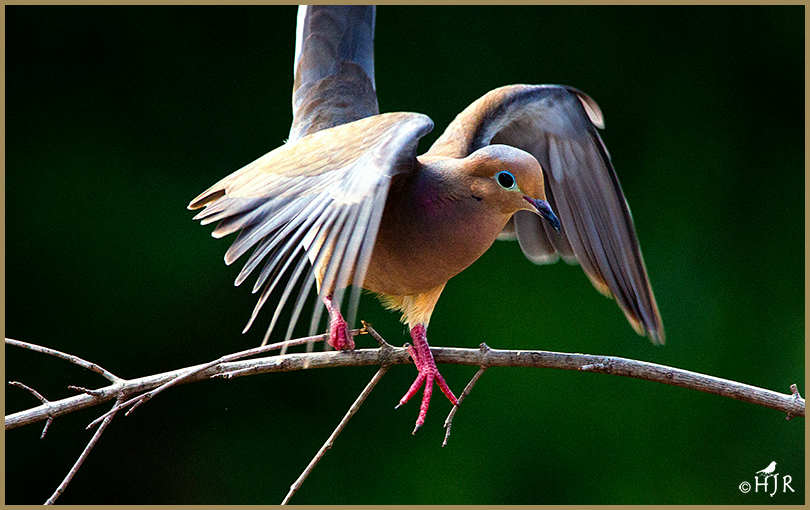
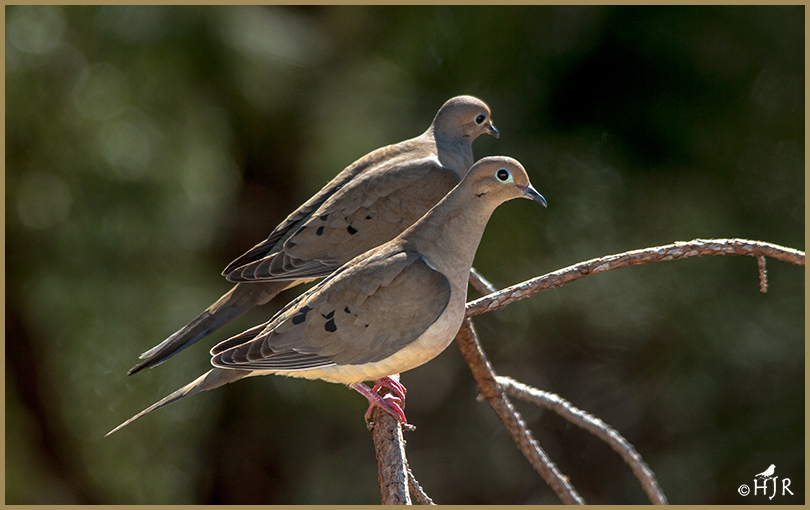
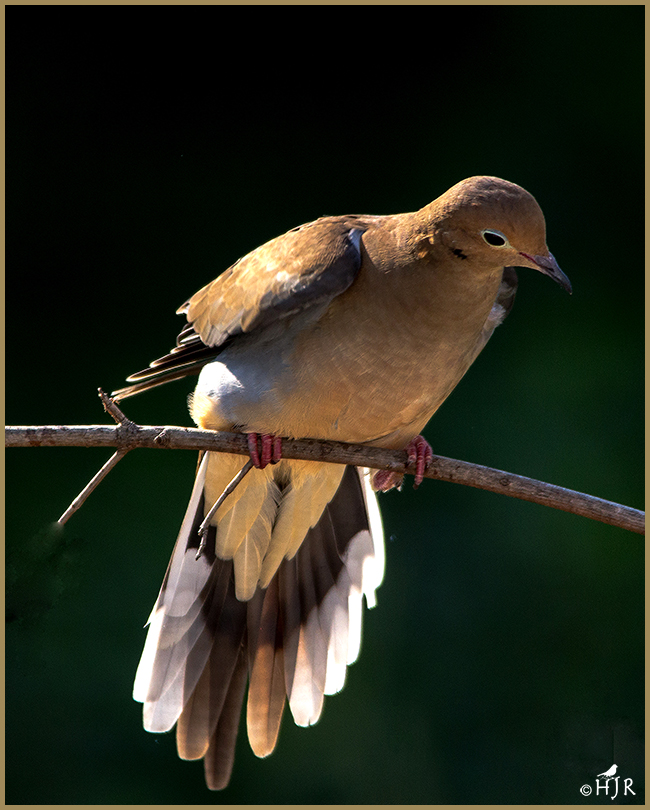
The Mourning Dove (Zenaida macroura) is a member of the dove family, Columbidae. Like other columbines, the mourning dove drinks by suction, without lifting or tilting its head. It often gathers at drinking spots around dawn and dusk. Mourning doves eat almost exclusively seeds, which make up more than 99% of their diet. Rarely, they will eat snails or insects. Mourning doves generally eat enough to fill their crops and then fly away to digest while resting. They often swallow grit such as fine gravel or sand to assist with digestion. The species usually forages on the ground, walking but not hopping. At bird feeders, mourning doves are attracted to one of the largest ranges of seed types of any North American bird, with a preference for rapeseed, corn, millet, safflower, and sunflower seeds. Mourning doves do not dig or scratch for seeds, though they will push aside ground litter; instead, they eat what is readily visible. They will sometimes perch on plants and eat from there. Mourning doves show a preference for the seeds of certain species of plant over others. Foods taken in preference to others include pine nuts, sweetgum seeds, and the seeds of pokeberry, amaranth, canary grass, corn, sesame, and wheat. When their favorite foods are absent, mourning doves will eat the seeds of other plants, including buckwheat, rye, goosegrass and smartweed.
European Starling
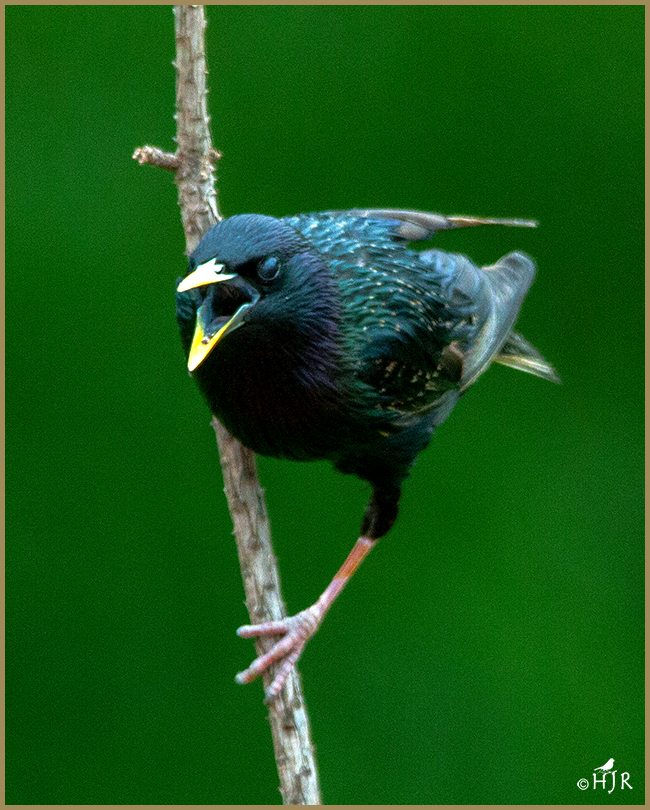
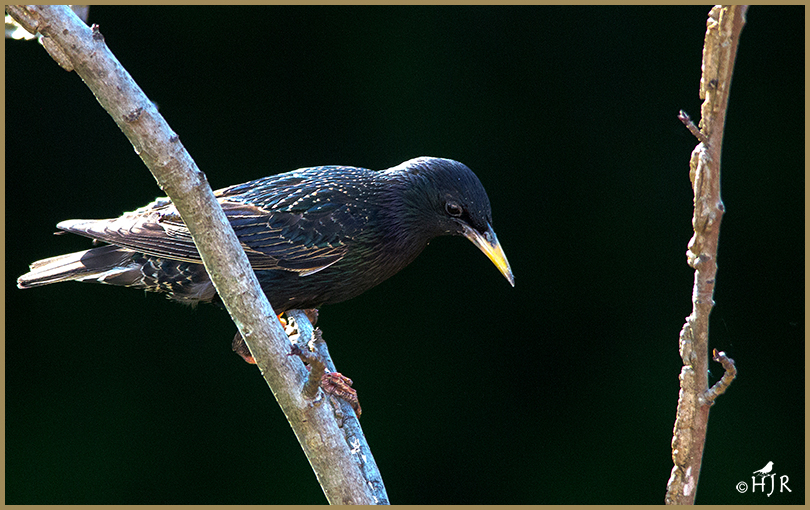
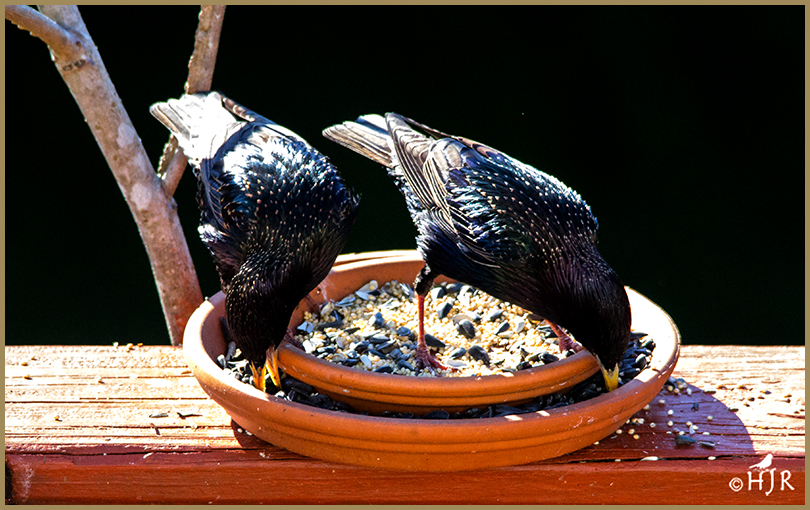
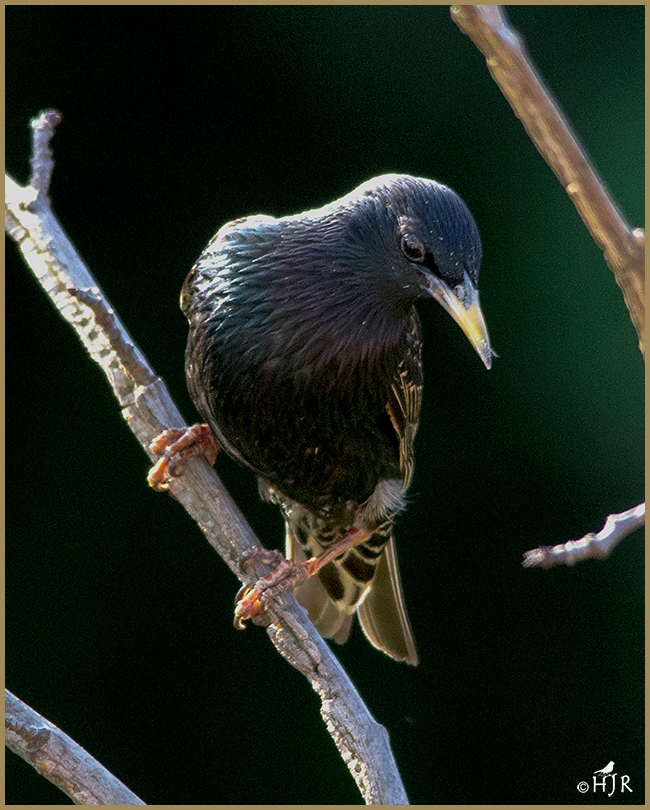
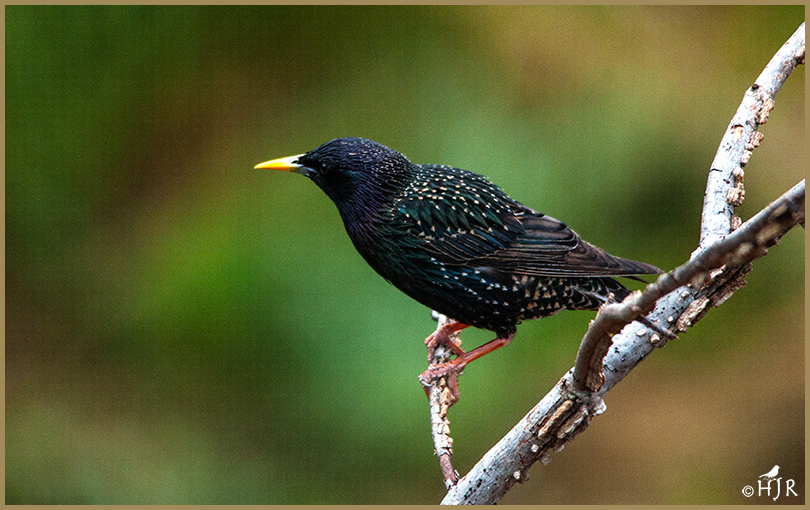
The European Starling (Sturnus vulgaris), also known simply as the starling in Great Britain and Ireland, is a medium-sized passerine bird in the starling family, Sturnidae. Unpaired males find a suitable cavity and begin to build nests in order to attract single females, often decorating the nest with ornaments such as flowers and fresh green material, which the female later disassembles upon accepting him as a mate. The amount of green material is not important, as long as some is present, but the presence of herbs in the decorative material appears to be significant in attracting a mate. The scent of plants such as yarrow acts as an olfactory attractant to females. The males sing throughout much of the construction and even more so when a female approaches his nest. Following copulation, the male and female continue to build the nest. Nests may be in any type of hole, common locations include inside hollowed trees, buildings, tree stumps and man-made nest-boxes. S. v. zetlandicus typically breeds in crevices and holes in cliffs, a habitat only rarely used by the nominate form. Nests are typically made out of straw, dry grass and twigs with an inner lining made up of feathers, wool and soft leaves. Construction usually takes four or five days and may continue through incubation. Common starlings are both monogamous and polygamous; although broods are generally brought up by one male and one female, occasionally the pair may have an extra helper. Pairs may be part of a colony, in which case several other nests may occupy the same or nearby trees. Males may mate with a second female while the first is still on the nest. The reproductive success of the bird is poorer in the second nest than it is in the primary nest and is better when the male remains monogamous.
© HJ Ruiz – Avian101
Share this:

Read Past Reviews

Book # 69
Quote from the Author
“A good chuckle is healthy, it helps you break the monotony of a serious life.” ~ H.J. Ruiz
 H.J. Ruiz - Avian101
You must be logged in to post a comment.