The Friendly Skies
Isn’t it amazing that birds are able to fly? They can go aloft and then soar up in the sky, defying gravity using nothing but their own power. Of course Nature has provided them with a light weight body and extremities built for creating a force to generate lift.
Those creatures are the product of millions of year of evolution, since they are descendants of dinosaurs.
Birds never cease to amaze me! I just have to look up to the sky and sooner or later you’ll see a bird flying by going somewhere. Flying the friendly skies.
Next, are some photos to show these amazing creatures. Enjoy!


Text and photographs © HJ Ruiz – Avian101
Share this:

Say Hello to My Little Friend!
I’ve been fortunate enough to have had many bird species in my backyard for a few years now.. I believe that my backyard has a bit of things that are naturally needed to be a good temporary or permanent habitat for birds. I have several kinds of trees, grasses, shrubs, bushes and plants. I have a small stream running along a shallow creek. The combination of those elements provides a good shelter and safe habitat for any species of birds. I account for complementing for the rest. I make sure they get their favorite seeds and maintain their habitat to be efficient, clean and in good looking condition. Today I will feature a friendly and dynamic little bird, the Brown-headed Nuthatch. Say hello to my little friend! The Brown-headed Nuthatch is a small songbird found in pine forests throughout the Southeastern United States. The bird, like other nuthatches, possesses a sharp black nail-like beak, which it uses to pound open seeds. It is a frequent visitor to feeding stations and is highly fond of sunflower seeds and suet cakes. Bold and inquisitive, this bird is readily approachable by humans. The bird is frequently observed using a small chip of bark held in its beak as a tool to dig for insects. Their total length is 3.5–4.3 in, wingspan is 6.3–7.1 in and body mass is 0.35–0.42 oz. This species sports a brown cap with narrow black eyeline and buff white cheeks, chin, and belly. Its wings are bluish-gray in color. A small white spot is found at the nape of the neck. The bird’s call is a sharp whee-hyah sounding very similar to a “rubber duck” toy and particularly is loud for a bird its size. They also make softer “pit pit pit” calls while in flight as well as other squeaking noises. If heard or seen well, this species is virtually unmistakable in the wild. Next, some pictures for you. Enjoy!


Text and photographs © HJ Ruiz – Avian101
Share this:

Captive of a Jewel
One specie of birds that captivated my heart when they started visiting my backyard was the Ruby-throated Hummingbirds.
The Ruby-throated Hummingbird is the smallest bird species that breeds in the Eastern United States and Eastern Canada, though is a roughly medium-sized species by hummingbird standards. Adults are metallic green above and greyish white below, with near-black wings. Their bill, at up 0.79 in, is long, straight and very slender. As in all hummingbirds, the toes and feet of this species are quite small, with a middle toe of around 0.24 in and a tarsus of approximately 0.16 in. The Ruby-throated Hummingbird can only shuffle if it wants to move along a branch, though it can scratch its head and neck with its feet.
The species is sexually dimorphic. The adult male, has a ruby red throat patch (also known as a gorget) which may appear black in some lighting, and a dark forked tail. The female has a dark rounded tail with white tips and generally no throat patch, though she may sometimes have a light or whitish throat patch. The male is smaller than the female, and has a slightly shorter bill. A molt of feathers occurs once a year, and begins during the autumn migration.
I personally love these little birds, they’re so incredibly small and beautiful that seem unreal. They can fly so fast they may suddenly “appear” in front of your face and look at you with those big eyes like smiling. This has happened to me when I’ve been refilling their nectar, just inches from my face watching me while hovering.
Next, I made a mosaic of pictures for you. Enjoy!


Text and photographs © HJ Ruiz – Avian101
Share this:

Panoramic View of Birds

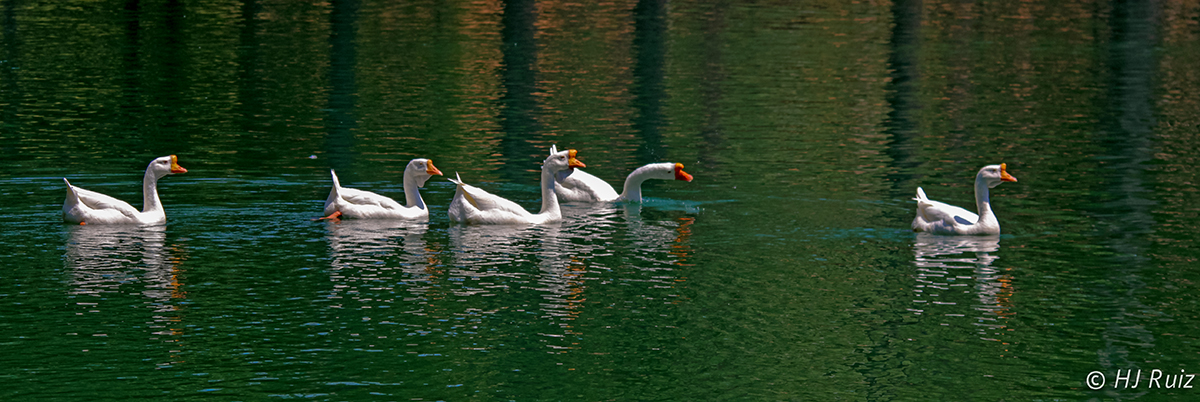
Domestic Geese – Click on image to see enlargement
© HJ Ruiz – Avian101
Share this:


Read Past Reviews

Book # 69

Quote from the Author
“A good chuckle is healthy, it helps you break the monotony of a serious life.” ~ H.J. Ruiz


You must be logged in to post a comment.