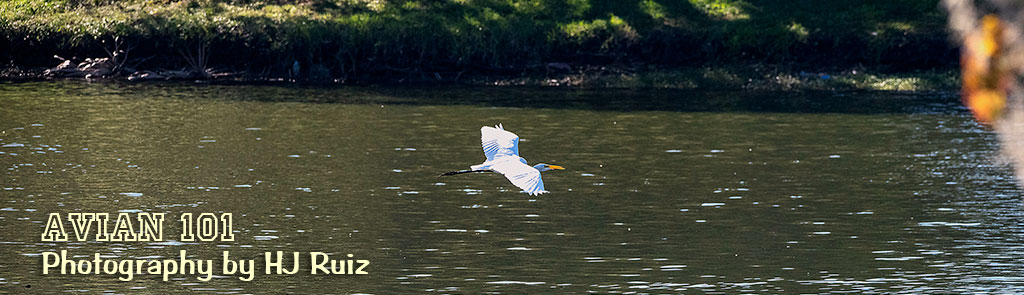
Panoramic View of Birds


Great Egret — Click on image to see enlargement —
© HJ Ruiz – Avian101
Share this:

Row, Row the Boat
Today’s feature gallery is about The Boat-tailed Grackle is a passerine bird of the family Icteridae found as a permanent resident on the coasts of the southeastern USA. It is found in coastal saltwater marshes, and, in Florida, also on inland waters. The nest is a well-concealed cup in trees or shrubs near water; three to five eggs are laid.
The male Boat-tailed Grackle is 15–17 in long and weighs 5.8–8.8 oz. Adult males have entirely iridescent black plumage, a long dark bill, a pale yellowish or brown iris and a long keel-shaped tail. The adult female is much smaller at 10–13 in long and a weight of 3.2–4.1 oz. She is also distinctive via her shorter tail and tawny-brown coloration, which covers the body apart from the darker wings and tail.
I’ve seen them all along Georgia eastern Georgia and in Florida at both, the eastern and western coasts. They are expert thieves, when you are having a picnic and leave any food unattended or if you are distracted. They will manage the way to get some of it. I usually save some crums of bread or any snacks to keep them pleased and away.
They look magnificent when the sun shines on their iridescent plumage.
Next, I have a nice little group of shot from diverse locations. Enjoy!


Text and photographs © HJ Ruiz – Avian101
Share this:

Close-Up


© HJ Ruiz – Avian101
Share this:

Robin Sans the Masked Man
The bird featured on my post today is the American Robin also known as the Robin, is a migratory songbird of the thrush family. It is named after the European Robin because of its reddish-orange breast, though the two species are not closely related, with the European robin belonging to the flycatcher family. The American Robin is widely distributed throughout North America, wintering from southern Canada to central Mexico and along the Pacific Coast. It is the state bird of Connecticut, Michigan, and Wisconsin.
The American Robin is active mostly during the day and assembles in large flocks at night. Its diet consists of invertebrates (such as beetle grubs, earthworms, and caterpillars), fruits and berries. It is one of the earliest bird species to lay eggs, beginning to breed shortly after returning to its summer range from its winter range. Its nest consists of long coarse grass, twigs, paper, and feathers, and is smeared with mud and often cushioned with grass or other soft materials. It is among the first birds to sing at dawn, and its song consists of several discrete units that are repeated.
One day while I was observing a group of robins that landed in my backyard I saw and learned how well organized they are, they readily formed a line a couple of feet apart from each other and they proceeded to comb the place and picking grubs, worms, grasshoppers etc. I was genuinely amazed. They are smart birds no doubt.
Next, I have a few photos of these amazing birds. Enjoy!


Text and photographs © HJ Ruiz – Avian101
Share this:


Read Past Reviews

Book # 69

Quote from the Author
“A good chuckle is healthy, it helps you break the monotony of a serious life.” ~ H.J. Ruiz


You must be logged in to post a comment.