Additional New Birds – Part One
During the course of time I’ve dedicated to photograph birds for my blog I’ve also seen many birds which I didn’t get the opportunity of using my camera to document my find because several unintended reasons. Those birds I do not count on my List of Birds. However, I have a group of birds that I shot only one or two frames, they will be added to my list.
I will start with two species for today’s post.
Bird # 192
The Ruddy Duck – Latin name: Oxyura jamaicensis
This a duck from North America and the Andes Mountains of South America, one of the stiff-tailed ducks.
Their breeding habitat is marshy lakes and ponds. They nest in dense marsh vegetation near water. The female builds the nest out of grass, locating it in tall vegetation to hide it from predators. A typical brood contains 5 to 15 ducklings. Pairs form each year.

Ruddy Duck
Adult males have a rust-red body, a blue bill, and a white face with a black cap. Adult females have a grey-brown body with a greyish face with a darker bill, cap and a cheek stripe. The southern subspecies ferruginea is occasionally considered a distinct species. It is separable by its all-black face and larger size. The subspecies andina has a varying amount of black coloration on its white face; it may in fact be nothing more than a hybrid population between the North American and the Andean Ruddy Duck. As the Colombian population is becoming scarce, it is necessary to clarify its taxonomic status, because it would be relevant for conservation purposes.
They are migratory and winter in coastal bays and unfrozen lakes and ponds.
These birds dive and swim underwater. They mainly eat seeds and roots of aquatic plants, aquatic insects and crustaceans.
——–
Bird # 193
The American Golden Plover – Latin name: Pluvialis dominica is a medium-sized plover.
Adults are spotted gold and black on the crown, back and wings. Their face and neck are black with a white border; they have a black breast and a dark rump. The legs are black.
It is similar to two other golden plovers, Eurasian and Pacific. The American Golden Plover is smaller, slimmer and relatively longer-legged than European Golden Plover (Pluvialis apricaria) which also has white axillary (armpit) feathers. It is more similar to Pacific Golden Plover (Pluvialis fulva) with which it was once considered conspecific under the name “Lesser Golden Plover”. The Pacific Golden Plover is slimmer than the American species, has a shorter primary projection, and longer legs, and is usually yellower on the back.
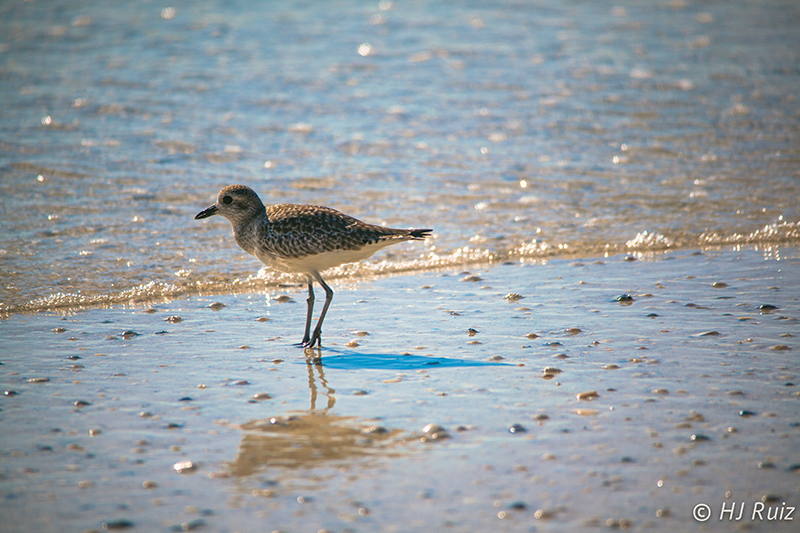
American Golden Plover
These birds forage for food on tundra, fields, beaches and tidal flats, usually by sight. They eat insects and crustaceans, also berries.
The breeding habitat of American Golden Plover is Arctic tundra from northern Canada and Alaska. They nest on the ground in a dry open area. They are migratory and winter in southern South America. They follow an elliptical migration path; northbound birds pass through Central America about January–April and stage in great numbers in places like Illinois before their final push north. In fall, they take a more easterly route, flying mostly over the western Atlantic and Caribbean Sea to the wintering grounds in Patagonia. The bird has one of the longest known migratory routes of over 25,000 miles. Of this, 2,400 miles is over open ocean where it cannot stop to feed or drink. It does this from body fat stores that it stocks up on prior to the flight. It is a regular vagrant to western Europe.
Text excerpts © Wikipedia – Photographs © HJ Ruiz – Avian101
Share this:

Never Too Late to Learn
During my recent vacation to Florida, while I was taking pictures of birds in a swampy area with a medium size pond also has a short boardwalk and some resting benches, there I met two older ladies that had been watching me moving around with my long lens camera trying to take better shots. They told me they are residents in Florida for many years but are originally from New Jersey, they were a couple of pleasantly nice and very talkative ladies, so we struck a conversation about birds and how they always love to drive to hot spots for birds and to simply observe them in their habitat. During our conversation we saw a small group of Boat-tailed Grackles perched onto the boardwalk’s hand railing so I took a few shots of them and showed the pictures to my new friends, the ladies were delighted to see how beautiful they looked on the camera screen. Both women commented that these grackles are among their favorite birds.
They asked me several questions about birds they have seen in the past, among those questions was this one: Why the grackle’s plumage is iridescence and changes colors. After a brief answer, they were satisfied and happy to have met me, soon enough they were letting me know about several hot spots in the area. That’s how I get my information that helps me find birds.


Text and photographs © HJ Ruiz – Avian101
Share this:

Panoramic View of Birds

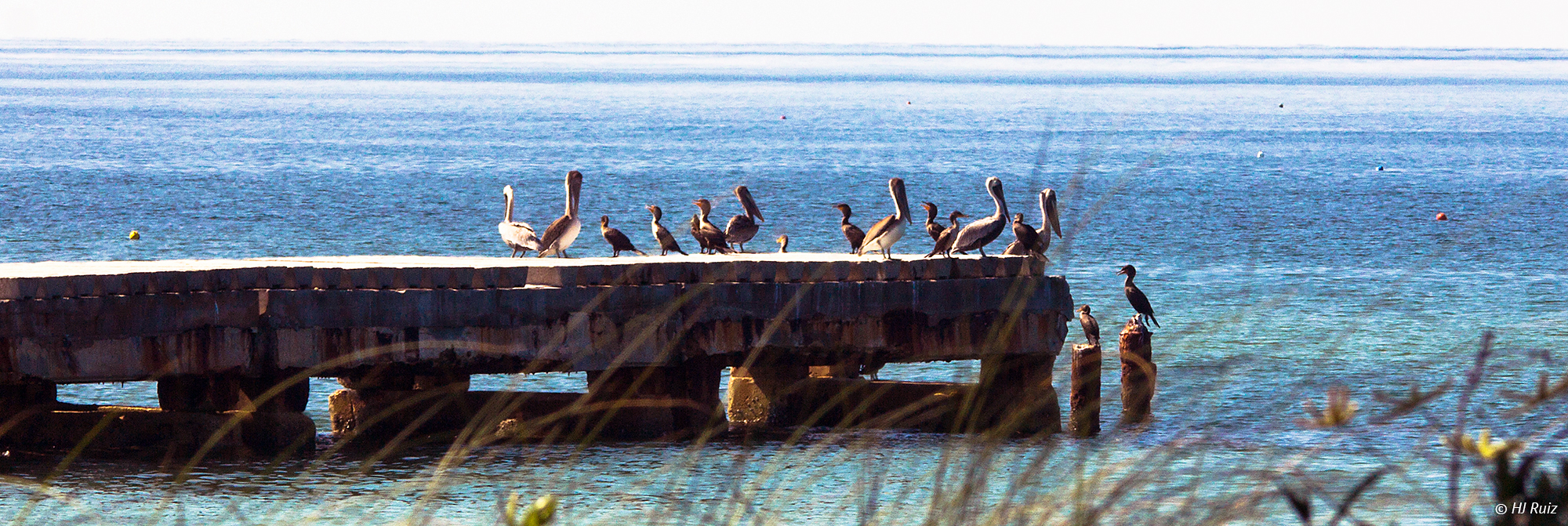
Pelicans and Cormorants — Click image to see enlargement –
© HJ Ruiz – Avian101
Share this:

Beautiful Poise
I love it when I have my camera lens focused on any bird because I can see a great deal of detail and not only that, I can click the shutter and have the image there for me to see it over. Thanks to the invention of photography we can record an image and relive the magical moment over and over, especially when you have a gorgeous bird in front of you such as the Great Egret. I do enjoy watching them, their beautiful poise distills pure beauty. They pose like models strutting their best sides and graceful manners.
Next, I bring you some shots from my last trip. Enjoy!


Text and photographs © HJ Ruiz – Avian101
Share this:


Read Past Reviews

Book # 69

Quote from the Author
“A good chuckle is healthy, it helps you break the monotony of a serious life.” ~ H.J. Ruiz


You must be logged in to post a comment.