Shorebird Taking a Bath
It may seem strange to some people but shorebirds feel quite comfortable to obtain food in foggy days. Apparently they might have the feeling that are somehow safer from predators or other individuals. What I’m trying to point out is that if you are going to do bird photography during a foggy day, do not feel disappointed or discourage by that. Just keep your eyes open and you camera ready, you will later see how much you achieved despite the fog.
Featured gallery for this post is about a handsome bird that is not too shy from the people that frequent the beach and they make good subjects for photo shoots. Here some information about this bird:
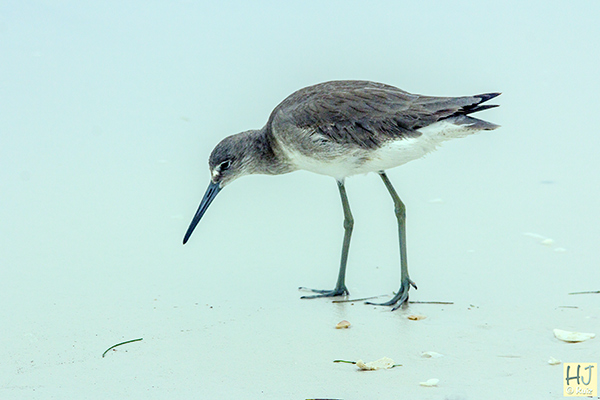
Willet
The Willet (Tringa semipalmata) is a large shorebird in the sandpiper family. It is a good-sized and stout scolopacid, the largest of the shanks. Its closest relative is the lesser yellowlegs, a much smaller bird with a very different appearance apart from the fine, clear, and dense pattern of the neck, which both species show in breeding plumage.
Adults have gray legs and a long, straight, dark and stout bill. The body is dark gray above and light underneath. The tail is white with a dark band at the end. The distinctive black and white pattern of the wings is a common sight along many North American coastal beaches.
Two subspecies (which may actually be different species) have very different breeding habitats and ranges. The eastern willet breeds in coastal salt marshes from Nova Scotia to Mexico and the Caribbean. It winters on the Atlantic coast of South America. The western willet breeds in freshwater prairie marshes in western North America. It winters on both coasts, from the mid-Atlantic states south to at least Brazil on the Atlantic, and from Oregon south to Peru and Chile on the Pacific.
Willets nest on the ground, usually in well-hidden locations in short grass, often in colonies. These birds forage on mudflats or in shallow water, probing or picking up food by sight. They mainly eat insects, crustaceans and marine worms, but also eat some plant material.
Note: The Willet’s population declined sharply due to hunting in the late nineteenth and early twentieth centuries. Their population has since increased, but they are still considered at risk, especially in light of continued habitat loss.


Text excerpts © Wikipedia – Photographs © HJ Ruiz – Avian101
Share this:

Rock the Boat
In my last trip to Florida I saw a lot of this particular species of bird, the Boat-tailed Grackles are all over, in large flocks or small groups. They can eat anything that looks edible. They are smart birds and adapt to urban areas very well. Here I have some more information about this birds:
The Boat-tailed Grackle (Quiscalus major) is a passerine bird of the family Icteridae found as a permanent resident on the coasts of the southeastern United States. It is found in coastal saltwater marshes, and, in Florida, also on inland waters. The nest is a well-concealed cup in trees or shrubs near water; three to five eggs are laid.
Adult males have entirely iridescent black plumage, a long dark bill, a pale yellowish or brown iris and a long keel-shaped tail. The adult female is much smaller She is also distinguished by her shorter tail and tawny-brown coloration, which covers the body apart from the darker wings and tail.
These birds forage on the ground, in shallow water, or in shrubs; they will steal food from other birds. They are omnivorous, eating insects, minnows, frogs, eggs, berries, seeds, and grain, even small birds.


Text excerpt © Wikipedia – Photographs © HJ Ruiz – Avian101
Share this:

Amazing Bird
While I was on vacation in Florida last month I had the opportunity to photograph a small bird that was busy wading and walking on the sand at the end of where the sea waters form ebbs of foam and sea debris such as kelp, shells, conchs, etc. This bird pecks on small mollusks, insects, crustaceans and sea weeds.
I’m referring to the American Golden Plover (Pluvialis dominica) is a medium-sized plover.The breeding habitat of American golden plover is Arctic tundra from northern Canada and Alaska. They nest on the ground in a dry open area. They are migratory and winter in southern South America. They follow an elliptical migration path; northbound birds pass through Central America about January–April and stage in great numbers in places like Illinois before their final push north. In fall, they take a more easterly route, flying mostly over the western Atlantic and Caribbean Sea to the wintering grounds in Patagonia. The bird has one of the longest known migratory routes of over 25,000 miles. Of this, 2,400 miles is over open ocean where it cannot stop to feed or drink. It does this from body fat stores that it stocks up on prior to the flight. It is a regular vagrant to western Europe.


Text excerpts © Wikipedia – Photographs © HJ Ruiz – Avian101
Share this:

Show and Tail
© HJ Ruiz – Avian101
Share this:

Read Past Reviews

Book # 69
Quote from the Author
“A good chuckle is healthy, it helps you break the monotony of a serious life.” ~ H.J. Ruiz


You must be logged in to post a comment.