
Memory Lane
APRIL 2010
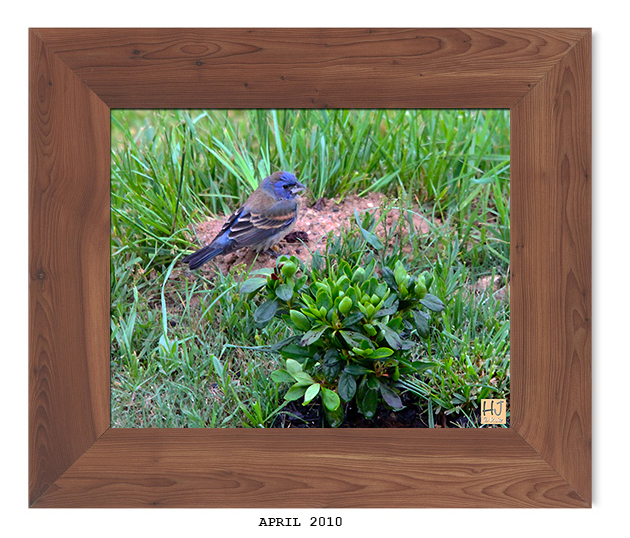
Blue Grosbeak — April 2010
© HJ Ruiz – Avian101
Share this:

Big Guys
It’s nearly impossible not to see some Brown Pelicans if you visit Florida beaches or harbors. And sometimes you may even see White Pelicans in the vicinity. The Brown Pelicans are large birds but smaller that their other Pelican species. Let’s find out a bit more information about these birds.
The Brown Pelican (Pelecanus occidentalis) is a small pelican found in the Americas. It is one of the best known and most prominent birds found in the coastal areas of the southern and western United States. It is one of only three pelican species found in the Western Hemisphere. The brown pelican is one of the only two pelican species which feeds by diving into the water.
This bird is readily distinguished from the American white pelican by its non-white plumage, smaller size and its habit of diving for fish from the air, as opposed to co-operative fishing from the surface. The Peruvian pelican, previously considered a subspecies of brown pelican, is now considered to be a separate species. It has very similar plumage to the brown, but it is noticeably larger. The brown and Peruvian pelicans may overlap in some areas along the Pacific coast of South America.


Text excerpts © Wikipedia – Photographs © HJ Ruiz – Avian101
Share this:

Tricolored Heron
Another handsome bird that I photographed in Florida during my last vacation is the Tricolor Heron. Most of these wader birds are very elusive and great masters of camouflaging with the surroundings, sometime they are very close to you and you aren’t able to see them until they move. I have a trained eye for birds and I’ve learned to scan with my eyes and spot birds by the movement of plants, leaves or brush. Next is a bit more information so you’ll be able to have a better idea of this handsome bird.
The Tricolored Heron (Egretta tricolor) It is a resident breeder from the Gulf states of the USA and northern Mexico south through Central America and the Caribbean to central Brazil and Peru. There is some post-breeding dispersal to well north of the nesting range.
Tricolored heron’s breeding habitat is sub-tropical swamps. It nests in colonies, often with other herons, usually on platforms of sticks in trees or shrubs. In each clutch, 3–7 eggs are typically laid.
This species measures from 22 to 30 inches long and has a wingspan of 38 inches. The slightly larger male heron weighs 14.6 oz. on average, while the female averages 11.8 oz). It is a medium-large, long-legged, long-necked heron with a long pointed yellowish or greyish bill with a black tip. The legs and feet are dark.
Adults have a blue-grey head, neck, back and upper-wings, with a white line along the neck. The belly is white. In breeding plumage, they have long blue filamentous plumes on the head and neck, and buff ones on the back.
The tricolored heron stalks its prey in shallow or deeper water, often running as it does so. It eats fish, crustaceans, reptiles, and insect.


Text excerpt © Wikipedia – Photographs © HJ Ruiz – Avian101
Share this:

Pedal to the Metal
Today my post is about a little bird that I enjoy watching run on the sandy beach back and forth from the ebbing surf, looking for the small invertebrates or any of their favorite food. They are very fast runners and they are sometimes a bit difficult to photograph because of their constant moving.
The Sanderling (Calidris alba) is a small wading bird. It is a circumpolar Arctic breeder, and is a long-distance migrant, wintering south to South America, South Europe, Africa, and Australia. It is highly gregarious in winter, sometimes forming large flocks on coastal mudflats or sandy beaches.
It is somewhat unlike other sandpipers in appearance, which has led to the suggestion that it should be placed into a monotypic genus Crocethia. A more recent review (Thomas et al., 2004) indicates, however, that the sanderling is a fairly typical “stint” or small sandpiper and should be separated from the large knots with its closest relatives in a distinct genus.
This bird is similar in size to a dunlin, but stouter, with a thick bill. It shows a strong white wing-bar in flight, and runs along the sandy beaches it prefers with a characteristic “bicycling” action of its legs, stopping frequently to pick small food items. It eats small crabs and other small invertebrates. In spring, birds migrating north from South America consume large numbers of horseshoe crab eggs in the Delaware Bay area.


Text excerpts © Wikipedia – Photographs © HJ Ruiz – Avian101
Share this:

Read Past Reviews

Book # 69
Quote from the Author
“A good chuckle is healthy, it helps you break the monotony of a serious life.” ~ H.J. Ruiz


You must be logged in to post a comment.