
Panoramic View of Birds

Northern Cardinal (M) — Click on image to see enlargement —
© HJ Ruiz – Avian101
Share this:

Memory Lane
December 2009
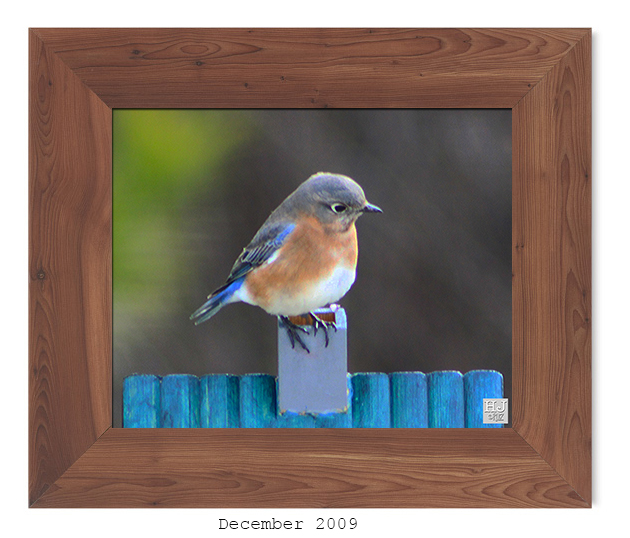
Eastern Bluebird — Dec. 2009
© HJ Ruiz – Avian101
Share this:

Tough as Nails
This year was the first, my backyard and feeders were visited by White-breasted Nuthatch. It was very delightful to observe them for the first time. This bird is quite good looking and vibrant, full of energy.
The white-breasted nuthatch is a small songbird of the nuthatch family which breeds in old-growth woodland across much of temperate North America. It is a stocky bird, with a large head, short tail, powerful bill, and strong feet. The upperparts are pale blue-gray, and the face and underparts are white. It has a black cap and a chestnut lower belly.
Like other nuthatches, the white-breasted nuthatch forages for insects on trunks and branches, and is able to move head-first down trees. Seeds form a substantial part of its winter diet, as do acorns and hickory nuts that were stored by the bird in the fall. The nest is in a hole in a tree, and the breeding pair may smear insects around the entrance as a deterrent to squirrels.
This bird is very independent and doesn’t mix with other species, it has the respect of other birds his size at the feeders, having the potential to be a strong adversary with the beak strong as a nail.
“I hope that they stay all year round.”
Photo Gallery


Text and photographs © HJ Ruiz – Avian101
Share this:

Red Tide
The Northern Cardinal is a North American bird in the genus Cardinalis; it can be found in southern Canada, through the eastern United States from Maine to Texas and south through Mexico. It is found in woodlands, gardens, shrublands, and swamps.
The northern cardinal is a mid-sized songbird. It has a distinctive crest on the head and a mask on the face which is black in the male and gray in the female. The male is a vibrant red, while the female is a dull red-brown shade. The northern cardinal is mainly granivorous, but also feeds on insects and fruit. During courtship, the male feeds seed to the female beak-to-beak. A clutch of three to four eggs is laid, and two to four clutches are produced each year. It was once prized as a pet, but its sale as a cage bird is now banned in the United States by the Migratory Bird Treaty Act of 1918.
The diet of the northern cardinal consists mainly (up to 90%) of weed seeds, grains, and fruits. It is a ground feeder and finds food while hopping on the ground through trees or shrubbery. It eats beetles, cicadas, grasshoppers, snails, wild fruit and berries, corn (maize) and oats, sunflower seeds.
The Northern Cardinals are very popular and favorite of the public because their wonderful appearance and strikingly beautiful colors. I’ve been blessed to have several cardinal families nesting in my backyard. It’s always a treat to see them flying around looking pretty and ready to pose for my photos.
“My neighbors never cease to ask me, what do I do to attract them?. I don’t know what to tell them anymore!”
Photo Gallery


Text and photographs © HJ Ruiz – Avian101
Share this:

Read Past Reviews

Book # 69
Quote from the Author
“A good chuckle is healthy, it helps you break the monotony of a serious life.” ~ H.J. Ruiz


You must be logged in to post a comment.