Look Outside my Window!
Welcome my friends! Today’s post is going to change a bit, this one will be dedicated to only one species of birds that are currently visiting my backyard with more frequency. They love to travel in groups or in large flocks. The name is Brown-headed Cowbird, birds that are common and very abundant. Let’s take a look at more information from © Wikipedia:
The Brown-headed Cowbird (Molothrus ater) is a small obligate brood parasitic icterid of temperate to subtropical North America. They are permanent residents in the southern parts of their range; northern birds migrate to the southern United States and Mexico in winter, returning to their summer habitat around March or April.
The brown-headed cowbird is typical for an icterid in general shape, but is distinguished by a finch-like head and beak and is smaller than most icterids. The adult male is iridescent black in color with a brown head. The adult female is slightly smaller and is dull grey with a pale throat and very fine streaking on the underparts.The species lives in open or semi-open country and often travels in flocks, sometimes mixed with red-winged blackbirds (particularly in spring) and bobolinks (particularly in fall), as well as common grackles or European starlings. These birds forage on the ground, often following grazing animals such as horses and cows to catch insects stirred up by the larger animals. They mainly eat seeds and insects. Brown-headed cowbirds do not raise their own young, instead laying their eggs in the nests of other bird species. Because of this, cowbirds are not exposed to species-typical visual and auditory information like other birds. Despite this, cowbirds are able to develop species-typical singing, social, and breeding behaviors.
Photo Gallery


© HJ Ruiz – Avian101
Share this:

Show and Tail


© HJ Ruiz – Avian101
Share this:

Panoramic View of Birds
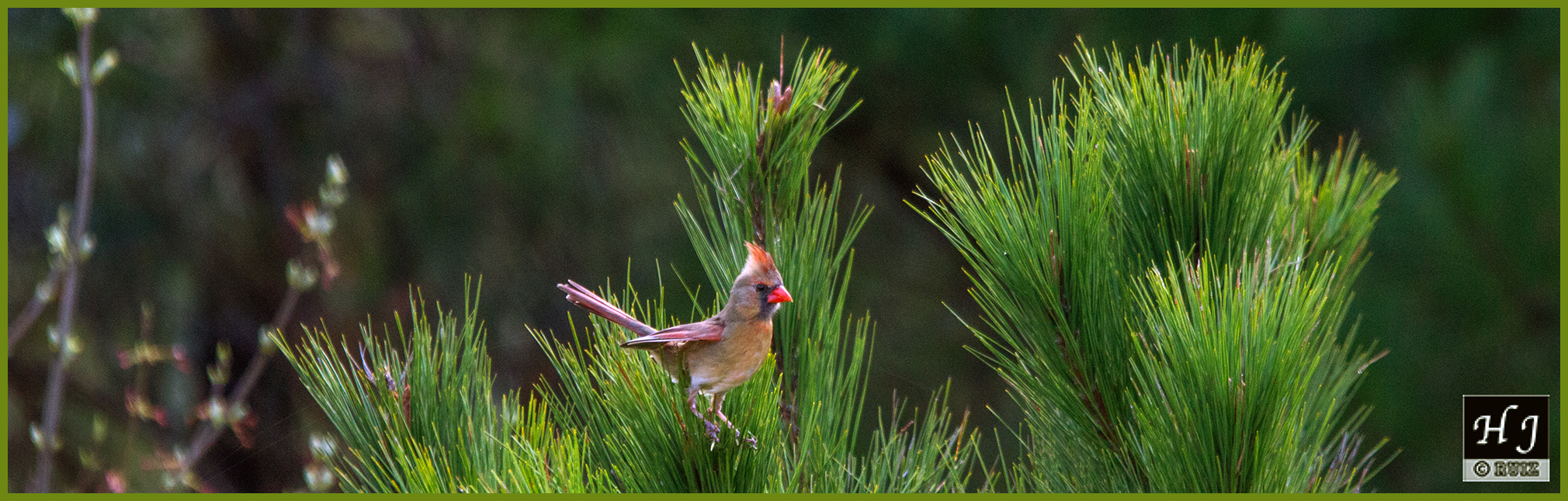
Female Northern Cardinal —Click for enlargement—
© HJ Ruiz – Avian101
Share this:

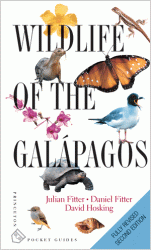
Wildlife of the Galapagos – Book Review
Wildlife of the Galapagos
Authors: Julian Fitter – Daniel Fitter – David Hosking
Book Review
“After a decade or so, the second edition of this guide about the animal life of the Galapagos will be published, totally revised, March 30th, 2016.
The group of islands known as the Galapagos are located in Ecuador and to my own opinion, are the best animal sanctuary in the world right now.
Click for info
This well structured guide, perfectly describe and defines each of the 400 more prominent species of birds, mammals, plants, invertebrates famous reptiles and marine life. Galapagos is the epitome of a scientific sanctuary, a perfect biologic museum of living creatures and also a great place to study about wildlife. The authors of this book are well qualified to give an accurate account of each of the previously mentioned species. The photographs displayed as well as drawings and maps, complete the information in a comprehensive language and easy to all levels of amateur or professional curiosity. I believe that this guide provides a great help to anybody planning to visit the Galapagos for quick reference.”
Review by: H.J. Ruiz – March 26th, 2016
© HJ Ruiz – Avian101
Share this:

Read Past Reviews

Book # 69
Quote from the Author
“A good chuckle is healthy, it helps you break the monotony of a serious life.” ~ H.J. Ruiz


You must be logged in to post a comment.