Photo Capture # 9 – Photo “Bomb”
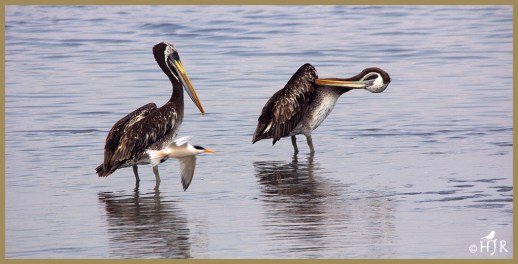
Photo “Bomb” – Two Peruvian Pelicans and a Royal Tern
© HJ Ruiz – Avian101
Share this:

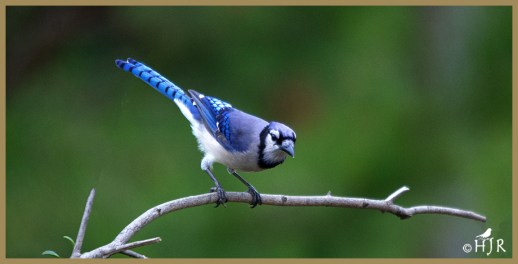
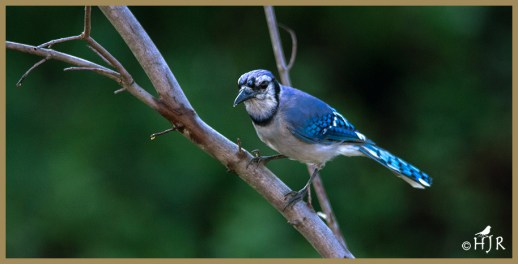
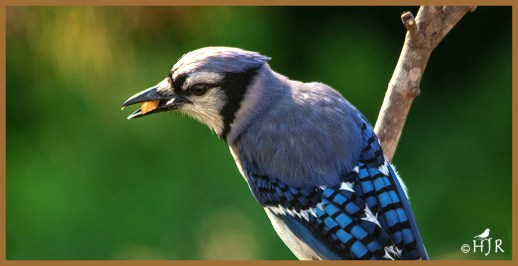
Bird’s ID – Blue Jay
Blue Jay
The Blue Jay (Cyanocitta cristata) is a passerine bird in the family Corvidae, native to North America. It resides through most of eastern and central United States, although western populations may be migratory. Resident populations are also found in Newfoundland, Canada, while breeding populations can be found in southern Canada. It breeds in both deciduous and coniferous forests, and is common in residential areas. It is predominantly blue with a white chest and underparts, and a blue crest. It has a black, U-shaped collar around its neck and a black border behind the crest. Both sexes are similar in size and plumage, and plumage does not vary throughout the year. Four subspecies of the blue jay have been recognized.
The blue jay mainly feeds on nuts and seeds such as acorns, soft fruits, arthropods, and occasionally small vertebrates. It typically gleans food from trees, shrubs, and the ground, though it sometimes hawks insects from the air. Like squirrels, blue jays are known to hide nuts for later consumption. It builds an open cup nest in the branches of a tree, which both sexes participate in constructing. The clutch can contain two to seven eggs, which are blueish or light brown with brown spots. Young are altricial, and are brooded by the female for 8–12 days after hatching. They may remain with their parents for one to two months.
ts plumage is lavender-blue to mid-blue in the crest, back, wings, and tail, and its face is white. The underside is off-white and the neck is collared with black which extends to the sides of the head. The wing primaries and tail are strongly barred with black, sky-blue and white. The bill, legs, and eyes are all black. Males and females are almost identical, but the male is slightly larger.
As with most other blue-hued birds, the blue jay’s coloration is not derived from pigments but is the result of light interference due to the internal structure of the feathers; if a blue feather is crushed, the blue disappears because the structure is destroyed. This is referred to as structural coloration.
Photo Gallery

© HJ Ruiz – Avian101
Share this:

Photo Capture # 8 – Crested Duck
Crested Duck
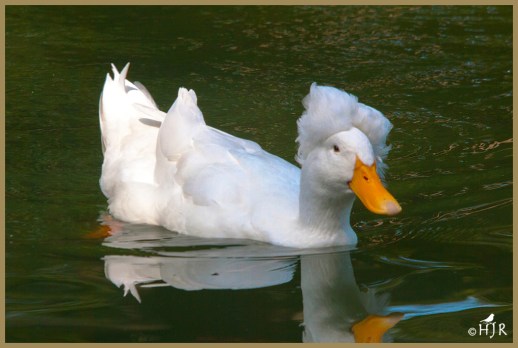
Crested Duck
© HJ Ruiz – Avian101
Share this:

What’s Up? – Halloween and birds…
Halloween and Birds…
Last week was a “smorgasbord” of weather, it was, one day windy, the next, rainy then cold and on Halloween day it was perfect!
The temperature was in the 70’s , sunny and bright in the morning same in the afternoon and gloriously mild in the evening.
It was a busy Halloween, there were children galore knocking on doors, all clad in the most exotic costumes. Tyler was dressed and made up as the animated character “Miguel” in the movie “COCO”. – (See photo below)
Tyler was so happy to bring home a ton of candy, collected from the neighbors! Do you remember the candy that Lucy bought? It wasn’t enough!
My birds have been happy with the change in weather too, they come in droves to the feeders. Of course I have to double the ration too!.. That’ll keep them happy too!
Photo Gallery


This is my son Tyler (8) ready for Halloween. His costume is based on an animated character Miguel from the movie “COCO”
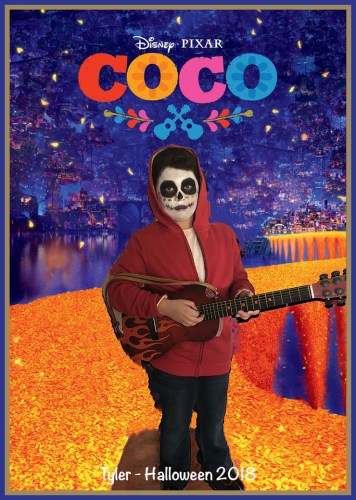
Tyler’s Halloween costume
© HJ Ruiz – Avian101
Share this:

Read Past Reviews

Book # 69
Quote from the Author
“A good chuckle is healthy, it helps you break the monotony of a serious life.” ~ H.J. Ruiz


You must be logged in to post a comment.