Bird’s ID – Broad-winged Hawk
Broad-winged Hawk
The Broad-winged Hawk (Buteo platypterus) is a small hawk of the genus Buteo. During the summer, some subspecies are distributed over eastern North America, as far west as British Columbia and Texas; they then migrate south to winter in the neotropics from Mexico south to southern Brazil. Other subspecies are all-year residents on Caribbean islands. As in most raptors, females are slightly larger than males. Broad-winged hawks’ wings are relatively short and broad with a tapered, somewhat pointed appearance. The two types of coloration are a dark morph with fewer white areas and a light morph that is more pale overall. Although the broad-winged hawk’s numbers are relatively stable, populations are declining in some parts of its breeding range because of forest fragmentation.
The broad-winged hawk is a relatively small Buteo, with a body size from 32 to 44 cm (13 to 17 in) in length and weighing 265 to 560 g (9.3 to 19.8 oz). The tail is relatively short, measuring 14.5–19.0 cm (5.7–7.5 in) in length. The tarsus measures from 5.6 to 6.6 cm (2.2 to 2.6 in). As in most raptors, females are slightly larger than males. Broad-winged hawks have relatively short and broad wings, pointed at the end, which have a tapered appearance unique to the species. The wingspan can range from 74 to 100 cm (29 to 39 in), with the extended wing bone (standard measurement) measuring 22.7–30 cm (8.9–11.8 in).
An adult’s body is a dark brown with a white belly and chest containing horizontal barring. Its tail can be a dark grey-black with white lines along the middle, base, and tip. The young hawks have a slightly different coloring with more white and longitudinal barring instead of horizontal barring. The two types of coloration are a dark morph with fewer white areas and a light morph that is more pale overall. The light morph of this bird is most likely to be confused with the red-shouldered hawk, but it has a longer, more heavily barred tail and wings with a solid rufous color in the adult, which are usually distinctive. Rare dark morphs are a darker brown on both upperparts and underparts. Dark-morph short-tailed hawks are similar, but are whitish under the tail with a single subterminal band.
Note: The Broad-winged Hawk is # 215 in the list count of “Lifers”
Photo Gallery

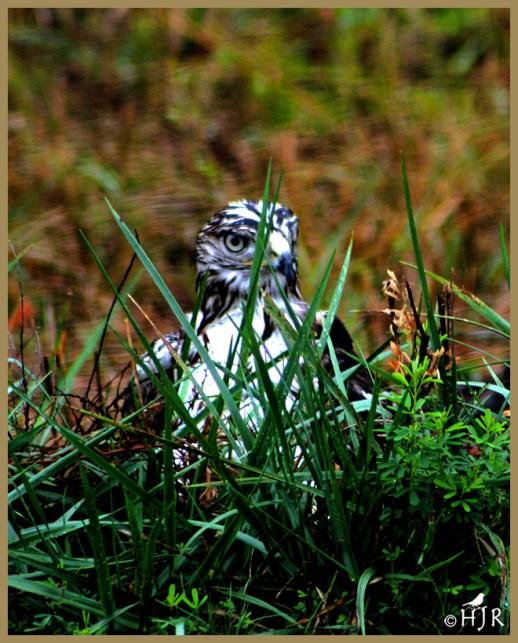
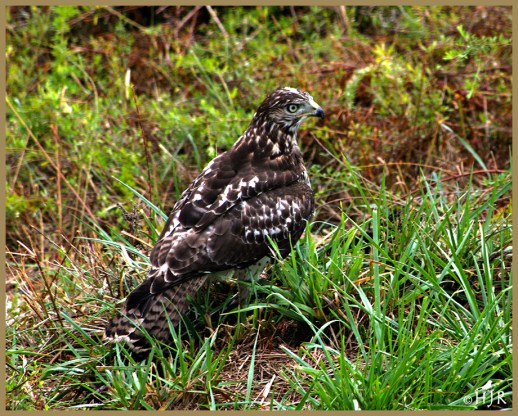
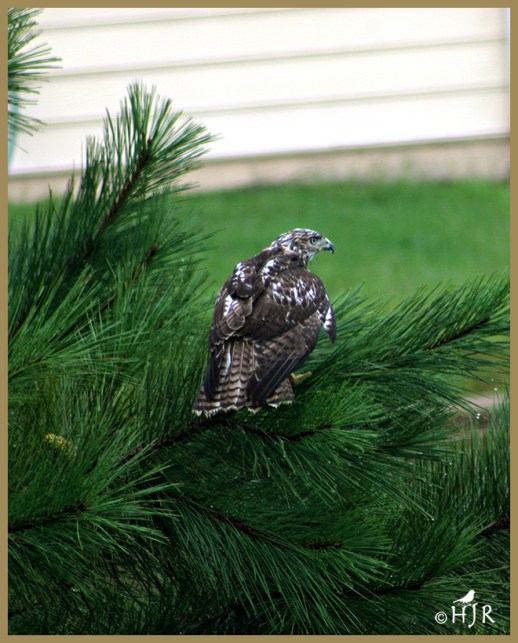
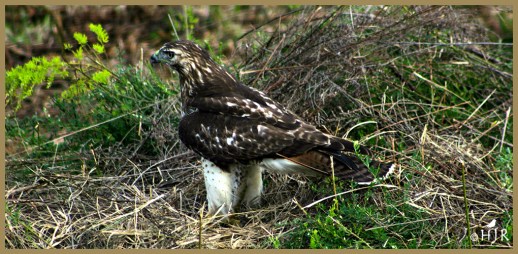
© HJ Ruiz – Avian101
Share this:

Photo Capture # 17 – Chilean Flamingo
Chilean Flamingo
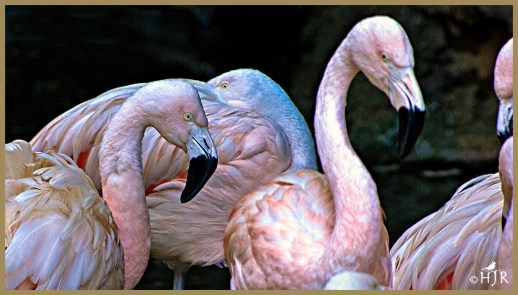
© HJ Ruiz – Avian101
Share this:

What’s Up? – Not so bad…
Not so bad…
Last week was very peculiar, weather wise. Very cold and icy at early mornings, then temperature rises to mid 60º’s, and gets sunny. Can’t complain about that!. One day I was working in my backyard after postponing several times because of the wether conditions. That’s when I do the trimming of the shrubs, also pruning of long branches for some trees using the hedge trimmer mostly and a saw.
While I was doing all the mentioned above, one of my neighbors was walking her dog, she called me from across the road and asked me: – What kind of bird is on top of that tree? She pointed at the tallest tree we have in this area, (Over two hundred years old Oak by the creek). I just saw a large bird right on top but couldn’t be precise and I said, must be a hawk of some kind, because the hawks always perch there and watch the whole area looking for preys. She accepted my guess answer and went home.
I continued working with the trimming, etc. Over one hour later I looked up the tree again and the bird was there yet. I went in the house and said to Lucy, – Somebody is watching me work! She got curious and came out to the patio, I pointed up the tree. She said what is that?
I don’t really know but if that bird is still there when I finish my work, then I’ll bring my camera to shoot some pictures and find out what bird it is…
An hour later, when I was finished…the darned bird sat still there! I brought my camera and shot some pictures, that’s when I found out it was a Black Vulture!
My regular birds are enjoying the good breaks on the weather, it makes quite a difference in the daily lives of everyone.


Photo Gallery


© HJ Ruiz – Avian101
Share this:

Photo Capture # 16 – Vermillion Flycatcher
Vermillion Flycatcher
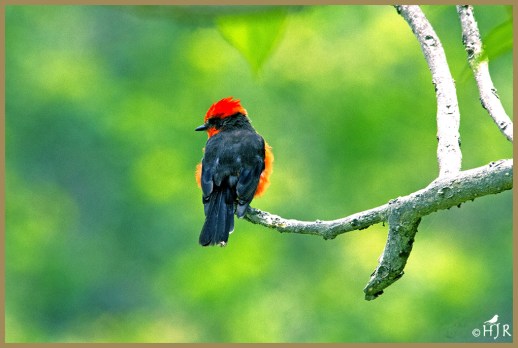
© HJ Ruiz – Avian101
Share this:

Read Past Reviews

Book # 69
Quote from the Author
“A good chuckle is healthy, it helps you break the monotony of a serious life.” ~ H.J. Ruiz
 H.J. Ruiz - Avian101
You must be logged in to post a comment.