Photo Capture # 33 – Royal Terns and Willet
Royal Terns and Willet
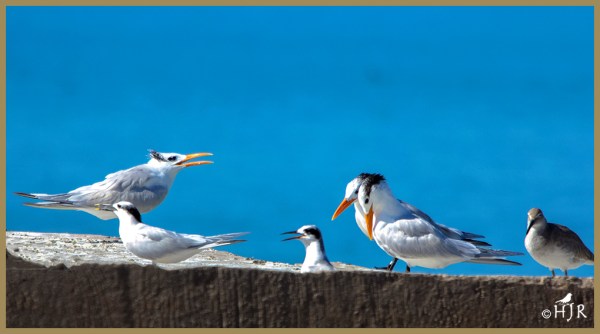
Royal Terns and Willet
© HJ Ruiz – Avian101
Share this:

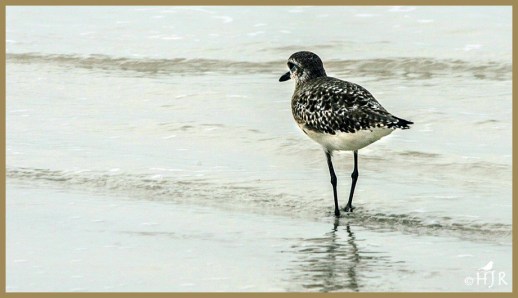
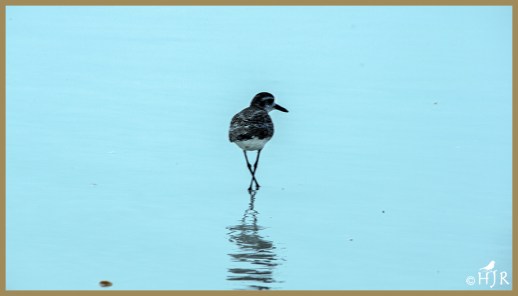
Bird’s ID – Black-bellied Plover
Black-bellied Plover
The Black-bellied Plover (Pluvialis squatarola), also known as the Gray Plover, is a medium-sized plover breeding in Arctic regions. It is a long-distance migrant, with a nearly worldwide coastal distribution when not breeding. The genus name is Latin and means relating to rain, from pluvia, “rain”. It was believed that golden plovers flocked when rain was imminent. The species name squatarola is a Latinised version of Sgatarola, a Venetian name for some kind of plover.
They are 27–30 cm (11–12 in) long with a wingspan of 71–83 cm (28–33 in) and a weight of 190–280 g (6.7–9.9 oz) (up to 345 g (12.2 oz) in preparation for migration). In spring and summer (late April or May to August), the adults are spotted black and white on the back and wings. The face and neck are black with a white border; they have a black breast and belly and a white rump. The tail is white with black barring. The bill and legs are black. They moult to winter plumage in mid August to early September and retain this until April; this being a fairly plain grey above, with a grey-speckled breast and white belly. The juvenile and first-winter plumages, held by young birds from fledging until about one year old, are similar to the adult winter plumage but with the back feathers blacker with creamy white edging. In all plumages, the inner flanks and axillary feathers at the base of the underwing are black, a feature which readily distinguishes it from the other three Pluvialis species in flight.
Their breeding habitat is Arctic islands and coastal areas across the northern coasts of Alaska, Canada, and Russia. They nest on the ground in a dry open tundra with good visibility; the nest is a shallow gravel scrape. Four eggs (sometimes only three) are laid in early June, with an incubation period of 26–27 days; the chicks fledge when 35–45 days old.
They migrate to winter in coastal areas throughout the world.
Young birds do not breed until two years old; they typically remain on the wintering grounds until their second summer.
They forage for food on beaches and tidal flats, usually by sight. The food consists of small mollusks, polychaete worms, crustaceans, and insects. It is less gregarious than the other Pluvialis species, not forming dense feeding flocks, instead feeding widely dispersed over beaches, with birds well spaced apart. They will however form dense flocks on high tide roosts.
Photo Gallery

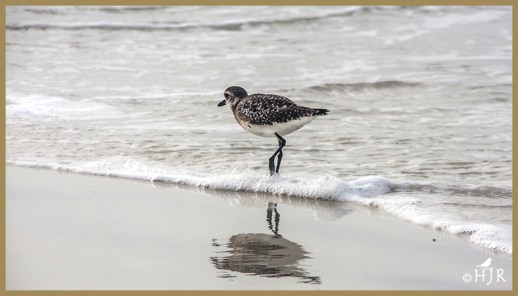

© HJ Ruiz – Avian101
Share this:

Photo Capture # 32 – Anhinga
Anhinga
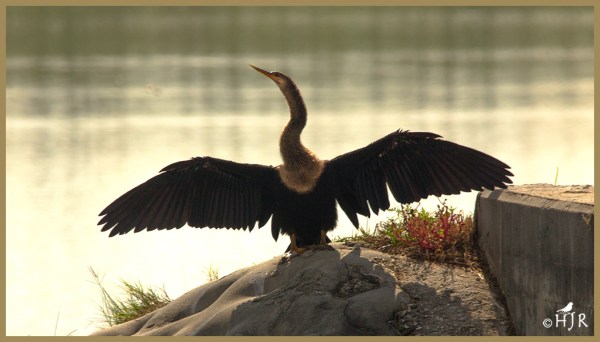
Anhinga
© HJ Ruiz – Avian101
Share this:

What’s Up? – End of the Year
End of the Year
Here we are, at the end of the year 2018. I will not dwell on describing how we had, very hot days, heavy storms, tornados, tropical storms, hurricanes, frost, floods and to top it, an earthquake.The mentioned, are not Avian101’s activities if you noticed, the real annual comment it’s about what has occurred throughout the year 2018, under my care.
I consider 2018 has been very good for my birds, they all look and are very healthy, they come and go, some build a nest but later leave to migration, some other birds decide to stay and build their nests to stay and brave the cold days of winter in my backyard.
I’ve been honored by having some birds return after a period of time and new additions to my “lifer” count (216). I haven’t seen any sick or ailing birds among my birds.
One thing I know, they have consumed much more seeds than previous years, destroyed many more clay saucers than before (with help of the squirrels).
Cats are still on the prowl, so are the Hawks! By the way, the other day I was shooting pictures and suddenly I saw a male cardinal start flight toward me and then veer away. I thought :
– ”What’s wrong with this guy?” Then I saw a Cooper’s Hawk come out running from under the deck and when he saw me, panicked! He made a u-turn quickly and took off flying, maneuvering like I’ve never seen before! He tried not to hit anything on the way to the trees.
I take this post as an opportunity to thank all my friends followers and visitors. They have been very supporting of my work, writing great comments that usually encourage me to improve and give me the energy to advance my blogging.
I wish ya’all have a healthy, happy and prosperous New Year!
Photo Gallery


Eating Lunch With…
Blue Jays
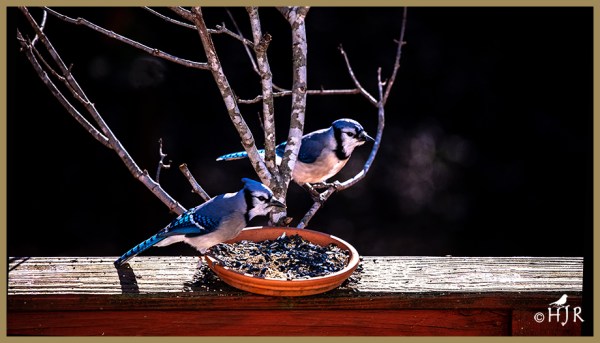
Blue Jays
© HJ Ruiz – Avian101
Share this:

Read Past Reviews

Book # 69
Quote from the Author
“A good chuckle is healthy, it helps you break the monotony of a serious life.” ~ H.J. Ruiz


You must be logged in to post a comment.