What’s Up? – Cold and Sunny…
Cold and Sunny…
It has been a wacky cold week for us. We had very cold mornings, then got sunny and just a few degrees warmer. For birds, the mere fact to see the sun shining came out happily to get their meals.
Overall I had a good week because my backyard was visited by a good variety of birds I haven’t seen for a while and one that will be added to my “Lifer” list (I’ll have it featured on Bird’s ID, next week)
Here are my last week’s visitors:
- Blue Jay
- European Starling
- Carolina Chickadee
- Carolina Wren
- Brown Thrasher
- Song Sparrow
- Field Sparrow
- Mourning Dove
- Brown-headed Cowbird
- Northern Mockingbird
- Northern Cardinal
- House Finch
- Palm Warbler
- Pine Warbler
- White-throated Sparrow
- Tufted Titmouse
- Brown-headed Nuthatch
- Ruby-crowned Kinglet (New “lifer”)
I do enjoy my birds and Photography a lot. By the way, I also enjoy birds from other places, reason that I’m starting to plan my next vacation trip to Florida on the last week of February 2019.
– I’d like to get some suggestions from you: What places in FLORIDA I should visit in order to shoot some good pictures? Please indicate the name of the place and if the place will be open that time. I think it will be interesting to see what I come out with. Thank you very much! – H.J.
Photo Gallery


Eating Lunch With…
Brown Thrasher
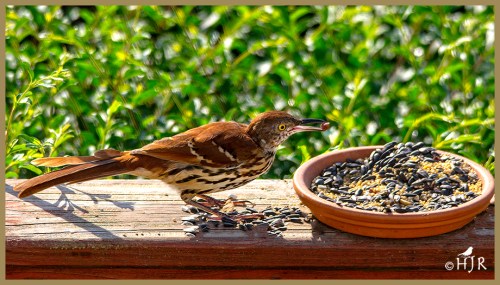
Brown Thrasher
© HJ Ruiz – Avian101
Share this:

Photo Capture # 46 – Great Egret
Great Egret

Great Egret
© HJ Ruiz – Avian101
Share this:

Red Gallery – Northern Cardinal
While cardinals are naturally ground feeders, humans provide them with an abundant amount of food in bird feeders. They are attracted to most bird feed, but are particularly fond of black oil sunflower seeds. They also like to eat suet, peanuts, fresh berries. Cardinals get their bright colors from the pigments found in berries and other plant materials in their diet.
Photo Gallery
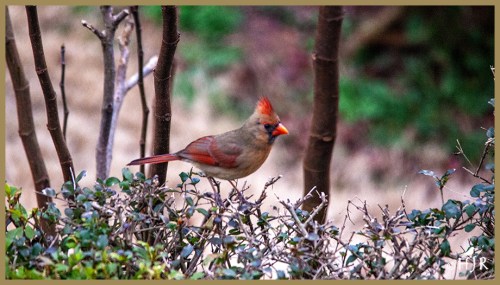
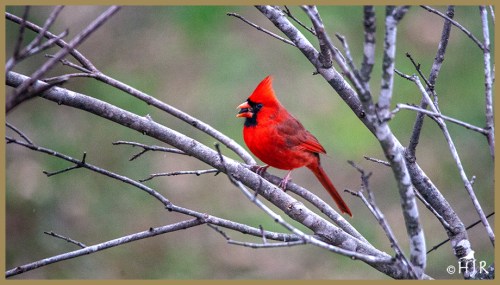
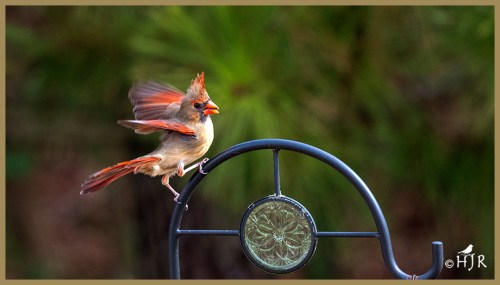
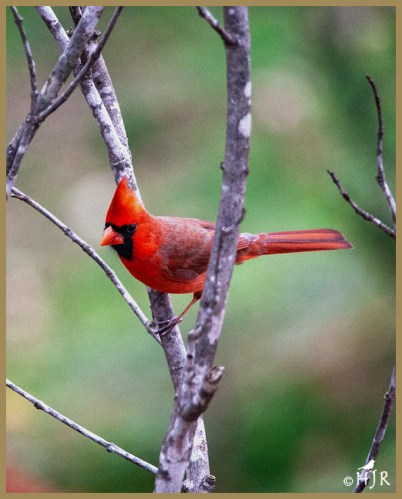
© HJ Ruiz – Avian101
Share this:

Bird’s ID – Ruby-throated Hummingbird
Ruby – throated Hummingbird
The Ruby-throated Hummingbird (Archilochus colubris) is a species of hummingbird that generally spends the winter in Central America, Mexico, and Florida, and migrates to Eastern North America for the summer to breed. It is by far the most common hummingbird seen east of the Mississippi River in North America.
This hummingbird is from 7 to 9 cm (2.8 to 3.5 in) long and has an 8 to 11 cm (3.1 to 4.3 in) wingspan. Weight can range from 2 to 6 g (0.071 to 0.212 oz), with males averaging 3.4 g (0.12 oz) against the slightly larger female which averages 3.8 g (0.13 oz). Adults are metallic green above and greyish white below, with near-black wings. Their bill, at up to 2 cm (0.79 in), is long, straight, and very slender. As in all hummingbirds, the toes and feet of this species are quite small, with a middle toe of around 0.6 cm (0.24 in) and a tarsus of approximately 0.4 cm (0.16 in). The ruby-throated hummingbird can only shuffle if it wants to move along a branch, though it can scratch its head and neck with its feet.
The species is sexually dimorphic. The adult male has a gorget (throat patch) of iridescent ruby red bordered narrowly with velvety black on the upper margin and a forked black tail with a faint violet sheen. The red iridescence is highly directional and appears dull black from many angles. The female has a notched tail with outer feathers banded in green, black, and white and a white throat that may be plain or lightly marked with dusky streaks or stipples. Males are smaller than females and have slightly shorter bills. Juvenile males resemble adult females, though usually with heavier throat markings. The plumage is molted once a year, beginning in late summer.
Ruby-throated hummingbirds are solitary. (Adults of this species are not social, other than during courtship (which lasts a few minutes); the female also cares for her offspring. Both males and females of any age are aggressive toward other hummingbirds. They may defend territories, such as a feeding territory, attacking and chasing other hummingbirds that enter.
As part of their spring migration, portions of the population fly from the Yucatan peninsula of Mexico across the Gulf of Mexico, arriving first in Florida and Louisiana. This feat is impressive, as a 800 km (500 mi), non-stop flight over water would seemingly require a caloric energy that far exceeds an adult hummingbird’s body weight of 3 g (0.11 oz). However, researchers discovered the tiny birds can double their fat mass in preparation for their Gulf crossing, then expend the entire calorie reserve from fat during the 20-hour non-stop crossing when food and water are unavailable.
Hummingbirds have one of the highest metabolic rates of any animal, with heart rates up to 1260 beats per minute, breathing rate of about 250 breaths per minute even at rest, and oxygen consumption of about 4 ml oxygen/g/hour at rest. During flight, hummingbird oxygen consumption per gram of muscle tissue is approximately 10 times higher than that seen for elite human athletes.
They feed frequently while active during the day. When temperatures drop, particularly on cold nights, they may conserve energy by entering hypothermic torpor.
Photo Gallery


© HJ Ruiz – Avian101
Share this:

Read Past Reviews

Book # 69
Quote from the Author
“A good chuckle is healthy, it helps you break the monotony of a serious life.” ~ H.J. Ruiz


You must be logged in to post a comment.