
Bird’s ID – Great Blue Heron
Great Blue Heron
The Great Blue Heron (Ardea herodias) is a large wading bird in the heron family Ardeidae, common near the shores of open water and in wetlands over most of North America and Central America, as well as the Caribbean and the Galápagos Islands. It is a rare vagrant to coastal Spain, the Azores, and areas of far southern Europe. An all-white population found only in south Florida and the Florida Keys is known as the great white heron. Debate exists about whether it is a white color morph of the great blue heron, a subspecies of it, or an entirely separate species.
It is the largest North American heron and, among all extant herons, it is surpassed only by the goliath heron (Ardea goliath) and the white-bellied heron (Ardea insignis). It has head-to-tail length of 91–137 cm (36–54 in), a wingspan of 167–201 cm (66–79 in), a height of 115–138 cm (45–54 in), and a weight of 1.82–3.6 kg (4.0–7.9 lb). In British Columbia, adult males averaged 2.48 kg (5.5 lb) and adult females 2.11 kg (4.7 lb). In Nova Scotia and New England, adult herons of both sexes averaged 2.23 kg (4.9 lb), while in Oregon, both sexes averaged 2.09 kg (4.6 lb) Thus, great blue herons are roughly twice as heavy as great egrets (Ardea alba), although only slightly taller than them, but they can weigh about half as much as a large goliath heron.
Notable features of great blue herons include slaty (gray with a slight azure blue) flight feathers, red-brown thighs, and a paired red-brown and black stripe up the flanks; the neck is rusty-gray, with black and white streaking down the front; the head is paler, with a nearly white face, and a pair of black or slate plumes runs from just above the eye to the back of the head. The feathers on the lower neck are long and plume-like; it also has plumes on the lower back at the start of the breeding season. The bill is dull yellowish, becoming orange briefly at the start of the breeding season, and the lower legs are gray, also becoming orangey at the start of the breeding season. Immature birds are duller in color, with a dull blackish-gray crown, and the flank pattern is only weakly defined; they have no plumes, and the bill is dull gray-yellow. Among standard measurements, the wing chord is 43–49.2 cm (16.9–19.4 in), the tail is 15.2–19.5 cm (6.0–7.7 in), the culmen is 12.3–15.2 cm (4.8–6.0 in), and the tarsus is 15.7–21 cm (6.2–8.3 in). The heron’s stride is around 22 cm (8.7 in), almost in a straight line. Two of the three front toes are generally closer together. In a track, the front toes, as well as the back, often show the small talons.
The primary food for great blue heron is small fish, though it is also known to opportunistically feed on a wide range of shrimp, crabs, aquatic insects, rodents, and other small mammals, amphibians, reptiles, and birds, especially ducklings. Primary prey is variable based on availability and abundance. In Nova Scotia, 98% of the diet was flounder In British Columbia, the primary prey species are sticklebacks, gunnels, sculpins, and perch. California herons were found to live mostly on sculpin, bass, perch, flounder, and top smelt. Nonpiscine prey is rarely quantitatively important, though one study in Idaho showed that from 24 to 40% of the diet was made up of voles.
Photo Gallery


© HJ Ruiz – Avian101
Share this:

Photo Capture # 48 – Northern Mockingbird
Northern Mockingbird
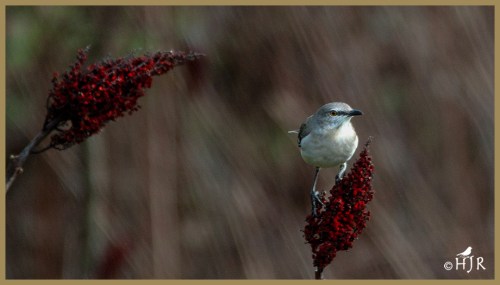
Northern Mockingbird
© HJ Ruiz – Avian101
Share this:

Bird’s ID – Common Moorhen
Common Moorhen
The Common Moorhen (Gallinula chloropus) is a bird species in the family Rallidae. It is distributed across many parts of the Old World.
The common moorhen lives around well-vegetated marshes, ponds, canals and other wetlands. The species is not found in the polar regions or many tropical rainforests. Elsewhere it is likely the most common rail species, except for the Eurasian coot in some regions.
The moorhen is a distinctive species, with dark plumage apart from the white undertail, yellow legs and a red frontal shield. The young are browner and lack the red shield. The frontal shield of the adult has a rounded top and fairly parallel sides; the tailward margin of the red unfeathered area is a smooth waving line. In the related common gallinule of the Americas, the frontal shield has a fairly straight top and is less wide towards the bill, giving a marked indentation to the back margin of the red area.
The common moorhen gives a wide range of gargling calls and will emit loud hisses when threatened. A midsized to large rail, it can range from 30 to 38 cm (12 to 15 in) in length and span 50 to 62 cm (20 to 24 in) across the wings. The body mass of this species can range from 192 to 500 g (6.8 to 17.6 oz).
This species will consume a wide variety of vegetable material and small aquatic creatures. They forage beside or in the water, sometimes walking on lilypads or upending in the water to feed. They are often secretive, but can become tame in some areas. Despite loss of habitat in parts of its range, the common moorhen remains plentiful and widespread.
Photo Gallery


© HJ Ruiz – Avian101
Share this:

Photo Capture # 47 – Blue Jay
Blue Jay
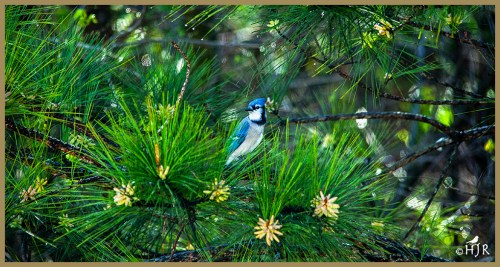
Blue Jay
© HJ Ruiz – Avian101
Share this:

Read Past Reviews

Book # 69

Quote from the Author
“A good chuckle is healthy, it helps you break the monotony of a serious life.” ~ H.J. Ruiz


You must be logged in to post a comment.