What’s Up? – Heat and Tempers
Heat and Tempers…
It’s been over a week without rain and the closest forecast for rain is next Saturday. The temperature of this weather has been considerably hotter than previous years. It’s in the mid 90ºs every day!
I’ve been watering the plants with a hose but only slightly, what we need is a good rain and get enough water for all vegetation, before it gets dry.
My birds have been consistent to visiting the feeders, I always make sure that they have a source of water to take a bath and to drink. They do enjoy the baths. Just yesterday, while we were having lunch I saw some starlings making such a splashy bath that the water end up on the ground, we were laughing, these guys love to stir things up in everything they do.
That morning I witnessed and could capture one frame only of a tremendous fight between brothers, young starlings with real hot tempers, the fight was very serious, and they wouldn’t stop. The parents were there on site but none impeded the fight. It really was a furious fight. Perhaps the heat has something to do with this.
By the way, the orphan brothers (Mockingbirds) are growing and feed on their own too, the are starting to defend themselves and I’m sure they’ll be in charge soon. It’s their nature!
Photo Gallery


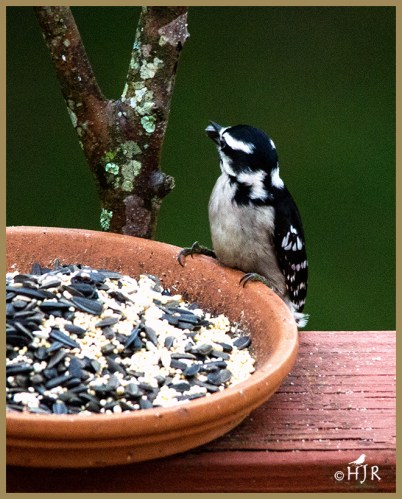
Eating Lunch With…
Downy Woodpecker (F)
Downy Woodpecker (F)
© HJ Ruiz – Avian101
Share this:

Photo Capture # 94 – House Finches
House Finches
” Daddy and the food demanding Boys”

House Finches
© HJ Ruiz – Avian101
Share this:

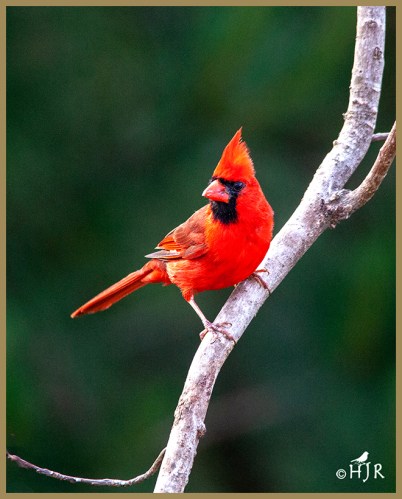
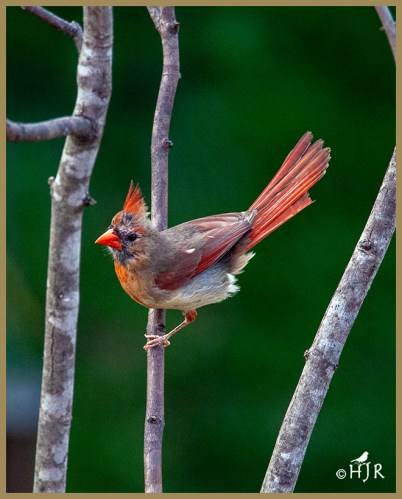
Red Gallery – Northern Cardinal
Quoting my Friends…
“I so enjoyed this look at the stately northern cardinal, HJ. As you listed the reasons they are a favorite, I remembered there were several US states that made it their state bird. Quick look up: seven states have the cardinal for their state bird: Illinois, Indiana, Kentucky, North Carolina, Ohio, Virginia and West Virginia. That is a much-loved species. Great post, my friend, I love the Red Gallery.” ~ Jet Eliot
Photo Gallery
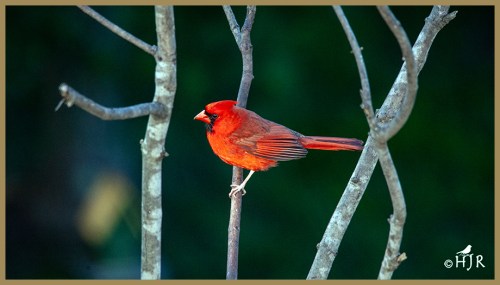
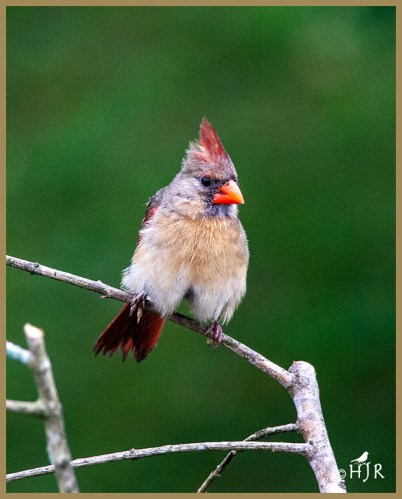
© HJ Ruiz – Avian101
Share this:

Bird’s ID – American Coot
American Coot
The American Coot (Fulica americana), also known as a mud hen, is a bird of the family Rallidae. Though commonly mistaken for ducks, American coots are only distantly related to ducks, belonging to a separate order. Unlike the webbed feet of ducks, coots have broad, lobed scales on their lower legs and toes that fold back with each step in order to facilitate walking on dry land. Coots live near water, typically inhabiting wetlands and open water bodies in North America. Groups of coots are called covers or rafts. The oldest known coot lived to be 22 years old.
The American coot is a migratory bird that occupies most of North America. It lives in the Pacific and southwestern United States and Mexico year-round and occupies more northeastern regions during the summer breeding season. In the winter they can be found as far south as Panama.Coots generally build floating nests and lay 8–12 eggs per clutch. Females and males have similar appearances, but they can be distinguished during aggressive displays by the larger ruff (head plumage) on the male. American coots eat primarily algae and other aquatic plants but also animals (both vertebrates and invertebrates) when available.
The American coot measures 34–43 cm (13–17 in) in length and 58–71 cm (23–28 in) across the wings. Adults have a short, thick, white bill and white frontal shield, which usually has a reddish-brown spot near the top of the bill between the eyes. Males and females look alike, but females are smaller. Body mass in females ranges from 427 to 628 g (0.941 to 1.385 lb) and in males from 576 to 848 g (1.270 to 1.870 lb). Juvenile birds have olive-brown crowns and a gray body. They become adult-colored around 4 months of age.
The American coot can dive for food but can also forage and scavenge on land. Their principal source of food is aquatic vegetation, especially algae. Yet they are omnivorous, also eating arthropods, fish, and other aquatic animals. During breeding season, coots are more likely to eat aquatic insects and mollusks—which constitute the majority of a chick’s diet.
Photo Gallery


© HJ Ruiz – Avian101
Share this:

Read Past Reviews

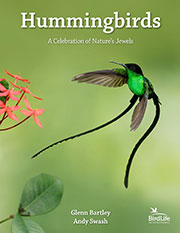
Book # 69
Quote from the Author
“A good chuckle is healthy, it helps you break the monotony of a serious life.” ~ H.J. Ruiz
 H.J. Ruiz - Avian101
You must be logged in to post a comment.