
Red Gallery – Northern Cardinal
Quoting my Friend’s Comments
“They really are splendid birds, and your photographs show them to great effect!” ~ Dries de Wets


© HJ Ruiz – Avian101
Share this:

Bird’s ID – Pekin Duck
Pekin Duck (America)
The Pekin or White Pekin is an American breed of domestic duck, raised primarily for meat. It derives from birds brought to the United States from China in the nineteenth century and is now bred in many countries, and on all continents. It is a distinct and separate breed from the German Pekin, which derives from the same Chinese stock but has different breeding, and so is often known as the American Pekin. Many of these ducks were reared on Long Island, New York, in the late nineteenth and early twentieth centuries.
The American Pekin is large and solidly built. The body is rectangular as seen from the side and is held at about 40º to the horizontal; the tail projects above the line of the back. The breast is smooth and broad and does not show a pronounced The head is large and rounded, and the neck is thick. The plumage is creamy white, the legs and feet are yellowish orange. The beak is yellow, fairly short, and almost straight.
The mallard was domesticated in China some 3000 years ago, and possibly much earlier. Force-feeding of ducks is documented from the tenth century, under the Five Dynasties. The Chinese were sophisticated breeders of ducks; among several breeds they created was one named shi-chin-ya-tze, which roughly translates to “ten-pound duck”, from which the American Pekin derives.
In 1872, James E. Palmer of Stonington, Connecticut, loaded fifteen white ducks of this type for shipment to a businessman named McGrath in the United States. The birds were loaded in Shanghai but had been hatched in Peking (now called Beijing). Nine of them – six hens and three drakes – survived the voyage, which took 124 days and reached New York City on 13 March 1873. Five of the surviving birds were dispatched to McGrath but were eaten before they reached him. Palmer’s four birds became the foundation stock of the American Pekin; by July 1873, his three hens had laid more than three hundred eggs.
In 1874, the Pekin was included in the first edition of the Standard of Perfection published by the new American Poultry Association. It was soon in widespread production for slaughter. Until that time, a popular breed raised for meat had been the Cayuga, which had the disadvantage of dark feathering, so that any fluff remaining on the carcass was easily seen; the white-feathered Pekin was preferable.
Other birds of the same type were imported to the United Kingdom in 1872 and from there soon reached Germany, where they gave rise to the German Pekin, a distinct and separate breed. In Germany, the Chinese ducks were cross-bred with upright white ducks brought from Japan by Dutch ships, resulting in birds with a steep body angle; those taken to the United States were crossed with birds of the British Aylesbury breed, which led to birds with a more horizontal stance. The Pekin in the United Kingdom derives from birds imported from Germany from about 1970.
Photo Gallery


© HJ Ruiz – Avian101
Share this:

Photo Capture # 111 – Eastern Towhee
Eastern Towhee (M)
“Good ole’ ruby eyes”

Eastern Towhee – “Good ole’ ruby eyes”
© HJ Ruiz – Avian101
Share this:

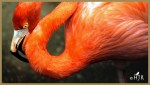
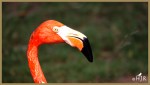
Bird’s ID – American Flamingo
American Flamingo
The American Flamingo (Phoenicopterus ruber) is a large species of flamingo closely related to the greater flamingo and Chilean flamingo. It is the only flamingo that naturally inhabits North America.
The American flamingo is a large wading bird with reddish-pink plumage. Like all flamingos, it lays a single chalky white egg on a mud mound, between May and August; incubation until hatching takes from 28 to 32 days; both parents brood the young for a period up to 6 years when they reach sexual maturity. Their life expectancy of 40 years is one of the longest in birds.
Adult American flamingos are smaller on average than greater flamingos but are the largest flamingos in the Americas. They measure from 120 to 145 cm (47 to 57 in) tall. The males weigh an average of 2.8 kg (6.2 lb), while females average 2.2 kg (4.9 lb). Most of its plumage is pink, giving rise to its earlier name of rosy flamingo and differentiating adults from the much paler greater flamingo. The wing coverts are red, and the primary and secondary flight feathers are black. The bill is pink and white with an extensive black tip. The legs are entirely pink. The call is a goose-like honking.
The American flamingo has adapted to its shallow-water environment in several ways. It has evolved long legs and large webbed feet to wade and stir up the bottom of the water bed to bring up their food source to then be retrieved. To feed, it has evolved a specialized beak which is hooked downward and features marginal lamellae on the upper mandible, and inner and outer lamellae on both the upper and lower mandibles. These are adapted for filtering out differently sized food from the water. Depending on the food source in their area, diets depend on the exact morphology of their beaks on what can and cannot be strained out of them. It submerges its head underwater to retrieve its food and may have its head underwater for long times, which requires it to hold its breath.
Photo Gallery




© HJ Ruiz – Avian101
Share this:

Read Past Reviews

Book # 69

Quote from the Author
“A good chuckle is healthy, it helps you break the monotony of a serious life.” ~ H.J. Ruiz
 H.J. Ruiz - Avian101
You must be logged in to post a comment.