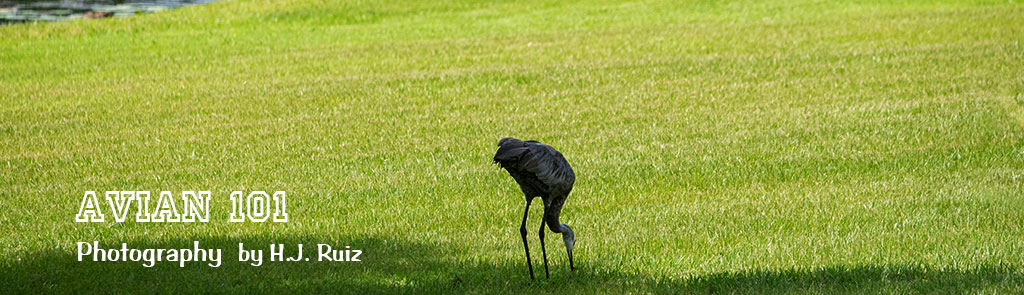
Bird’s ID – Ring-billed Gull
Ring-billed Gull
The Ring-billed Gull (Larus delawarensis) is a medium-sized gull. The genus name is from Latin Larus which appears to have referred to a gull or other large seabird. The specific delawarensis refers to the Delaware River.
Adults are 49 cm (19 in) length and have a 124 cm (49 in) wingspan. The head, neck and underparts are white; the relatively short bill is yellow with a dark ring; the back and wings are silver gray; and the legs are yellow. The eyes are yellow with red rims. This gull takes three years to reach its breeding plumage; its appearance changes with each fall molt.
The ring-billed gulls’ breeding habitat is near lakes, rivers, or the coast in Canada and the northern United States. They nest colonially on the ground, often on islands. This bird tends to be faithful to its nesting site, if not its mate, from year to year.
The ring-billed gull is a familiar sight in parking lots of the United States, where it can regularly be found congregating in large numbers. In some areas, it is displacing less aggressive birds such as the common tern.
They are migratory and most move south to the Gulf of Mexico and the Atlantic and Pacific coasts of North America, and the Great Lakes.
This gull is a regular wanderer to western Europe. In Ireland and Great Britain it is no longer classed as a rarity, with several birds regularly wintering in those countries.
Ring-billed gulls forage in flight or pick up objects while swimming, walking or wading. They also steal food from other birds and frequently scavenge. They are omnivorous; their diet may include insects, fish, grain, eggs, earthworms and rodents. These birds are opportunistic and have adapted well to taking food when discarded or even left unattended by people. It is regarded as a pest by many beach-goers because of its willingness to steal unguarded food on crowded beaches.
Photo Gallery


© HJ Ruiz – Avian101
Share this:

Photo Capture # 113 – Double-crested Cormorant
Double-crested Cormorant
“My friend, I welcome you with open arms!”
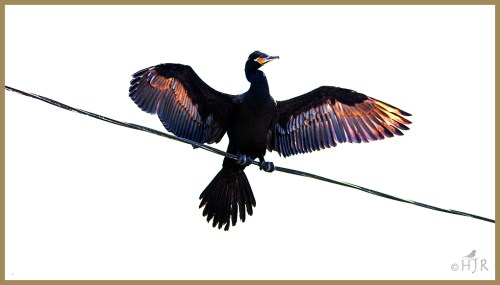
Double-crested Cormorant – “My friend, I welcome you with open arms”
© HJ Ruiz – Avian101
Share this:

What’s Up? – Hurricane?…Not!
Hurricane?… Not!
We continue to have hot days with high humidity but we hardly get a few drops of rain. However , the News read on Sunday morning:
“Tropical Storm Barry trudged through northwestern Louisiana on Sunday, threatening tornadoes and dropping up to 15 inches of rain in some places to create life-threatening flood conditions along the Mississippi River.
Barry, which made landfall as a category 1 hurricane on Saturday then quickly weakened to a tropical storm, was 50 miles (85 km) south-southeast of Shreveport with maximum sustained winds of 40 miles (65 km) per hour on Sunday morning.
Fears that Barry might devastate the low-lying city of New Orleans like Hurricane Katrina did in 2005 were unfounded, but rain in the forecast could still cause life-threatening flooding, the National Weather Service said.” (Reuters)
Fortunately, we are far from the path of the Tropical Storm Barry.
Aldough, we would like to get some rain to keep all our plants looking bright green and healthy.
My backyard stll gets visited by many birds looking for daily meals, their consumption is higher than previous years, the reason, many blackbirds are still staying in the area with their broods and these are voracious! Other than that, it’s just like any other summer days.
My suet cake is a total success! Most birds go crazy for it!
Photo Gallery


Share this:

Photo Capture # 112 – Brown-headed Cowbird
Brown-headed Cowbird (F)
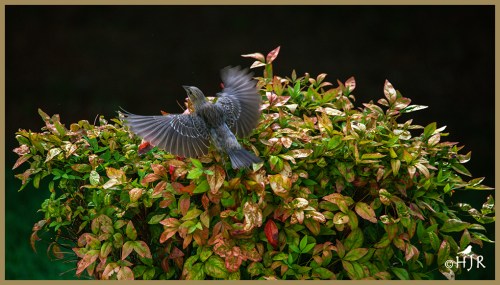
Brown-headed Cowbird (F)
© HJ Ruiz – Avian101
Share this:

Read Past Reviews

Book # 69
Quote from the Author
“A good chuckle is healthy, it helps you break the monotony of a serious life.” ~ H.J. Ruiz
 H.J. Ruiz - Avian101
You must be logged in to post a comment.