What’s Up? – So-So Summer
So-So Summer
We are going through a summer drought. The temperature continues on the high side andt we hardly get any rain. Once in a while we get storms but they move away quickly and do not discharge any water. The plants and grasses are in need of some water right now! I just hope we get some rain soon.
My birds are avoiding the harsh sun the best they can. I provide them with water and seeds which they consume in shorter time and then fly back to the trees or bushes to take shelter.
Last week I was refilling the feeders when I heard a peculiar bird call that I recognized immediately. It was a young Cooper’s Hawk with a smaller bird chasing him and trying to peck him, the hawk was flying desperately fast to avoid the little attacker. They passed over me at about 50 feet high. Then I noticed a second young hawk lagging behind at 40 feet following the first two birds. They kept their flight until the reached a tall tree ,where they have a nest. I didn’t see the outcome though.
Of course I didn’t have my camera with me!
Photo Gallery


© HJ Ruiz – Avian101
Share this:

Photo Capture # 130 – American White Ibis
American White Ibis
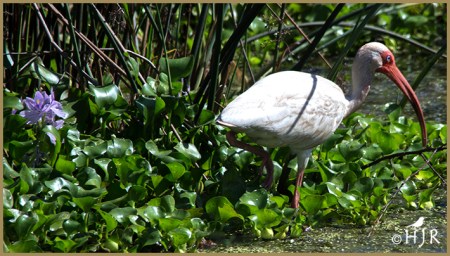
American White Ibis
© HJ Ruiz – Avian101
Share this:

Red Gallery – Northern Cardinal
Photo Gallery for Saturday


© HJ Ruiz – Avian101
Share this:

Bird’s ID – Chilean Flamingo
Chilean Flamingo
The Chilean Flamingo (Phoenicopterus chilensis) is a large species of flamingo at 110–130 cm (43–51 in) closely related to American flamingo and greater flamingo, with which it was sometimes considered conspecific. The species is listed as near threatened by the IUCN.
It breeds in South America from Ecuador and Peru to Chile and Argentina and east to Brazil; it has been introduced into Germany and the Netherlands (colony on the border, Zwillbrocker Venn). Also, a small population occurs in Utah and California. Like all flamingos, it lays a single chalky-white egg on a mud mound.
These flamingos are mainly restricted to salt lagoons and soda lakes but these areas are vulnerable to habitat loss and water pollution.
The plumage is pinker than the slightly larger greater flamingo, but less so than the Caribbean flamingo. It can be differentiated from these species by its grayish legs with pink joints (tibiotarsal articulation), and also by the larger amount of black on the bill (more than half). Young chicks may have no sign of pink coloring whatsoever, but instead remain gray.
The Chilean flamingo’s bill is equipped with comb-like structures that enable it to filter food—mainly algae and plankton—from the water of the coastal mudflats, estuaries, lagoons, and salt lakes where it lives.
Photo Gallery


© HJ Ruiz – Avian101
Share this:

Read Past Reviews

Book # 69
Quote from the Author
“A good chuckle is healthy, it helps you break the monotony of a serious life.” ~ H.J. Ruiz


You must be logged in to post a comment.