
What’s Up? – We need some rain!
We need some rain!
My son Tyler (9) is on a week vacation from school, most of the times we visited Florida.
Not this time , we have important appointments with Doctors .My wife Lucy has a complete check-up every 6 months. Tyler has appointment with a Pediatric Ophthalmologist.
I have appointment with an Ophthalmologist too. We have to be in town for our appointments. I gave Tyler a Canon Rebel -T1i camera with a zoom lens 55-250 mm to try and learn how to use it. He was excited about it. He did well but he needs some practice yet.
We went to a nice place yesterday that has a great area to enjoy contact with Nature, once there we had a picnic and ate our meals al fresco. It was sunny and bright and the temperature was at mid 80’s and there was a soothing breeze that made things perfect. On the other hand we noticed immediately, the river was almost dry. The lack of rain was evident.I hope this drought ends soon!
Photo Gallery


In my backyard I have to be careful with my plants and I water them with a hose.
My birds are not many but they come to eat their seeds. The weather must be tough for them too!
Photo Gallery


© HJ Ruiz – Avian101
Share this:

Photo Capture # 142 – Red-winged Blackbird
Red-winged Blackbird (M)
Potential actor or politician — “Can’t you just say you don’t like it, and cut all the drama?”
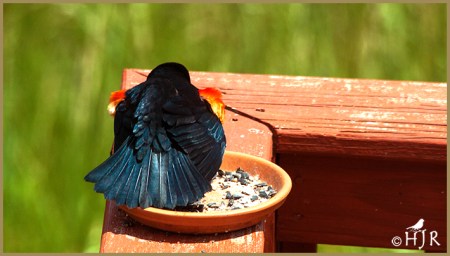
Red-winged Blackbird (M) —
“Can’t you just say you don’t like it, and cut all the drama?”
© HJ Ruiz – Avian101
Share this:

Red Gallery – Northern Cardinal
Photo Gallery for Saturday


© HJ Ruiz – Avian101
Share this:

Bird’s ID – Green Heron
Green Heron
The Green Heron (Butorides virescens) is a small heron of North and Central America. Butorides is from Middle English butor “bittern” and Ancient Greek -oides, “resembling”, and virescens is Latin for “greenish”.
It was long considered conspecific with its sister species the striated heron (Butorides striata), and together they were called “green-backed heron”. Birds of the nominate subspecies (no matter which taxonomic arrangement is preferred) are extremely rare vagrants to western Europe—for example, a sighting in Pembrokeshire in 2018 was only the second recorded sighting in Wales; individuals from the Pacific coast of North America may similarly stray as far as Hawaii.
The green heron is relatively small; adult body length is about 44 cm (17 in). The neck is often pulled in tight against the body. Adults have a glossy, greenish-black cap, a greenish back and wings that are grey-black grading into green or blue, a chestnut neck with a white line down the front, grey underparts and short yellow legs. The bill is dark with a long, sharp point. Female adults tend to be smaller than male and have duller and lighter plumage, particularly in the breeding season. Juveniles are duller, with the head sides, neck and underparts streaked brown and white, tan-splotched back and wing coverts, and greenish-yellow legs and bill. Hatchlings are covered in down feathers, light grey above, and white on the belly.
Photo Gallery


© HJ Ruiz – Avian101
Share this:

Read Past Reviews

Book # 69
Quote from the Author
“A good chuckle is healthy, it helps you break the monotony of a serious life.” ~ H.J. Ruiz


You must be logged in to post a comment.