Photography of Birds – Set # 12
Set # 12
Tree Swallow
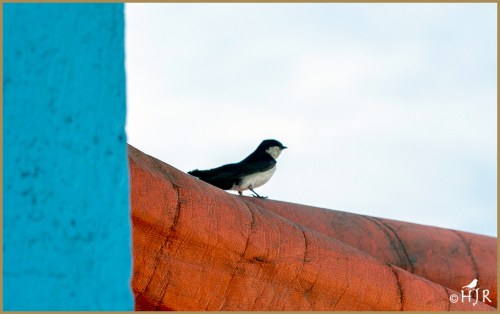
Tree Swallow
Very popular migratory birds in the Coast of Peru, very abundant in the urban areas. They help balance the increment of mosquitos during humid season, insects which they catch in the air.
Belcher’s Gull
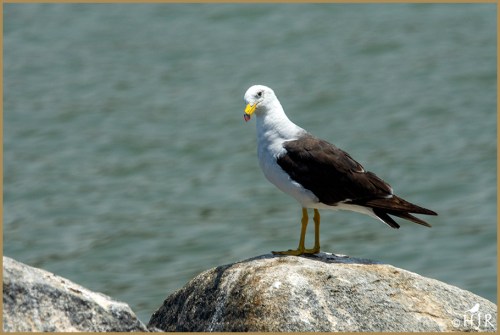
Belcher’s Gull
The Belcher’s Gull is a medium-size gull, can be found in the coasts of Peru and Chile.
© HJ Ruiz – Avian101
Share this:

Visit to Ballestas Islands
Ballestas Islands
The Ballestas Islands (Spanish: Islas Ballestas) are a group of small islands near the town of Paracas within the Paracas District of the Pisco Province in the Ica Region, on the south coast of Peru.
Composed largely of rock formations and covering an estimated area of 0.12 km², these islands are an important sanctuary for marine fauna like the guanay guano bird, the blue-footed booby and the Peruvian Booby (gray footed Booby) and Inca Terns. Other notable species include Humboldt penguins and two varieties of seals (fur seals and sea lions), amongst other mammals.
Quite interesting tour, around the islands. Trips are exclusively done in the morning or early afternoon, before the wind usually picks up speed and increases the odds of capsizing. It’s hard to maneuver the boats under choppy conditions.
| Location | Pacific Ocean |
| Coordinates | 13°44′09″S 76°23′47″W
Coordinates: 13°44′09″S 76°23′47″W |
| Major islands | Ballesta Norte, Ballesta Centro, Ballesta Sur |
|
Administration |
|
|
Peru |
|
| Region | Ica |
Photo Gallery


© HJ Ruiz – Avian101
Share this:

Photography of Birds – Set # 11
Set # 11
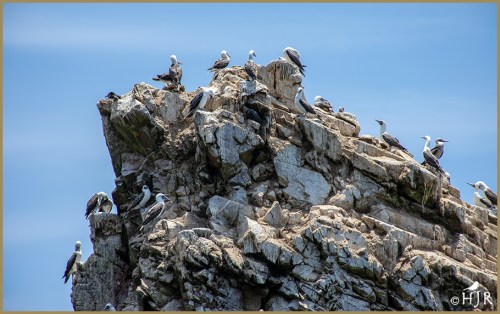
Peruvian Booby
Peruvian Boobys are numerous, they use small islands along the coastal territory of Peru. They are # 1 producers of guano* high quality of nitrates and phosphorus, highly components of excellent fertilisers.
*Guano: Bird guano has high levels of nutrients like nitrate and ammonium. By mass, it is 8–21% nitrogen; the nitrogen content is about 80% uric acid, 10% protein, 7% ammonia, and 0.5% nitrate.Some of bird guano’s most common chemical elements are phosphorus, calcium, and magnesium. It may react with the rocky substrate of islands like basalt to form authigenic, phosphatic minerals including taranakite and leucophosphite.
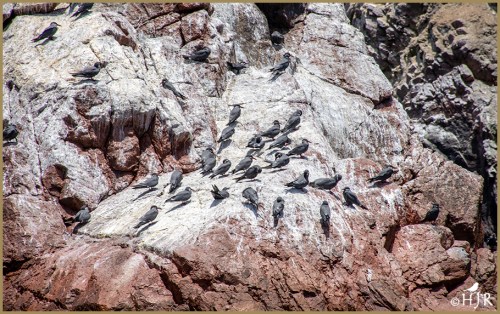
Inca Terns
I ‘m always delighted to see the Inca Terns. What a distinguished looking and handsome bird this is. Don’t you agree?
© HJ Ruiz – Avian101
Share this:

Bird’s ID – Rufous-collared Sparrow # 221
Rufous-collared Sparrow
The Rufous-collared Sparrow (Zonotrichia capensis) is an American sparrow found in a wide range of habitats, often near humans, from the extreme south-east of Mexico to Tierra del Fuego, and on the island of Hispaniola. It is famous for its diverse vocalizations, which have been intensely studied since the 1970s. The rufous-collared sparrow is 13.5–15 cm (5.3–5.9 in) long and weighs 20–25 g (0.71–0.88 oz). The adult has a stubby grey bill and a grey head with broad black stripes on the crown sides and thinner stripes through the eye and below the cheeks. The nape and breast sides are rufous and the upper-parts are black-streaked buff-brown. There are two white wing bars. The throat is white, and the underparts are off-white, becoming brown on the flanks and with a black breast patch.
Young birds have a duller, indistinct head pattern, with brown stripes and a buff ground colour. They lack the rufous collar, and have streaked underparts.
The rufous-collared sparrow feeds on the ground on seeds, fallen grain, insects and spiders. It will sometimes join mixed-species feeding flocks and has been observed to pick termites from spider webs. It is usually seen in pairs which hold small territories, or in small flocks. Tame and approachable, it is common throughout its large range and not considered threatened by the IUCN.
The breeding season is limited by food availability and ultimately rainfall. In the subtropical yungas of north-west Argentina, females begin to build nests around the end of October, when the wet season comes, but by early December most nesting activity has already finished. By contrast, 2,000 m (6,600 ft) Above sea level, in the Andes of Pichincha Province (Ecuador), eggs were being incubated in December, and nest-building activity recorded in March and April, suggesting extended breeding throughout the wet season. The open cup nest consists of plant material lined with fine grasses. It is constructed in matted vegetation on the ground, low in a tree or bush, or in a niche in a wall.
The photographs depicted here were shot at 2500 m asl (7500 ft) in Arequipa (Peru) 629 miles from Lima.
This Rufous-collared Sparrow is listed # 221 on my lifer list.
Photo Gallery


© HJ Ruiz – Avian101
Share this:

Read Past Reviews

Book # 69
Quote from the Author
“A good chuckle is healthy, it helps you break the monotony of a serious life.” ~ H.J. Ruiz


You must be logged in to post a comment.