Book Review # 57 – Bird Love
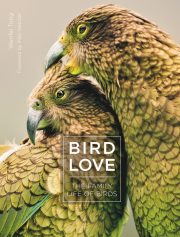
Bird Love
The Family Life of Birds
Author:
Wenfei Tong – With a foreword by Mike Webster
Publisher:
Princeton University Press
Brief Review:
More info.
I have enjoyed this book very much. The main reason is the author’s approach, which, I agree 100%. Let’s get to know the bird by knowing how it lives. The points that capture the behaviors and their daily lives are the following:
- Ecology and Mating Systems
- Courtship
- Nests and Eggs
- Raising Chicks
- Sex Role Reversals
- Group Breeding
- Brood Parasitism
You’ll find out and get to know the bird’s way to see life, very much as humans behave and act. This approach will get you closer to your avian friends, and lead you, to understand how they live.
This book has 192 pages with 220 gorgeous photos and a wonderful foreword by Mike Webster.
I was very pleased when I finished reading this book, which I recommend to my friends, readers, that visit my blog daily.
Reviewed by:
H.J. Ruiz -Avian101.Wordpress.com – April 9th, 2020
Share this:

Bird’s ID – Pied-billed Grebe # 222
Pied-billed Grebe
The Pied-billed Grebe (Podilymbus podiceps) is a species of the grebe family of water birds. Since the Atitlán grebe (Podilymbus gigas) has become extinct, it is the sole extant member of the genus Podilymbus. The pied-billed grebe is primarily found in ponds throughout the Americas.
Pied-billed grebes are small, stocky, and short-necked. They are 31–38 cm (12–15 in) in length, with a wingspan of 45–62 cm (18–24 in) and weigh 253–568 g (8.9–20.0 oz). They are mainly brown, with a darker crown and back. Their brown color serves as camouflage in the marshes they live in. They do not have white under their wings when flying, like other grebes. Their undertail is white and they have a short, blunt chicken-like bill that is a light grey color, which in summer is encircled by a broad black band (hence the name). In the summer, its throat is black. There is no sexual dimorphism. Juveniles have black and white stripes and look more like winter adults. This grebe does not have webbed feet. Its toes have lobes that come out of the side of each toe. These lobes allow for easy paddling. When flying, the feet appear behind the body due to the feet’s placement in the far back of the body.
Pied-billed grebes feed mainly on aquatic invertebrates, and also on small fish and amphibians (frogs, tadpoles). They dive to obtain food.
I photographed this Pied-billed Grebe in Mejia (Arequipa) Bird Sanctuary (Humedals).
The Pied-billed Grebe made # 222 lifer on my List.
Photo Gallery


© HJ Ruiz – Avian101
Share this:

Photography of Birds – Set # 17
Set # 17 (Local Birds)
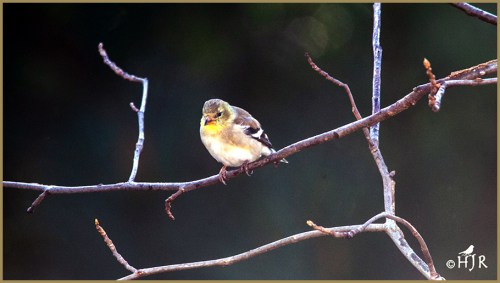
American Goldfinch
American Goldfinch
Although the sun shined, the temperatures were kind of low for this time of the year. However, birds have been returning from their migrations, such as this little American Goldfinch. He is young and not so comfortable with the weather we are having now.
Northern Mockingbird

Northern Mockingbird
The Northern Mockingbirds are always in good shape and ready to rumble (You’re more than ready for any kind of action) I know…Some people do not like them because they are very possesive and bully. However, they do not tell you about all the good things they do for the birds. Many times they give their own lives defending other birds from predators. I’ve seen enough instances to be convinced, these birds are heros. Pain in the a** but heros. (So it was General Patton!)
© HJ Ruiz – Avian101
Share this:

Photography of Birds – Set # 16
Set # 16
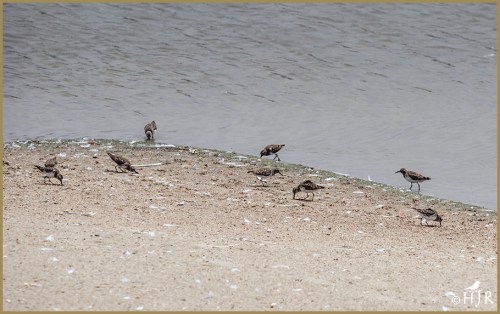
Ruddy Turnstones
Ruddy Turnstones
Hungry little goup of Ruddy Turnstones, they were quite busy doing what they do best, they turn little shells, feathers or stones and usually get some kind of invertebrate. They were so busy that didn’t mind my presence. Eat well, little friends.
Great Egret
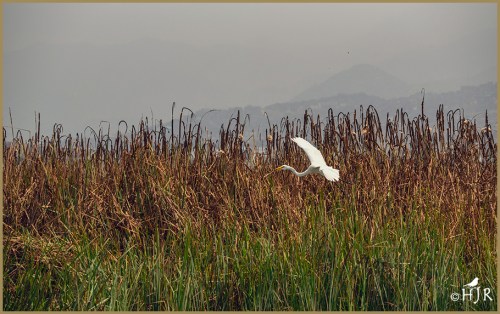
Great Egret
The Great Egret that you see above went into the thick patch of reeds in the swamp. That called my attention, why a big bird get into such tight space place. The answer came after a couple of minutes! Another Great egret flew into the same place and…They just wanted a few private moments and consumate their love!
© HJ Ruiz – Avian101
Share this:

Read Past Reviews

Book # 69
Quote from the Author
“A good chuckle is healthy, it helps you break the monotony of a serious life.” ~ H.J. Ruiz
 H.J. Ruiz - Avian101
You must be logged in to post a comment.