Photography of Birds – Set # 67
Set # 67
Red-breasted Nuthatch

Red-breasted Nuthatch
Like all nuthatches, the red-breasted nuthatch is an acrobatic species, hitching itself up and down tree trunks and branches to look for food. It goes headfirst when climbing down. It can “walk” on the underside of branches. Unlike woodpeckers and creepers, it does not use its tail as a prop while climbing. It tends to forage singly or in pairs.
Purple Finch (F)
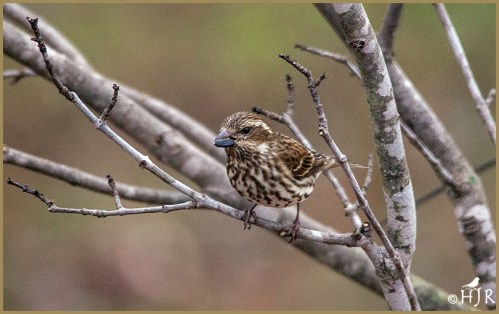
Purple Finch (F)
The Purple Finch population has declined sharply in the East due to the house finch. Most of the time, when these two species collide, the house finch outcompetes the purple finch. This bird has also been displaced from some habitat by the introduced house sparrow.
© HJ Ruiz – Avian101
Share this:

Photography of Birds – Set # 66
Set # 66
Red-winged Blackbird

Male

Female

Male

Male

Male

Female
The stains on the body and wings are vital in the defense of the territory. Males with larger spots are more effective at chasing away their non-territorial rivals and are more successful in contests within aviaries. A staining of the black as part of an experiment, 64% of males lost their territories, while only 8% of control subjects did. However, males whose wings had been dyed before they had mated could still attract females and successfully reproduce. In the sergeant thrush, the spots on the wings are a sign of threat among males and have an unimportant role, if any, in intersex encounters. Therefore, the spots are likely to have evolved in response to pressures linked to intrasexual selection.
© HJ Ruiz – Avian101
Share this:

Photography of Birds – Set # 65
Set # 65
Chipping Sparrow


The male chipping sparrow start arriving at the breeding grounds from March (in more southern areas, such as Texas)) to mid-May (in southern Alberta and northern Ontario). The female arrives one to two weeks later, and the male starts singing soon after to find and court a mate. After pair formation, nesting begins (within about two weeks of the female’s arrival). Overall, the breeding season is from March till about August.
© HJ Ruiz – Avian101
Share this:

Photography of Birds – Set # 64
Set # 64
Eastern Towhee

Male

Female

Female

Male

Male
Eastern towhees primarily eat on the ground, although they also glean from vegetation. When foraging on the ground eastern towhees use a scratching technique where both feet kick back simultaneously. In a laboratory study, 4 eastern towhees used this method to successfully obtain seed buried almost 1 inch (2.5 cm) deep. When foraging above ground the majority of time is spent gleaning foliage.
© HJ Ruiz – Avian101
Share this:

Read Past Reviews

Book # 69
Quote from the Author
“A good chuckle is healthy, it helps you break the monotony of a serious life.” ~ H.J. Ruiz


You must be logged in to post a comment.