
Photography of Birds – Set # 83
Set # 83
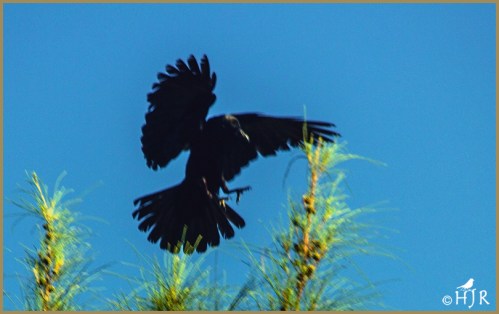
American Crow
American Crow
The American crow is omnivorous. It will feed on invertebrates of all types, carrion, scraps of human food, seeds, eggs and nestlings, stranded fish on the shore and various grains. American crows are active hunters and will prey on mice, frogs, and other small animals. In winter and autumn, the diet of American crows is more dependent on nuts and acorns. Occasionally, they will visit bird feeders. The American crow is one of only a few species of bird that has been observed modifying and using tools to obtain food.
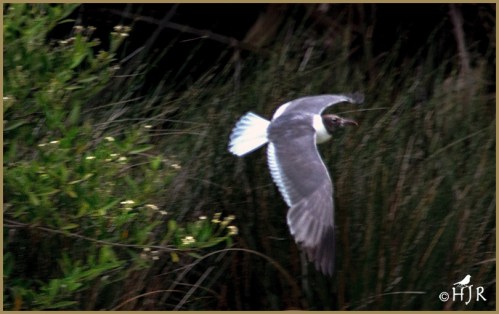
Laughing Gull
Laughing Gull
It breeds on the Atlantic coast of North America, the Caribbean, and northern South America. Northernmost populations migrate farther south in winter, and this species occurs as a rare vagrant to western Europe. The laughing gull’s English name is derived from its raucous kee-agh call, which sounds like a high-pitched laugh “ha… ha… ha…”.
Laughing gulls breed in coastal marshes and ponds in large colonies. The large nest, made largely from grasses, is constructed on the ground. The three or four greenish eggs are incubated for about three weeks.
© HJ Ruiz – Avian101
Share this:

Photography of Birds – Set # 82
Set # 82
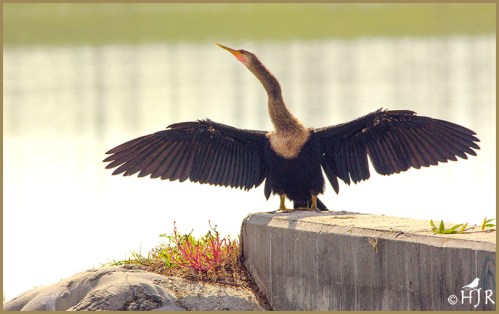
Anhinga (F)
Anhinga (F)
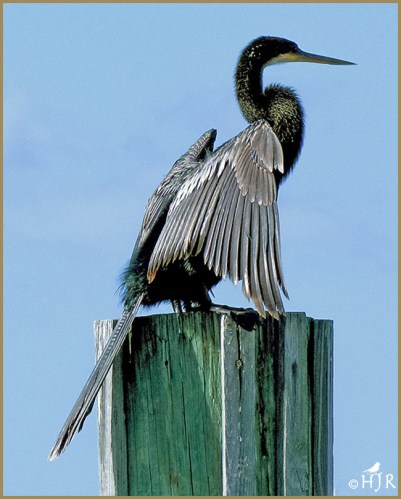
Anhinga (M)
Anhinga (M)
Anhingas swim with their webbed feet and pursue their prey, fish, under water and spear their prey by rapidly stretching out their neck. They come up to handle and swallow fish. Unlike ducks, ospreys and pelicans which coat their feathers with oil from their uropygial gland, the anhinga does not have waterproof feathers. Their feathers get soaked upon immersion in water. Therefore, they cannot stay floating on water for long periods of time. Their dense bones, wetted plumage and neutral buoyancy in water, allows them to fully submerge and search for underwater prey.
© HJ Ruiz – Avian101
Share this:

Red Gallery – Independence Day

Photo Gallery


Today is 4th of July

Happy 4th of July-2020
© HJ Ruiz – Avian101
Share this:

Photography of Birds – Set # 81
Set # 81
Blue Jay
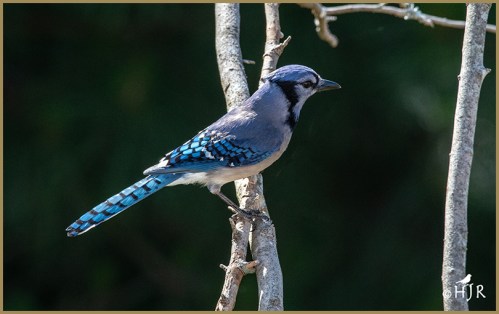
Blue Jay
They have a pronounced crest on the head, a crown of feathers, which may be raised or lowered according to the bird’s mood. When excited or aggressive, the crest will be fully raised. When frightened, the crest bristles outwards, brushlike. When the bird is feeding among other jays or resting, the crest is flattened on the head.
Its plumage is lavender-blue to mid-blue in the crest, back, wings, and tail, and its face is white. The underside is off-white and the neck is collared with black which extends to the sides of the head.
European Starling

European Starling
Large flocks typical of this species can be beneficial to agriculture by controlling invertebrate pests; however, starlings can also be pests themselves when they feed on fruit and sprouting crops. Common starlings may also be a nuisance through the noise and mess caused by their large urban roosts. Introduced populations in particular have been subjected to a range of controls, including culling, but these have had limited success.
© HJ Ruiz – Avian101
Share this:

Read Past Reviews

Book # 69
Quote from the Author
“A good chuckle is healthy, it helps you break the monotony of a serious life.” ~ H.J. Ruiz
 H.J. Ruiz - Avian101
You must be logged in to post a comment.